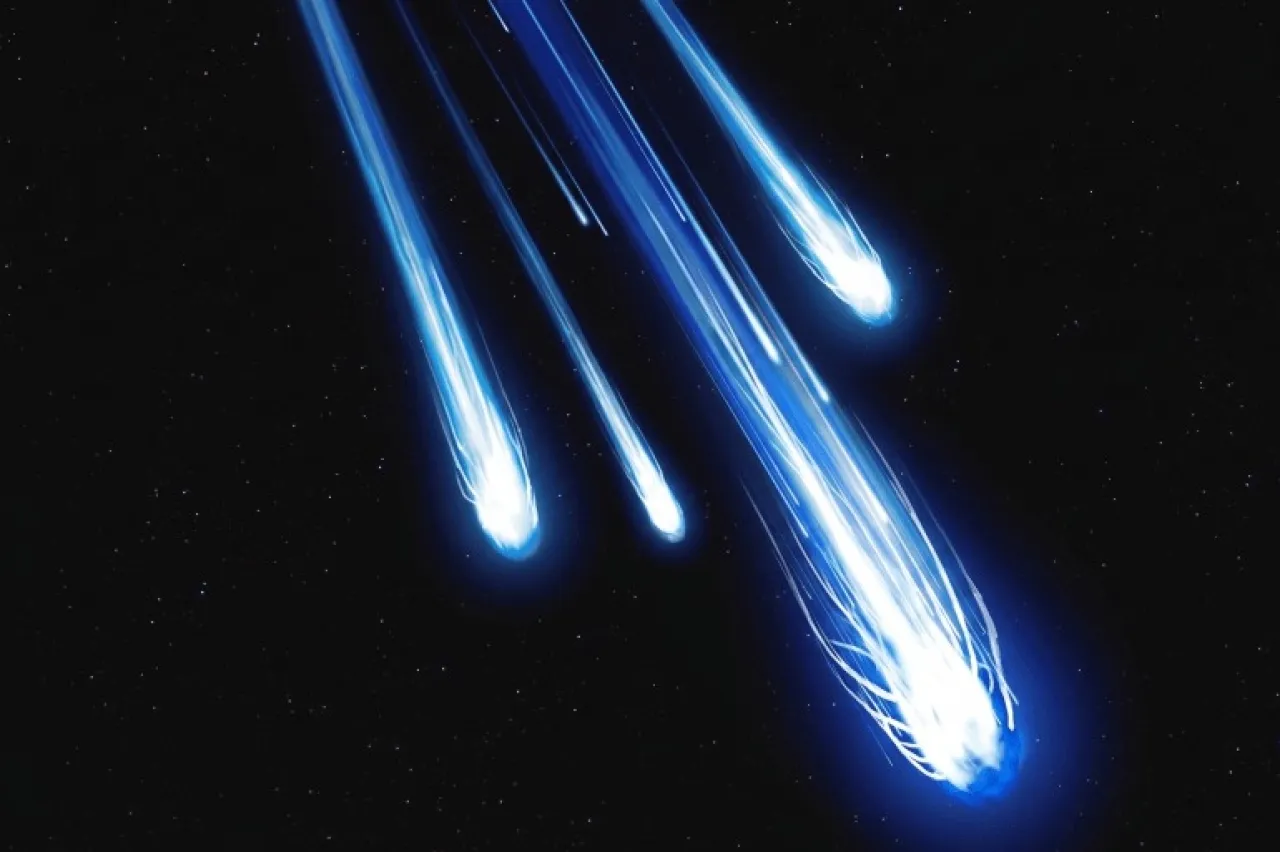
Khaberni - An international team of scientists has observed an asteroid disintegrating near the sun, not using traditional telescopes, but through tracking meteor showers that have reached Earth.
These results came after analyzing millions of observations collected by comprehensive sky camera networks located in Canada, Japan, Europe, and the state of California, USA.
The study was published in the journal "Astrophysics" in its March 2026 issue, led by planetary scientist Patrick Schober, a researcher at the Johnson Space Center of NASA, where the team relied on vast meteor data to identify an unusual pattern that led to the discovery of its source, a gradually disintegrating asteroid under the sun's heat.
How was it Detected? From Meteors to the Asteroid
What's notable in this discovery is that the asteroid itself was not directly observed, but was inferred through what is known as Meteor Showers. Global networks recorded 282 bright meteors following similar trajectories, suggesting that they originate from a single source.
These meteors were detected by automated monitoring systems, a network of sensitive digital cameras operating throughout the night, capturing flashes of small objects entering the atmosphere at high speeds.
Subsequently, the data is analyzed using advanced algorithms that compare trajectories, speeds, and directions, allowing the original orbit of these fragments to be reconstructed, thus identifying their common source.
The 282 meteors caught indicate a specific group of meteors that have been documented and analyzed precisely, not referring to meteorites falling to Earth, as most of these particles are very small, the size of sand grains, and burn up completely when entering the atmosphere.
The importance of this group lies in that they formed a "single orbital fingerprint," meaning they originated from a single disintegrating body, which led scientists to conclude the existence of the disintegrating asteroid.
Thermal Suicide... How the Asteroid Disintegrates
When the asteroid orbits in a highly elongated orbit, it comes closer to the sun to a distance less than one to five times the Earth's distance from it (about 30 million kilometers), this proximity leads to exposure to enormous temperatures.
As a result, a process known as "thermal stress" occurs where materials expand and then contract repeatedly, leading to surface cracking and separation. Over time, the asteroid begins to release dust, gas, and fragments, in a process similar to "gradual disintegration."
This phenomenon isn't entirely new, as the asteroid "Phaethon" (3200 Phaethon) is a known example, producing the Geminids meteor shower that peaks in mid-December each year through a similar mechanism.
Meteor Showers.. A Natural Laboratory for Understanding Asteroids
When Earth passes through the path of debris from an asteroid or comet, the particles left behind enter the atmosphere at high speed, heat up due to intense friction, and then light up due to ionization of atmospheric gases and components they carry, appearing as meteors that vary in color depending on the composition of the atmosphere or the meteor itself.
This phenomenon represents an important scientific tool, as it allows for the study of bodies that can't be seen directly. Meteors act as messengers carrying information about the composition of the asteroid, such as minerals and chemical elements, as well as about its orbital history.
Furthermore, analyzing meteor distribution over time helps in understanding how debris spreads in space, a process known as the spread of the meteor shower.
Can the Timing of This Shower Be Predicted?
Yes, but it requires more data. If scientists confirm the orbit of this meteor stream with precision, predictions can be made about when Earth will cross through it, just like with known annual showers such as the Geminids.
Currently, the new shower is still being studied, but if the debris flow continues at the same pattern, it could become a periodic meteor shower that astronomy enthusiasts can observe annually.
This discovery highlights the importance of automated monitoring and artificial intelligence in analyzing astronomical data. With the planned launch of NASA's "NEO Surveyor" mission in 2027, which uses an infrared telescope to detect asteroids close to the sun, often invisible in visible light, the ability to monitor such objects will significantly improve.
What Does This Discovery Mean Scientifically?
This discovery provides a deeper understanding of the behavior of fragile asteroids, especially those living in harsh thermal environments, and enhances the concept that some asteroids can disintegrate autonomously without the need for collision.
In addition, it contributes to developing "planetary defense" strategies, as it helps in discovering objects that may be dangerous but are invisible.
This discovery not only adds a new meteor shower to the sky but also opens a scientific window to understand how asteroids change and disintegrate over time. With the evolution of monitoring tools, it may become possible to track these objects accurately, determine their origins, and perhaps predict their behavior before they become a potential hazard.
For astronomy enthusiasts, this event might mark the beginning of a new annual celestial show, while for scientists, it represents a rare opportunity to study the "death of an asteroid" moment by moment.