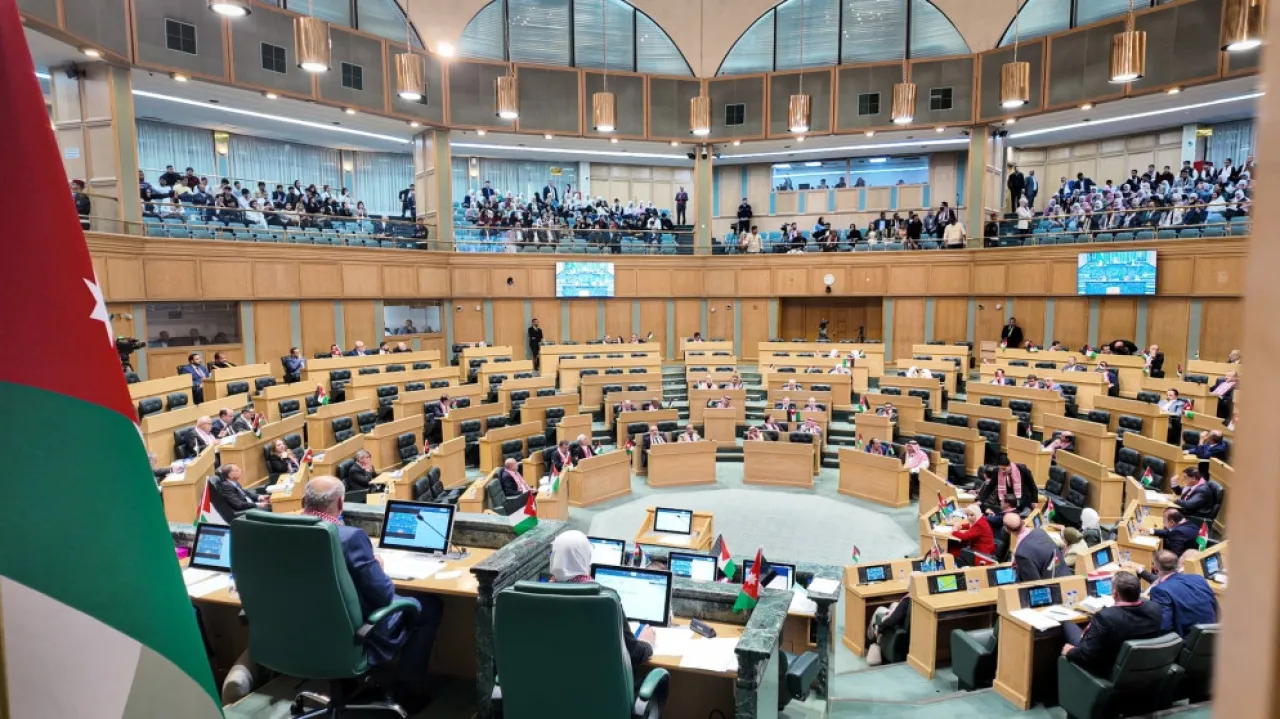
Khaberni - The House of Representatives, in a legislative session on Sunday, continues to discuss the bill for ratifying the executive agreement for evaluation, development, and exploitation activities of copper and associated minerals in the Abu Khashiba area.
The Council of Ministers approved, during a session held on November 16, 2025, the draft law and referred it to the House of Representatives.
The Council, in turn, referred on November 24, 2025, the draft law of ratification of the agreement, concluded between the Government of the Hashemite Kingdom of Jordan, represented by the Ministry of Energy and Mineral Resources, and Wadi Araba Minerals Company, licensed for exploration, prospecting, development, operation, and marketing of minerals (copper and associated minerals) for the year 2025, to the Parliamentary Energy and Mineral Resources Committee, which in turn ratified it on April 13, 2026.
The draft law is in accordance with the provisions of Article 117 of the Jordanian Constitution, which states: "It is necessary to ratify by law any concession involving the exploitation of mines or minerals or public utilities," and in implementation of the provisions of Article 9 of the Natural Resources Law No. 19 of 2018, which states: "It is necessary to ratify production sharing agreements or executive agreements and licenses granted according to the provisions of Article 117 of the Constitution."
This agreement is part of the government's efforts to support investment in the mining sector and natural resources, which enhances its contribution to supporting the national economy, developing local communities, creating employment opportunities, enhancing the competitiveness of the local product, and reducing reliance on traditional sources.
The Minister of Energy and Mineral Resources, Saleh Al-Kharabsheh, stated that the mining agreement was conducted according to effective legislation and with transparent and complete procedures, noting that "all requested documents were provided to the specialized committee, including the original assets."
He mentioned that "the figures raised about the agreement are inaccurate. The Parliamentary Energy Committee holds all documents, from the initial memorandum of understanding through to the executive agreement," explaining that "legally, a mining concession cannot be granted except to a locally registered company, as any foreign company cannot operate except through a local entity subject to Jordanian law."
Al-Kharabsheh continued, "the agreement imposes clear obligations on the company, any breach of which leads directly to the cancellation of the license," pointing out that "the talk about reserving lands for 30 or 40 years is inaccurate, as the projects are subject to continuous monitoring and follow-up."
He confirmed that "mining projects are by nature long-term investments extending over decades," emphasizing that "global experiences in this sector confirm that some mines operate for more than 50 years, and that the agreement is entirely subject to Jordanian law in its interpretation, implementation, and arbitration, and that any arbitration proceedings are conducted in accordance with Jordanian law without detracting from national sovereignty."
Regarding the returns, Al-Kharabsheh clarified that "it is a progressive system starting from a percentage on revenue, and increasing to higher percentages of net profits as they rise, in addition to taxes, mining fees, and community contributions," stressing that "the agreement is based on the Investment Environment Law, which regulates the legal framework for taxes, exemptions, and obligations."
In turn, the Minister of State for Legal Affairs, Fayad Al-Judges, confirmed that "the agreement includes a set of substantial guarantees that prevent the monopolistic company from remaining in its current situation," explaining that later it "will be obliged to transform into a public shareholding company."
He said, "Whether the company is existing or new, to which the concession rights are transferred, it will be required to apply to the Securities Authority to offer 49 percent of its shares for public subscription, which allows Jordanian citizens and legal persons the opportunity to own and participate in the project without restrictions on the number of subscribers."
Al-Judges pointed out that "this approach means opening the door for all Jordanians to enter ownership, whereby the subscription is according to the approved mechanisms, and if the demand exceeds the number of shares offered, allocation will be according to predetermined percentages," adding "that the founding shares will be governed by a trading ban period of two years."
He drew attention to the fact that the share will "be offered at its nominal value of one dinar, with the possibility of adding an issuance premium determined by the Securities Authority based on its evaluation of the company's assets, reputation, and future prospects," explaining that "being a newly established company may limit the rise of this premium according to the technical estimation."
Al-Judges emphasized that "the main goal of these arrangements is to end any monopolistic or exclusive character of the concession, and transform it into an open investment opportunity for Jordanians, thus enhancing popular participation in national wealth."
About the arbitration clause, Al-Judges said, "The applicable law is fully Jordanian law, while dispute resolution procedures are limited to the International Chamber of Commerce," adding that "this provision reinforces the supremacy of Jordanian law over all rights and obligations."
Al-Judges affirmed that "this balance is an important gain, as it reassures investors, while at the same time establishing that the ultimate legal reference is Jordanian law."
In turn, deputies said, "We are discussing an agreement related to sovereign national wealth, which is not owned by a transient government, nor a minister, nor a company," adding "We want an agreement that does not subsequently restrict the state, nor bind its right to legislate, monitor, and hold accountable."
They confirmed, "We are in favor of respectable investment, but against immunizing the investor, except in accordance with the law," saying at the same time, "The state's right to legislate and oversee is above any agreement, and above any urgency."
They noted that "the license granted to the company extends for 30 years," saying "the majority of the license termination clauses are in favor of the company, not in the state's favor."