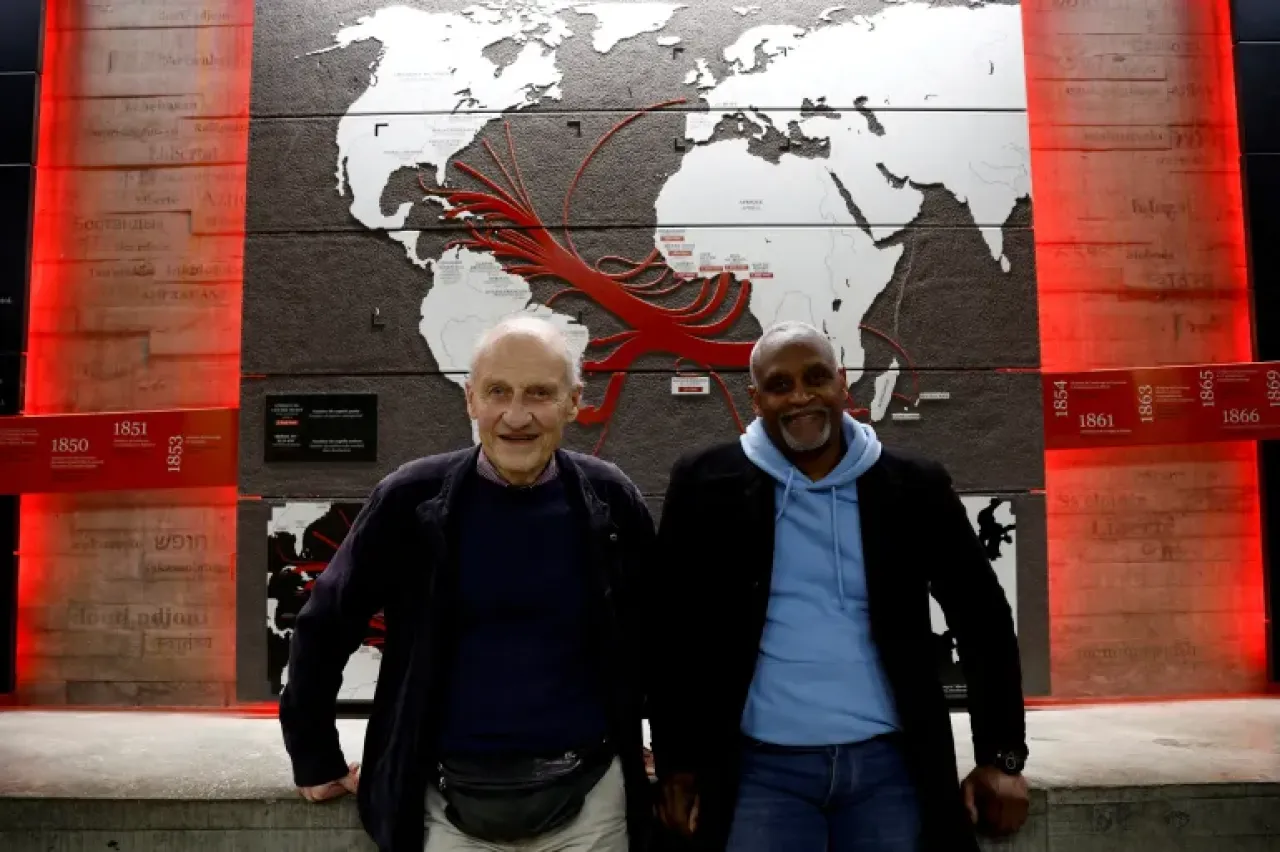
Khaberni - In what is believed to be the first of its kind on the French level and before a crowd in the city of Nantes, Pierre Jeune de Brance apologized for his ancestors' involvement in the Atlantic slave trade, calling on the government and French families to follow his lead.
This took place today, Saturday, during Brance's (81 years old) participation in the unveiling of a ship's mast sculpture along with Deudonne Botran, a descendant of slaves from the Caribbean island of Martinique.
Brance and Botran are working together in an association dedicated to "breaking the barrier of silence" about the issue of slavery. They said the mast would serve as a "beacon of humanity."
Jeune de Brance's step follows similar official apologies from families in Britain and other countries, which included commitments to "help repair the damage caused by their ancestors."
Brance said other French families should confront their historical links to slavery, and the French state should go beyond "symbolic gestures" to address the facts of the past and take actions including providing reparations.
He added, "Amid the rise of racism in our society, I felt a responsibility to not allow this past to be erased," referring to his desire to pass on his family's history to his grandchildren.
For his part, Botran said, "Many families of descendants of slave traders do not dare speak out openly for fear of reopening old wounds and causing anger," asserting that Brance’s apology is a courageous act.
Brance's ancestors, who settled in Nantes—the largest French port for the Atlantic slave trade— were shipowners who transported about 4,500 enslaved Africans and owned plantations in the Caribbean region.
Between the 15th and 19th centuries, at least 12.5 million Africans were kidnapped and transported forcibly, most of them aboard European ships, with the number of human trafficking victims in France estimated at about 1.3 million people.
Official recognition, but..
France recognized the slave trade across the Atlantic as a crime against humanity in 2001, but like most European countries, it has not offered an official apology for its role in it.
During his presidency, French President Emmanuel Macron expanded access to archival materials related to France's colonial past, and last year said he intends to form a committee to study the history of France's relationship with Haiti but without addressing the issue of reparations.
Paris's stance on the issue of reparations was clearly highlighted when it abstained last month from voting at the United Nations on a resolution led by Africa declaring slavery "the most atrocious crime against humanity" and calling for reparations.
Calls for reparations are increasing, with measures ranging from offering formal apologies and financial compensation around the world, even as critics of these calls deny the liability of nations and institutions for historical crimes.
The most atrocious crime against humanity
On March 25 last year, the General Assembly Hall of the United Nations in New York witnessed a historic moment when the member states passed a resolution that considers the African slave trade across the Atlantic "the most atrocious crime that has been committed against humanity."
The resolution, initiated by Ghana and broadly supported by Africa and the Caribbean, not only condemned symbolically but called for practical steps including formal apologies, financial compensation, and the return of looted cultural properties. The president of Ghana, John Dramani Mahama, before the General Assembly, said: "We gather today in sober solidarity to acknowledge the truth and seek a path to healing and compensatory justice."
Despite warm applause during the announcement, the voting revealed a deep division in the international community, with the United States, Israel, and Argentina opposing the resolution, while 52 countries, including the United Kingdom and all European Union members, abstained. This highlights the divide between the global south, which sees reparations as a moral and legal obligation, and the western north which rejects turning acknowledgment into a financial or legal commitment.
The UN resolution described the trafficking and enslavement of Africans as a systemic, long-standing crime, whose repercussions are still evident in forms of racial discrimination and economic disparities. It also emphasized the need for formal apologies from historically involved nations and consideration of financial reparations to support affected communities and the return of looted properties and artifacts.
Opponents of the resolution justified their stance with legal and political considerations, stating that Washington "does not recognize a legal right to compensation for historical damages that were not contrary to international law at the time." They described the demand for reparations as an "opportunistic attempt to redistribute modern resources to individuals and nations remotely associated with historical victims," declared the U.S. Ambassador Dan Negrea.