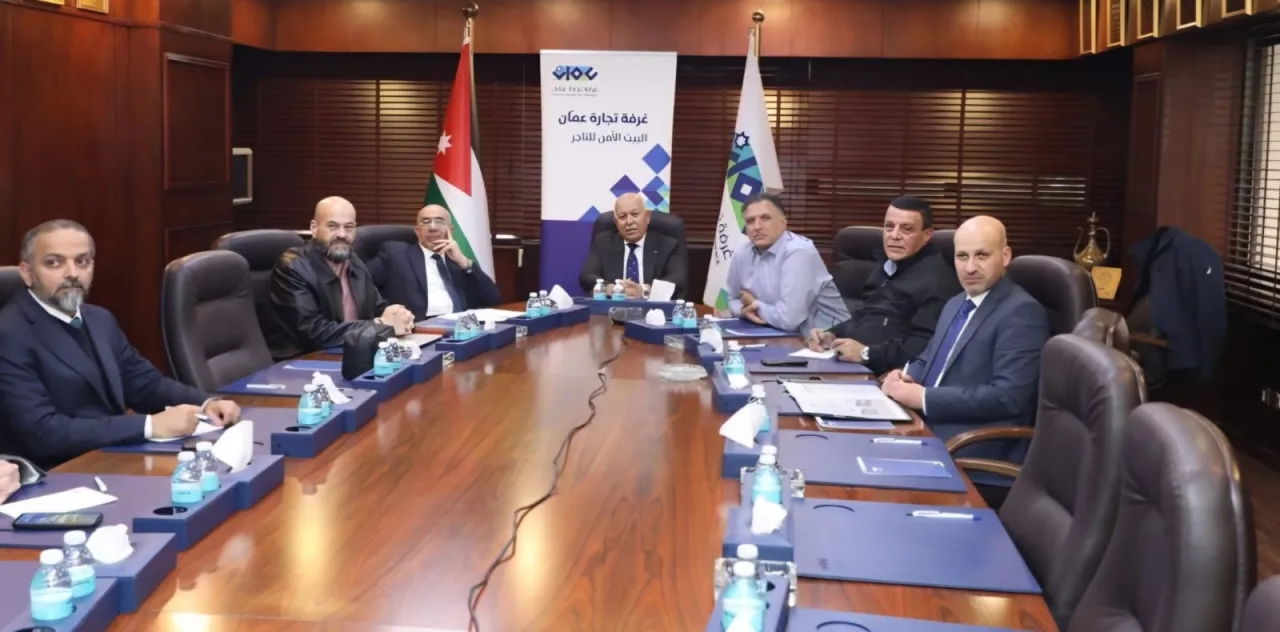
Khaberni - The First Deputy President of the Amman Chamber of Commerce, Nabil Al-Khatib, confirmed that the Jordanian-Saudi Business Network has made significant progress since its launch, transitioning from the conceptual stage to implementation, by establishing a preliminary base for communication between businessmen, investors, and executives, and organizing bilateral meetings to explore opportunities for joint cooperation.
Al-Khatib stated during a virtual meeting of the network organized by the chamber today that the next phase requires moving to a more advanced level focused on developing real investment projects and building sustainable partnerships on the ground, enhancing economic integration between the business communities in Jordan and Saudi Arabia.
According to a statement from the chamber today, Al-Khatib, in the presence of the Second Deputy President of the chamber, Bahjat Hamdan, the secretary-general, Mohammed Tahboub, and board member Falah Al-Saghir, indicated that what was discussed during the Amman meeting and what was achieved in the Riyadh meeting confirms the presence of a real opportunity to build a successful model for economic integration, especially given the availability of Jordanian expertise and substantial investment opportunities in the Saudi market.
He pointed out the existence of a set of challenges, whether at the level of procedures or availability of information and follow-up mechanisms, which requires organized and institutional work to address them, emphasizing the importance of preparing a list of ready investment projects, enhancing periodic meetings among the network members, and activating its digital platform, in addition to forming sectoral committees, which contribute to transforming the network into an effective platform for implementation, not just networking.
Members of the Amman Chamber of Commerce Board stressed that the Jordanian-Saudi Business Network represents a qualitative step in organizing the relationship between the business communities of the two countries, after it had depended on individual efforts, noting that what has been achieved so far reflects a gradual transition from the idea stage to practical application through the launch of the network and building a base for communication and organizing bilateral business meetings.
They explained that the current phase requires focusing on transforming the outcomes of the meetings into tangible investment projects, affirming that the challenge no longer lies in networking itself, but in the ability to implement and follow up, especially in the need for accurate information about investment opportunities and regulations in both countries.
They pointed out that the absence of a clear organizational structure for the network limits work efficiency, which necessitates the approval of an institutional framework that defines roles, responsibilities, and decision-making mechanisms, to enhance the sustainability of the network's operations and ensure practical outcomes on the ground.
They emphasized the importance of preparing a list of ready investment projects in priority sectors, in addition to activating the sectoral committees and enhancing the role of the electronic platform, which provides direct networking tools and contributes to speeding up investment decision-making.
They stressed the need to coordinate with governmental entities in both countries to address legislative challenges and facilitate procedures for investors, adding to the adoption of a regular meeting program and issuing periodic reports that reflect achievements and opportunities, enhancing transparency and motivating broader participation from the business community.
Participants in the meeting raised several challenges facing the development of the network's work, in addition to presenting investment opportunities executable in various vital sectors, affirming the necessity of moving from the networking stage to actual implementation and transforming the outcomes of the meetings into tangible projects on the ground.
In this context, it was confirmed that forming specialized sector committees to support the network's work, including committees for the real estate and construction sector, the information technology, innovation, and entrepreneurship sector, the food sector, the tourism and medical tourism sector, the logistics and transportation services sector, the energy sector, the financial advisory, insurance, and legal sector, and the advertising and marketing sector, contributes to organizing sectorial work and accelerating the identification of investment opportunities and the implementation of projects.
Participants noted that forming these committees will speed up work on identifying investment opportunities, following up on project implementation, and enhancing integration between the economic sectors of the two countries.