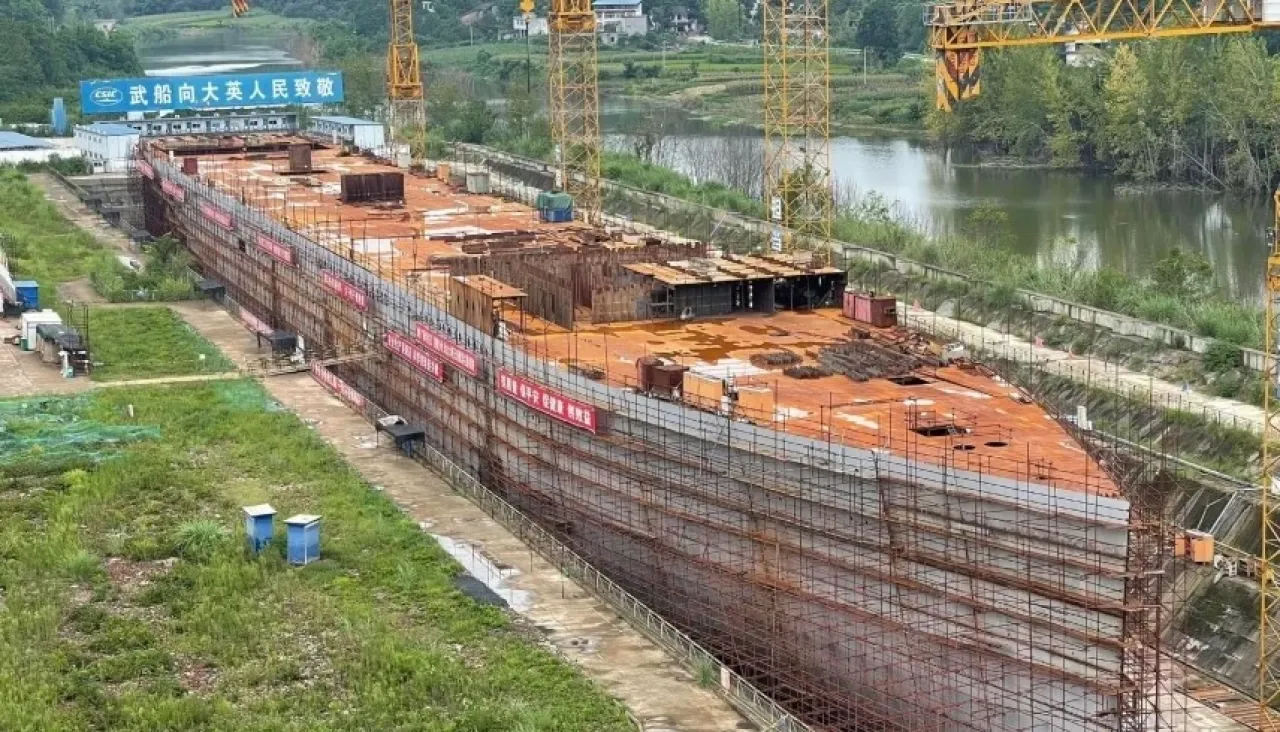
Khaberni - In 2014, Chinese investor "Su Xiao Jun" launched a massive investment project to build a full-size replica of the legendary "Titanic" ship, betting on the widespread public passion that was fueled by James Cameron's famous movie in China, which at the time generated record revenues exceeding $200 million.
But this ambition met with a tragic end; the project concluded with the official bankruptcy of "Su" company at the end of March, turning the dream, which cost millions, into an abandoned rusty skeleton, after the funding dried up and the company failed to complete the construction, making it a symbol of the so-called "lavish vanity projects" that sunk into debt before seeing the light of day.
The gamble of a lifetime and the fading of dreams
"Su," the experienced contractor, bet all his savings on this project; he sold his shares in 13 hydropower stations to fund his vision. However, after 11 years, the "Chinese Titanic" met a fate no less tragic than the original ship, although this time it sunk in the mire of debt and stagnation on dry land.
The now rusty ship skeleton, which measures 269 meters in length and 28 meters in width, lies abandoned on a plot of land in "Daying" county, southwest China.
Construction work stopped before the completion of the external structure, and the interior decoration work never began, which prompted "Qixing Cultural and Tourism Transformation" company to officially declare bankruptcy, setting a bitter end to Su's unparalleled gamble.
Drying up of funding sources
"China News Week" magazine quoted "Su" as saying, "We sold all the power stations and almost all our assets, yet we could not continue construction." The initial plan aimed to spend 600 million yuan (88 million dollars) just to build the structure, with total investment expected to reach one billion yuan.
With the slowdown of the real estate sector in China, the project faced severe financing crises; a state-owned contractor withdrew due to new policy restrictions, and "Zhejiang Chuoshang Bank" stopped funding after the first installment, cutting off the last lifeline from the project.
A costly bill for the local government
The loss was not confined to the private sector but extended to affect the local "Daying" government, which bore the costs of relocating residents and the vast land compensations covering 450 hectares, in addition to providing tens of millions of yuan as industrial support.
Economic figures clearly indicate a mismatch in estimates; while the province's gross domestic product last year was 22.1 billion yuan, the cultural and tourism sector contributed only 3.1 billion yuan, reflecting the local market's inability to absorb such a massive project and justify its financial risks.
Era of "wasted investments"
According to experts, the Titanic project today symbolizes a period of wild investment in China, which left local authorities burdened with incomplete projects and crippling debts. Chinese leaders, including President "Xi Jinping," have repeatedly warned of the risks of lavish local investments that drain budgets fruitlessly.
In a speech delivered earlier this year, President "Xi" mentioned difficulties in operating high-speed train stations and the underutilization of stadiums and museums, and the abandonment of industrial zones, stressing the need to curb the unconsidered expansion that led to the emergence of such struggling entities.
Official data confirm this concern; the debt ratio of local governments rose to 39.1% of the GDP last year, indicating the beginning of a new era of Chinese financial conservatism and correction after years of expansion that ended with the sinking of the Chinese "Titanic" in the sands of debt.