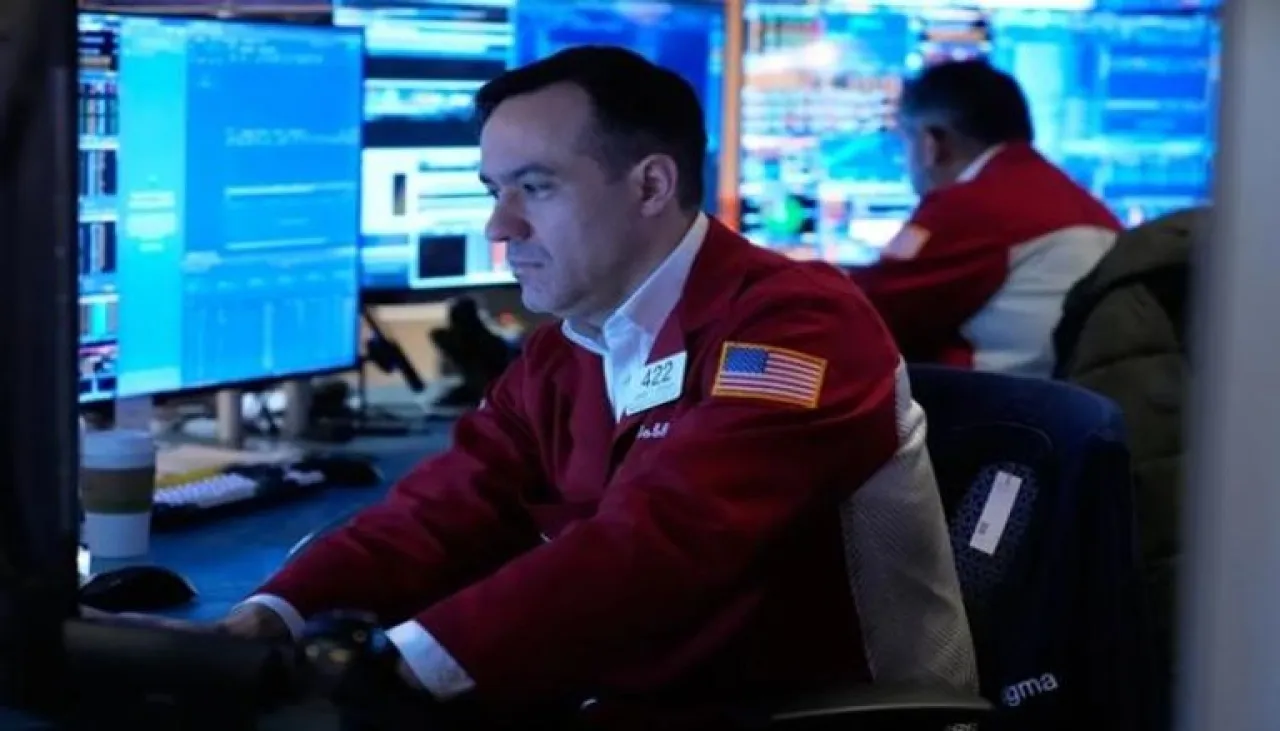
Khaberni - Stock indices fluctuated on Wall Street during Friday's trading, amid an anticipation dominating the global markets, with a relative stability in oil prices following a fragile ceasefire agreement between the United States and Iran, keeping investors in a state of high caution.
The Standard & Poor's 500 index rose 0.2% in morning trading, heading for a second consecutive week of gains, while the Dow Jones industrial index dropped 106 points, or about 0.3%, by 10:43 AM Eastern Time. Conversely, the Nasdaq composite index rose by 0.6%.
According to the Associated Press, these movements come after two weeks of gains by the key indices, driven by cautious optimism about containing the war with Iran, despite the ongoing uncertainty that makes the markets vulnerable to sharp fluctuations with any political or military development.
The market recorded a mixed state, with the number of losers surpassing the winners within the Standard & Poor's 500, although the index managed to recover most of March's losses to close only 2% below its record high registered in January.
In contrast, shares of major technology companies helped support the market, with Nvidia shares rising by 2.4%, and Broadcom shares by 4.9%, mitigating selling pressures in other sectors.
The global markets in Asia and Europe also performed positively, at a time when oil remained the most influential factor on market movements.
Crude oil prices saw sharp fluctuations since the outbreak of the war, with navigation through the Strait of Hormuz slowing down, pushing oil prices to high levels over the past weeks.
Brent crude rose from about $70 per barrel before the war in late February to over $119 at some points, before dropping by 0.5% to $95.47 on Friday. U.S. crude also dropped by 0.3% to $97.59 per barrel.
Investors are anticipating a new round of high-level talks between Iran and the United States scheduled for Saturday, amidst ongoing political uncertainty, especially after media reports indicated preconditions that could obstruct the negotiations.
On the American economic front, data showed that inflation recorded its largest increase in 4 years during March, driven by rising gasoline prices due to energy market disruptions, although the reading was slightly lower than analysts' expectations.
The yields on U.S. bonds stabilized somewhat after the inflation data was released, with the yield on 10-year Treasury bonds rising to 4.31% compared to 4.29% in Thursday's session.
Inflation still represents the greatest challenge for the Federal Reserve, amid rising prices of goods and services, partly driven by the impact of customs duties and rising energy costs, which gradually reflects on food, transportation, and aviation prices.
Consumer confidence fell by 10.7% in April, according to a University of Michigan survey, with inflation expectations for the next year rising to 4.8% compared to 3.8% in March, reflecting growing concerns among American households.
Amid these data, the U.S. Federal Reserve continues its cautious approach, keeping interest rates at high levels to curb inflation, with expectations in Wall Street that the tight monetary policy will continue until 2026, with a possibility of additional rate hikes if inflationary pressures continue to rise.