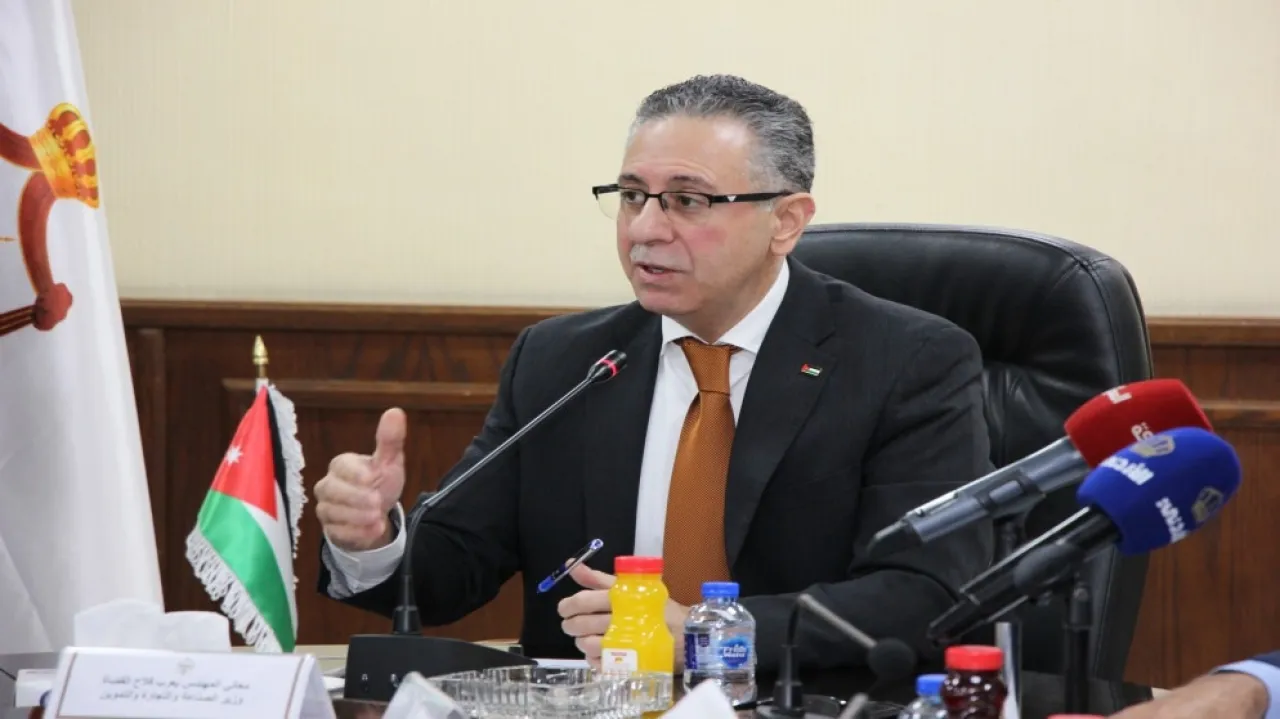
Khaberni - Minister of Industry, Trade and Supply Ya'rab Al-Qudah confirmed that the national economy continues to develop and adapt, despite the tensions in the region, along with strengthening partnerships with the private sector and brotherly and friendly countries.
Al-Qudah stated that the kingdom has proven its ability to face current challenges, as the markets did not experience any shortage of goods in the recent period, thanks to the efficiency of the trade and industry sectors, while the port of Aqaba maintained operation levels similar to the previous year, reflecting the robustness of supply chains.
He added during the inaugural, on behalf of the Prime Minister, Wednesday, "The Economic Forum for Diplomatic Missions in Jordan" that the government is keen on direct communication with the private sector and enhancing the partnership with it, to serve the national economy and move towards implementing the economic modernization vision.
Al-Qudah emphasized during the forum, organized by the Jordanian Businessmen Association in cooperation with the Ministries of Investment, Foreign Affairs and Expatriate Affairs under the motto "Investment for the Future," that the government worked on transforming the concept of partnership with the private sector from a theoretical framework into real projects on the ground, contributing to launching a broad package of joint projects.
He pointed out that the convening of the forum at this time carries important messages reflecting the resilience of the Jordanian economy and its stability and growth, alongside the robustness of the Kingdom's diplomatic relations with various countries, and that Jordan always was and will remain a genuine support to its Arab brothers.
He clarified that Jordan's role during the COVID-19 pandemic was not limited to managing the crisis, but parallel efforts were taken to plan for the national economy's future, where the economic modernization vision was prepared with broad participation from the private sector, to be a roadmap for building a real and comprehensive economic renaissance and enhancing the national economy's regional and global integration.
He mentioned that the economic modernization vision came under the directives of His Majesty King Abdullah II to be a "roadmap" and an executive action plan for successive governments, based on measurable indicators, ensuring performance monitoring and enabling the private sector and the community to assess achievements.
Al-Qudah presented several economic indicators, stating that the economic growth rate during the last year 2025 had progressively increased from 2.6% in the first quarter to 3% in the fourth quarter, which is higher than international expectations.
He mentioned that national exports last year increased by 10% compared to 2024, with noticeable growth in multiple markets, including Arab countries, Asian countries, and the European Union.
He added that foreign investment in Jordan increased by more than 25% during 2025, alongside notable growth in re-export activities, enhancing the kingdom’s status as a regional hub connecting the economies of the region.
In terms of the tourism sector, the Minister of Industry pointed out that growth surpassed 7% last year, compared to the year before, despite regional challenges, particularly due to events in Gaza.
Al-Qudah explained that indicators at the beginning of 2026 reflect the continuation of positive momentum, where national exports grew over 11% during the past January this year, along with rising foreign investments and expansion in export markets.
He touched on several major strategic projects, such as the national water carrier project, the railway project, and the Amrah city project, affirming that they are proceeding steadily and rapidly and constitute major drivers for economic growth.
Al-Qudah affirmed that Jordan continues to solidify its position as a regional logistical hub, supported by logistical projects and specialized zones enhancing its role in re-exporting, storage, and servicing neighboring markets.
He noted that exports were partially affected by regional developments, but alternative markets have contributed to compensating for part of this decline, affirming the continuation of exports, particularly in the food and pharmaceutical industries, to various brotherly countries.
He pointed out that Jordan adopts an approach of integration and solidarity with countries in the region, saying that economic relations with the brethren are based on the principle of a shared destiny, enhancing stability and development.
Al-Qudah emphasized the importance of maintaining economic momentum, calling for continued joint work between the government and the private sector, and wishing for the kingdom's ongoing security, stability, and prosperity.
On his part, Secretary-General of the Ministry of Foreign Affairs and Expatriates Affairs, Daifallah Al-Fayez, stated that economic diplomacy is increasingly important as a practical tool to support and accelerate the implementation of the economic modernization vision, through attracting investments, opening new markets, and building strategic partnerships, in addition to transferring knowledge and technology.
He explained that current regional and international challenges, including geopolitical shifts, supply chain disruptions, rising financing and energy costs, directly reflect on investment flows and trade movement, but Jordan has dealt with these issues realistically and methodically, based on flexibility and adaptation.
He pointed out that the kingdom, under the directives of His Majesty King Abdullah II, has managed to maintain an attractive, secure investment environment, enhancing investors' confidence and supporting business sustainability, emphasizing that economic diplomacy has become a fundamental tool not only for attracting opportunities but also for bolstering the national economy's resilience and continuous growth.
Al-Fayez stated that Jordan is witnessing tangible growth reflecting increased investor confidence, through rising foreign investment flows, expansion in developmental zones, and an increase in promising projects, confirming that the kingdom is steadily moving towards the future.
He pointed out that investment opportunities in Jordan include priority sectors such as renewable energy, mining, information technology, tourism, logistics services, and infrastructure, supported by a stable, advanced legislative framework and qualified human resources.
Al-Fayez affirmed that the kingdom’s strategic location grants it access to global markets, qualifying it to be a hub for re-exporting, storage, and a regional logistical passage, stating that the forum represents a practical opportunity to move from dialogue to implementation, from presenting opportunities to building partnerships, and from visions to tangible results.
On his behalf, president of the Jordanian Businessmen Association, Ayman Al-Alawneh, explained that the national economy has proven its resilience and flexibility in facing shocks, relying on ongoing structural reforms and a solid national will, despite the region's economic crises and disruptions in supply chains and challenges in the energy, food, and financing sectors.
Al-Alawneh affirmed that Jordan will remain a model of stability and moderation, and a trusted partner both regionally and internationally.
He noted that the kingdom has succeeded in maintaining an attractive investment environment based on the rule of law, clarity of legislation, and openness to the world, enhancing investors' confidence and establishing long-term partnerships, pointing out that the forum represents a real opportunity to exchange views on the future of investment, especially in the context of accelerating global transformations, reshaping supply chains, accelerating digital and green economy transitions.
He pointed out that Jordan is progressing in implementing the economic modernization vision, which forms a roadmap to achieve sustainable and inclusive growth through improving the business environment, enhancing competitiveness, stimulating innovation, and creating high-quality job opportunities, affirming that the private sector is the main driver of this growth and the fundamental partner in achieving this vision.
He stressed the importance of the partnership between the public and private sectors as an effective tool to execute major projects, especially in sectors such as energy, infrastructure, industry, tourism, and technology, contributing to resource mobilization and achieving real added value for the national economy.
Al-Alawneh appreciated the government's efforts in protecting citizens, ensuring market stability, providing goods, enhancing supply chains, in addition to supporting Jordan's position as a regional logistical center, and adopting flexible economic policies that maintain financial stability and investors' confidence.
He praised the role of the Ministry of Foreign Affairs and Expatriates Affairs in enhancing economic diplomacy, contributing to integrating foreign policy and economic goals, and maximizing international cooperation opportunities.
Al-Alawneh confirmed that the participation of ambassadors and representatives of diplomatic missions reflects the depth of Jordan's relations with brotherly and friendly nations, and serves as an incentive to enhance economic, trade, and investment cooperation in the upcoming phase, stressing the importance of building strategic partnerships based on mutual interests to achieve sustainable development and support regional economic stability.
The forum aims to enhance economic dialogue and build effective international partnerships, affirm Jordan's position as an attractive investment environment, and support efforts towards sustainable growth and enhancing integration with international partners and building sustainable economic relationships based on mutual interests.
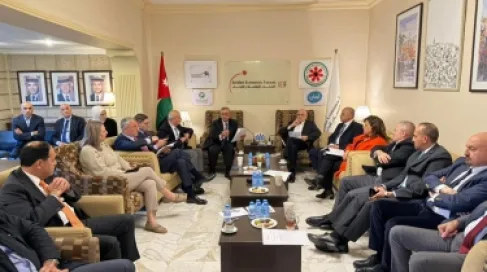
The forum gathers a number of ambassadors and representatives of diplomatic missions accredited in the kingdom, especially ambassadors from the European Union, the United States, the United Kingdom, along with a number of ambassadors from friendly and brotherly Arab countries, granting it a strategic dimension contributing to deepening the partnership between Jordan and these countries in the economic, investment, and trade fields.
The forum serves as a pivotal opportunity to affirm the robustness of the partnership between Jordan and its international partners, enhancing coordination and integration in developmental priorities, in addition to showcasing the economic modernization vision programs and the structural reforms achieved by the kingdom on the national economy’s path.
The forum highlights the promising investment opportunities in high-value sectors, contributing to solidifying confidence in the national economy, stimulating new investment flows, broadening markets for Jordanian exports, and reinforcing long-term strategic partnerships between Jordan and countries worldwide.
The forum focuses on the foundations of the economic modernization vision as the comprehensive national framework to achieve sustainable economic development, through improving the business environment, enhancing competitiveness, stimulating innovation, and generating employment opportunities.
It also sheds light on the role of the private sector as a key partner in implementing the economic modernization vision and its role in supporting productivity- and knowledge-based economic growth, aligning with national priorities for the upcoming phase.
The forum discusses prospects for enhancing the partnership between the public and private sectors and its pivotal role in supporting major investment projects, especially in vital sectors such as water, transport, energy, infrastructure, industry, tourism, and information technology.
During the forum, some of the most notable success stories of Jordanian businessmen will be showcased as inspiring models that reflect the private sector’s capacity for innovation, expansion, and regional and international competition, displaying a positive image of the kingdom's investment climate and encouraging investors and international partners to explore available opportunities and establish long-term partnerships that support the national economy and enhance comprehensive development.