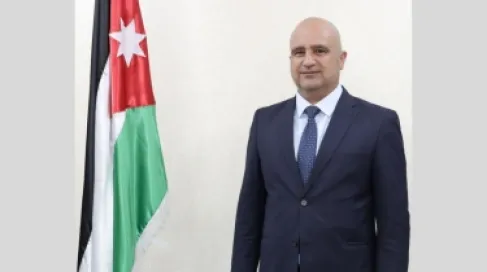
Khaberni - The foreign reserves of the central bank are nearing 28 billion dollars, and they cover the kingdom's imports of goods and services for about 10 months, according to the Jordanian central bank governor Adel Sharkes.
Sharkes stated in his talk to "Al-Mamlaka," that the duration of the import coverage is more than three times the internationally recognized level.
He emphasized that the banking sector enjoys a high degree of resilience and financial safety.
Speaking about the legal liquidity in banks, he said that it has reached 144%, although the required ratio is 100%, confirming that banks currently have a high safety margin.
He pointed out that the capital adequacy ratio in banks has reached 18%.
Sharkes reviewed the fundamental factors that enhance the flexibility of the national economy, foremost among them the strength of monetary stability, mentioning the presence of a high safety margin from foreign reserves, which allows the ability to face external shocks.
He explained that the inflation rate in the first two months of the current year was 1.10%.
Speaking about exports, Sharkes said that their performance did not come out of nowhere, but rather as a result of diversifying Jordan's trade partners.
He added, "We have a wide network of regional and international markets, and we have an export structure that depends on stable external demand, especially in the sectors of pharmaceutical industries, apparel, phosphates, and potash."
He continued, "We have diverse sources of external income, whether from remittances of workers abroad, tourism income, or foreign investment figures."
Sharkes talked about the government's proactive measures in dealing with the current regional crisis, including sustaining energy security, supply chains, and enhancing stock, alongside the gradual reflection of oil prices on the local market, which helps contain inflationary pressures and strengthens the resilience of the national economy.
He pointed out that the balance of payments achieved 2 billion dollars with a growth of 25%, the highest since 2017.
The preliminary data of the balance of payments showed that the inflow of direct foreign investment into the kingdom during 2025 amounted to about 2.024 billion dollars, compared with 1.618 billion dollars during 2024, achieving a growth of 25.1%, the highest level these flows have recorded since 2017, an indicator reflecting the increasing confidence of investors in the Jordanian economy, the robustness of economic policies, and the attractiveness of the investment environment in the kingdom.
The investments from Arab countries amounted to 1.241 billion dollars, accounting for 61.3% of these total flows.
Sharkes said that investment represents long-term commitments that are not affected by any short-term crisis.
He added, "The foreign investment which amounted to 2 billion dollars reflects the attractiveness of the national economy and the confidence of investors in the investment climate in the kingdom and the followed economic policies, which is consistent with the goals of the economic modernization vision we hope to achieve."