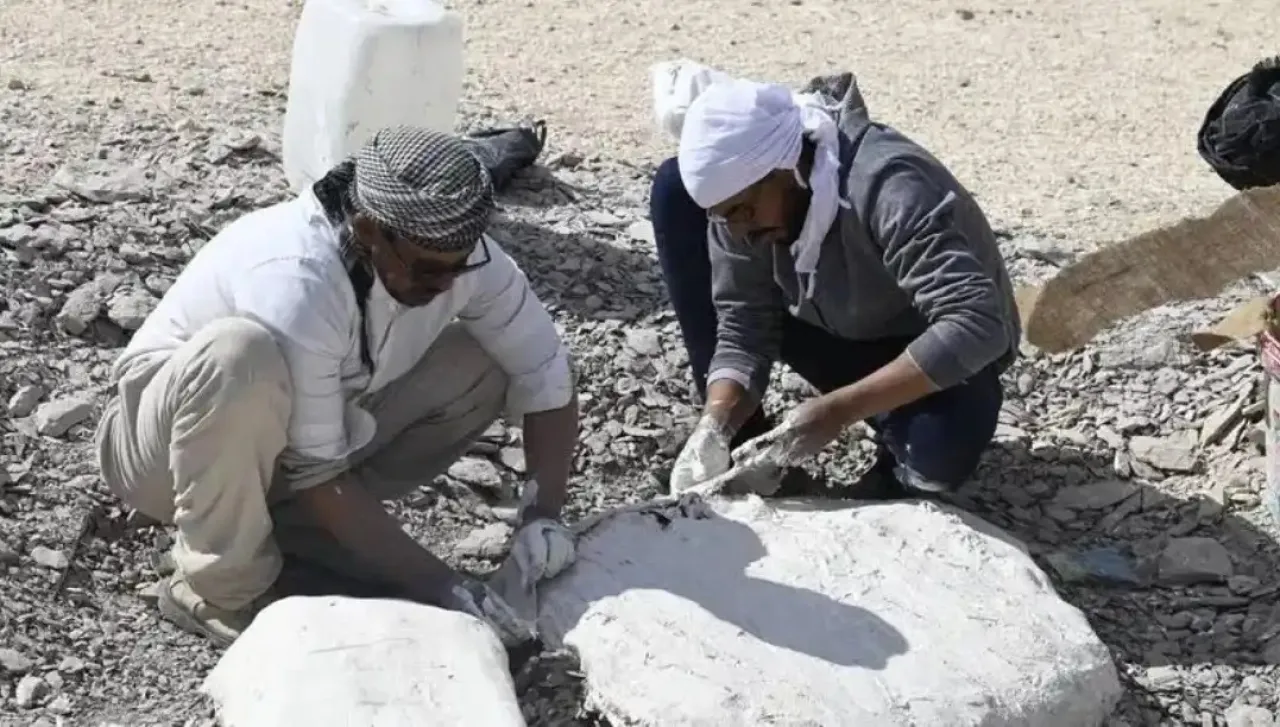
Khaberni - The announcement by Egypt's "New Valley" University about the remains of the first giant sea turtle that appeared in the country about 66 million years ago and was found at "Dakhla" oasis in the Western Desert, has sparked positive reactions in the scientific and academic circles.
Many consider the announcement a rare scientific discovery that sheds light on unknown pages of fossil and geological history in Egypt when the vast desert was part of the seas.
According to experts, the discovery has significant scientific implications, including that this time period, which shortly preceded the dinosaurs' extinction, saw Egypt covered by shallow seas that were habitats for sea giants, enhancing our understanding of ancient marine food chains and environments.
With its size reaching several meters, this turtle places Egypt on the map of major global sites that host giant marine reptiles, thereby competing with similar discoveries in North America and Europe.
Geographically and climatically, this discovery helps scientists draw a more accurate map of continental movements and ancient waterways, and confirms that these creatures existed in Egypt's Western Desert, which were tropical humid environments and warm seas, providing vital data on how large marine creatures responded to climate and environmental changes through the ages.
The discovery also represents an achievement for the Egyptian scientific community, reflecting the advancement of local research teams in excavation, study, and restoration using the latest technologies, contributing to promoting "fossil tourism" and environmental awareness, and proving that the Earth's subsurface in Egypt still hides secrets yet to be revealed about the history of life on our planet.