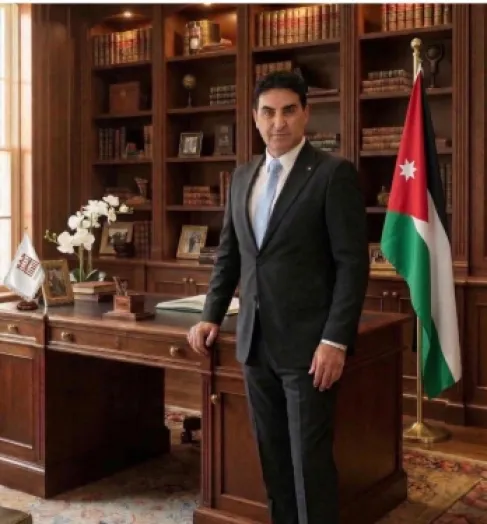
By Dr. Ayman Al-Khazaaleh
Throughout the penultimate week of March 2026, at the peak of the temporal moment overlapping with its geopolitical complexities, the Jordanian state faced a “fateful clash” with geography; where celebrations of national sentiment on the anniversary of the Day of Dignity and Mother’s Day met with existential security and economic imperatives, placing the decision-maker in front of an unprecedented “strategic quandary.” At a time when the country was preparing for Eid al-Fitr, the military scene was boiling over a cauldron of “transboundary threats”; as the Royal Air Force commenced “preventative branding” operations in the rural Swaida and the Syrian desert to eradicate the infrastructure of the sovereignty-transcending drug economy, yet the internal price was steep; as revealed by the martyrdom of an elite group from the Anti-Narcotics Directorate in a bloody raid in East Amman, exposing a gap in “urban combat tactics” against Captagon and crystal meth gangs. Consequently, the government must cease the policy of “emergency response,” radically shifting towards “cybernetic security,” artificial intelligence surveillance, and predictive analysis; thereby reducing human costs and redefining sovereignty as a technical system, not just a physical sacrifice in the age of "drones".
As for aerial influence, the skies over the Kingdom turned into a “shadow arena” and an undeclared battlefield for settling regional scores; where the interception of air defense systems of Iranian drones and missiles headed towards the “Dimona reactor” places Jordan before a scenario of “geographical hostage” within an equation controlled by others. Iran’s attempt to strike a nuclear facility near our borders is not merely a military event, but a threat of a “silent ecological annihilation” that could affect our agriculture and progeny. Despite the King’s firm statements that Jordan will not be a battleground, the reality indicates a governmental shortfall in building a completely independent “layered air defense system,” capable of neutralizing these objects without structural reliance on traditional alliances. The stance exceeds “diplomatic protest” to imposing “armed aerial neutrality,” and the government must stop being an “anxious spectator.”
Diplomatically, the King’s urgent tour in the UAE, Qatar, and Bahrain came against the backdrop of the Iranian-Israeli war drums, as an attempt to “adjust the rhythm” and secure a regional safety net within the frame of “risk containment diplomacy” and rebalancing. Despite the royal diplomacy’s success in securing an Emirati grant, the problem lies not in the flow of resources as much as in the pattern of their employment; as the government continues its “financial dependence” without devising solutions for the national economy. The organic link between Gulf stability and Jordanian national security is a “destiny conjunction”; as the regional war threatens to “desertify the cash flows” of 500,000 Jordanian expatriates and devastates the tourism sector that entered a “recession phase” due to tourist panic. Therefore, directing these grants immediately to productive water and energy projects instead of patching the ongoing budget gaps becomes a critical necessity, with the need to fortify the “Social Security Law 2026”—currently under parliamentary discussion—against any legislative slips that increase the burdens on youth in an inflationary era.
In the executive balance, the government's decisions about “digital transformation” of identity, “school transportation,” and setting the holiday schedule appear “to be decorating the ship amid the hurricane.” Bearing the direct security and economic costs in March alone calls for declaring an “economic emergency” that re-prioritizes according to the logic of comprehensive national security. Additionally, the deficiency in foresight of the supply chain crisis through the Bab el Mandeb is reflected in a sharp inflation in the prices of basic commodities; this requires shifting from crisis management to building “sovereign immunity” through establishing an actual strategic reserve exceeding announced figures, and activating price control mechanisms through a solid partnership between the military and civilian institutions, thus cementing a practical concept of food and oil independence.
In summary, Jordan is not merely a “geographic insulator;” it is the pulsating heart and a crucial pivot in the Middle Eastern balance network. Hence, the challenges it faces—from sky rockets to drug toxins, from pocket pressures to economic infrastructure imbalances—are merely manifestations of one multifaceted battle, and it is imperative for the executive authority to exit its bureaucratic torpor, understanding that sovereignty in the times of composite chaos is indivisible: it is either whole or nonexistent.