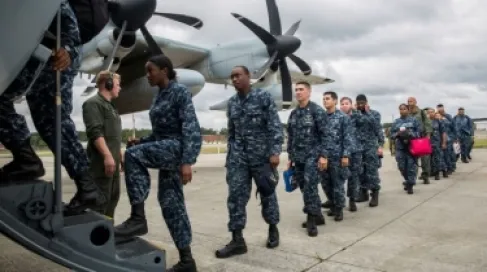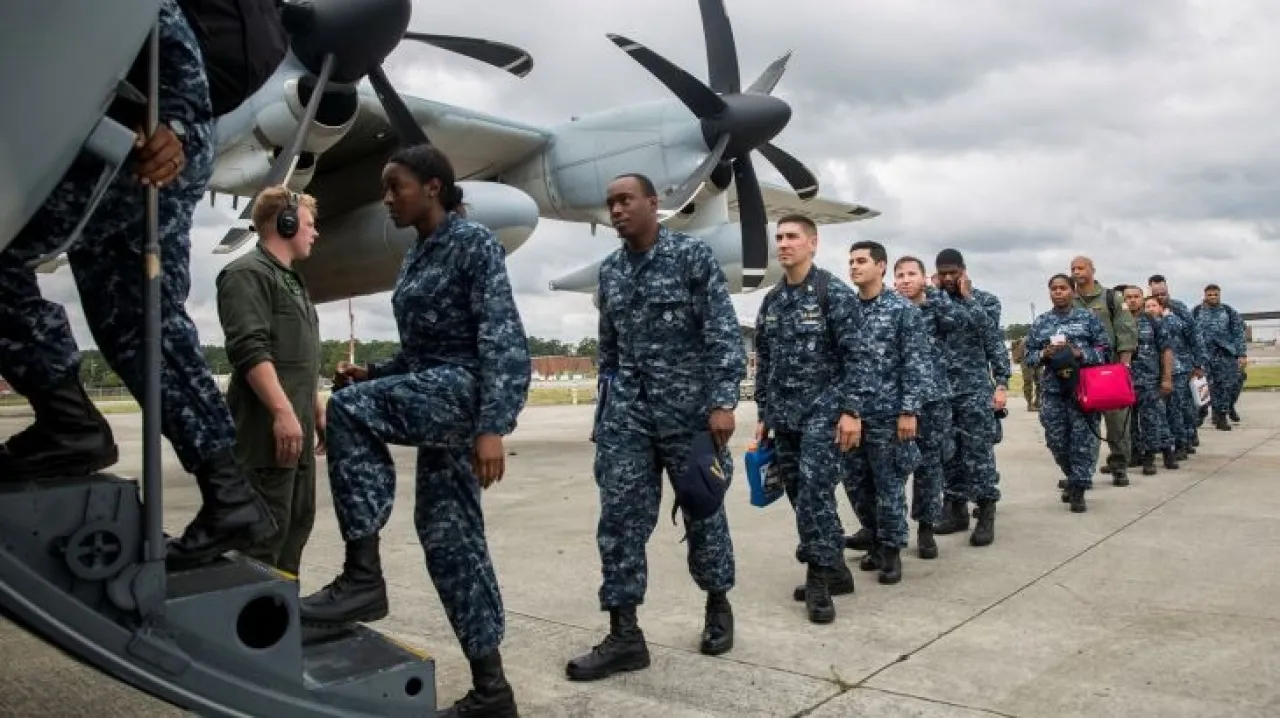
The United States Marine Corps' rapid intervention unit "Marines" is moving towards the Middle East, in a step that reflects Washington's push to secure freedom of navigation in the Strait of Hormuz amid escalating regional tensions.
This comes after statements by US President Donald Trump on the necessity of restoring security to the strait and ensuring the movement of ships, amid reciprocal bombardment between the United States and Israel on one hand and Iran on the other.
Through an interactive map, Salam Khader showcased the path of the "Exploration Unit 31," which departed from its base in Okinawa, and was last spotted off the coasts of Singapore, before the crew of the "USS Tripoli" turned off its monitoring devices as a tactical move to avoid disclosing the location of the ship, which carries about 2200 Marines onboard.
This ship serves as a comprehensive base for launching amphibious and air operations, equipped with helicopters, artillery capabilities, and armored vehicles, giving it the ability to carry out multiple combat tasks independently.
The unit includes a squadron of "F-35" fighter jets, in addition to a squadron of "MV-22 Osprey" tiltrotor aircraft.
Multiple Options
On his part, military and strategic expert Brigadier Elias Hanna explained that the current mission of the exploration unit might not involve a direct operation, but aims to provide multiple options for the American command, including partial control of islands such as Kish, Siri, and Khark to enhance monitoring of the strait.
He added that the lengthy Iranian coastline (about 2400 kilometers) makes any direct operation a significant challenge, and controlling the strait a complicated process that requires a coalition and substantial logistical support.
The expert clarified that Iran still controls the movement of navigation, and can disrupt the strait using missiles or fast boats, while the American operation represents a limited possibility and is not inevitable, as any ground operation would require an increase in troops and ensuring tangible results without slipping into open escalation.
Hanna pointed out that Iranian retaliatory operations targeting oil and gas facilities in the south of the country, which in turn targeted facilities in the Gulf, show that the current tension is still within the "escalation ladder," and that any American move must consider the Iranian control network through the islands and ports.
The movement of the American unit comes within the context of ongoing tensions between the United States, Iran, and Israel, with continued reciprocal bombing of military and economic facilities in the region, amid fears of escalating into a broader confrontation.