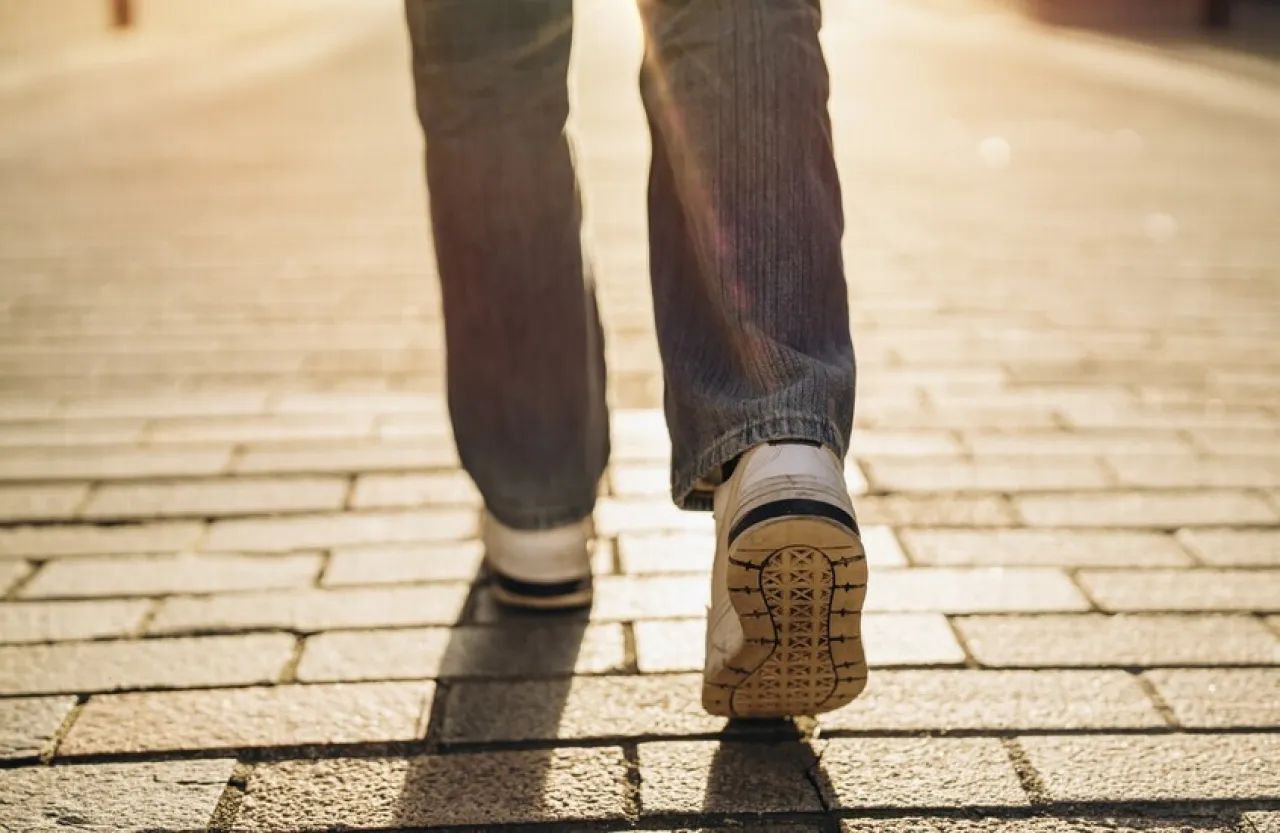
Khaberni - In an exciting scientific discovery, a recent study revealed that the way a person walks can accurately uncover the emotions stirring within them, even before they speak or show any facial expressions.
Researchers from the Advanced Telecommunications Research Institute in Japan have decoded the relationship between walking patterns and emotional states, confirming that the movement of the arms and legs carries a universal language.
Humans rely on a set of signals to read others' emotional states. These signals include subtle expressions, such as slight movements of the eyebrows, eyes, and mouth, which can indicate happiness, anger, fear, sadness, or surprise.
Also, subtle changes in body language, such as moving from an open to a closed posture, can reveal whether a person is interested or feeling stressed.
In the recent study, scientists used motion capture technology to analyze people's walking. In an initial experiment, trained actors were asked to recall personal memories that evoke feelings of anger, happiness, fear, or sadness, then walk a short distance while immersed in those memories. The actors wore reflective markers that allowed researchers to record their movements and convert them into video clips of light points, which were then shown to participants who could accurately deduce the emotions beyond random guessing levels.
The study identified distinctive kinematic patterns for each feeling; angry walking is characterized by fast pace and a wide, strong swing of the arms, while sad walking features drooped shoulders, little arm movement, and slow steps with less vertical bounce. A happy walk carries a clear bounce and a slight sway, whereas a fearful walk focuses on limited movement of the forearms rather than the entire arms. The results also showed that the sad walk was the easiest to recognize, while angry walk was the most difficult to distinguish.
What makes these results interesting is that walking is considered a more honest window into real emotions compared to facial expressions, as the researchers explain. Facial expressions can be consciously controlled and falsified, but walking represents a spontaneous and habitual motor behavior which is difficult to control or change deliberately. This means a person can be emotionally read from a distance, even before their face becomes clear or they start to speak.
The research didn't stop there as a study from the University of Portsmouth in the UK added new dimensions to the relationship between walking and personality. The researchers found that exaggerated movement of both the upper and lower body indicates aggression, while a noticeable "hip sway" is associated with agreeability and sociability, or what is known as the social personality. Interestingly, less overall movement in walking with a bit of sway indicates traits like creativity and awareness.
These results open promising practical horizons, especially in the security field, where researcher Liam Satchell from the University of Portsmouth confirms that if security camera operators could be trained to recognize aggressive walking, we might enhance their ability to detect and prevent imminent crimes before they occur. These studies also offer valuable tools in the fields of psychology, personality analysis, and deeper understanding of human behavior.