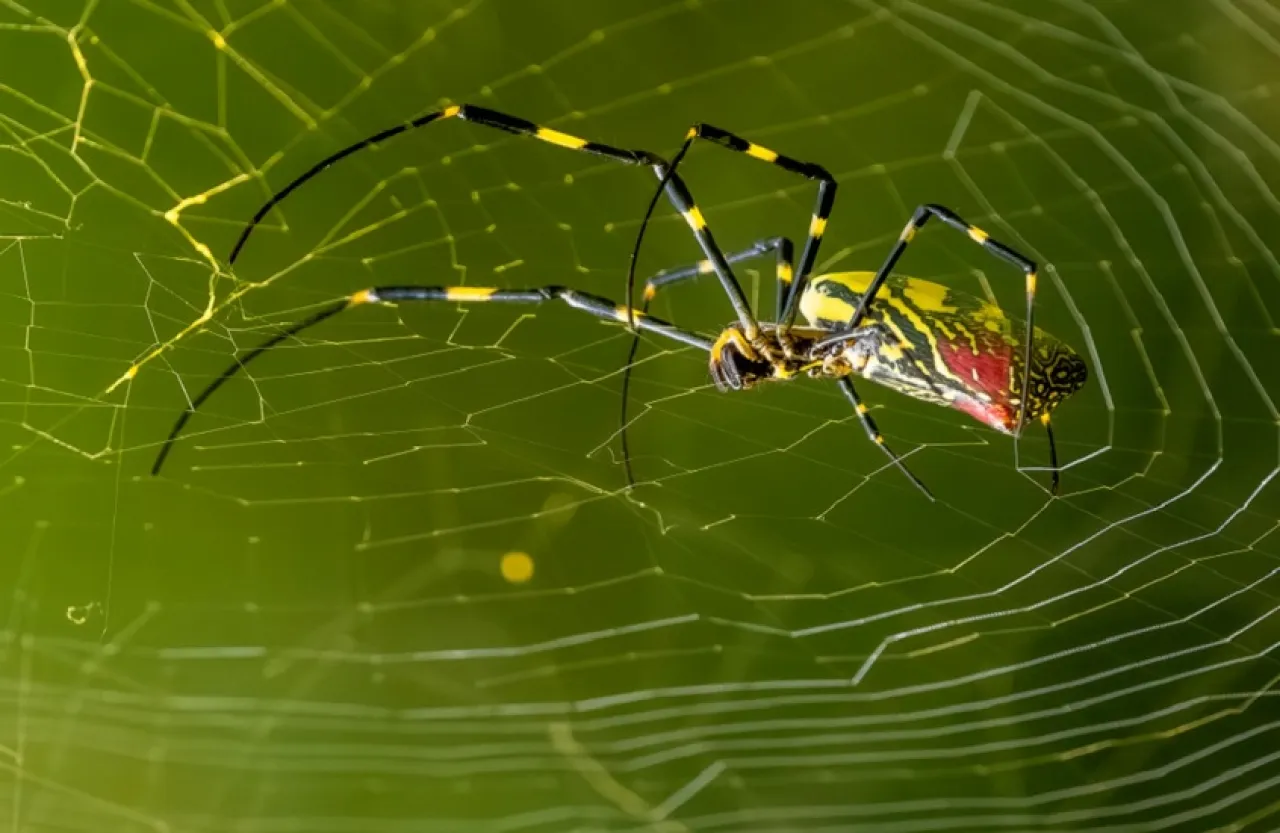
Khaberni - A type of spider known as the "Joro spider" with a bright yellow color is spreading across the United States, amid warnings of its increased settlement in new areas within the country.
This spider, originally from Japan, China, Korea, Taiwan, and other parts of Asia, has been spotted in increasing numbers since it was re-identified in the United States in 2024. It has marked its presence in multiple states including Georgia, Tennessee, North Carolina, South Carolina, California, Virginia, Maryland, and Pennsylvania, and is often observed in the fall when it reaches its full size between August and October.
Experts suggest that the spread of this species could be due to its ability to travel through the air in a phenomenon known as "ballooning," where spiders release silken threads that act as sails, helping them to rise and move over long distances, which facilitates their geographical expansion with each breeding season.
With the approach of spring, new eggs are prepared to hatch, which could lead to an additional increase in the population of these spiders, especially since their young are capable of traveling long distances through the wind, enhancing the likelihood of their spread to new areas within the country.
The female "Joro" spiders are distinguished by their shiny yellow color with blue stripes and red markings, along with their large size, which can sometimes reach the size of a human hand, while the males are smaller and have a dark brown color. The females build large golden silk webs to trap their prey, and these webs become more widespread as the number of spiders increases.
Despite their striking nature and ability to adapt to various environments, including busy cities and roads with vibrations and noise, studies have shown that these spiders are not greatly affected by such conditions, unlike other types of spiders.
In this context, researchers at the Odum School of Ecology at the University of Georgia have conducted experiments to simulate road vibrations, and it turns out that the "Joro spider" is capable of coexisting with these environments without significant impact, which explains their spread near urban areas.
However, researchers confirm that this invasive species does not pose a direct threat to humans, as no cases of death or medically significant bites have been recorded, and their behavior tends to avoid biting.
Nonetheless, researchers indicate that its danger lies in being an invasive species that may affect the ecological balance by competing with local species for food and space, in addition to preying on creatures caught in its webs.
It is believed that this spider entered the United States over a decade ago through commercial shipments from East Asia, and since then, it has gradually continued to spread, with expectations of reaching areas in Canada in the future.
Its ability to adapt and spread rapidly is attributed to biological traits, including a high metabolic rate, fast heart rate, and tolerance to cold weather, as laboratory experiments have shown that more than 75% of the samples subjected to freezing were not significantly affected.
Estimates indicate that the life cycle of this spider begins with egg hatching between May and June, then the young grow over several months to reach their full size, before they begin the mating stage.
While its spread may be seen as a nuisance in some areas, experts believe it can be easily managed in the residential environment, while it remains within the list of invasive species that require ongoing scientific monitoring.