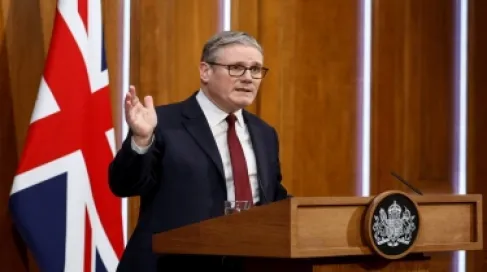
Khaberni - British Prime Minister Keir Starmer said his country will not be dragged into the American-Israeli war on Iran and that it will continue to work on ending it and resolving the traffic crisis in the Strait of Hormuz as soon as possible.
Starmer added in a speech today, Monday, that the United Kingdom is working around the clock to protect its citizens and interests, and to assist its partners in the Gulf region.
He pointed out that Britain is also working to protect its bases and allies with thousands of soldiers now stationed in Cyprus and across the region, saying that 3 fighter squadrons are participating in operations to counter Iranian drones.
He explained that the recent war has weakened the capabilities of the Iranian regime but emphasized the need to prevent Russian President Vladimir Putin from exploiting it to achieve additional gains in Ukraine.
Negotiation Agreement
Starmer said that after the war stops, the world will need a negotiation agreement that restricts the threats of Iran and its capacity to restore its missile program, and limits its arming of affiliated militias, and its threats to international shipping that affects oil supplies leading to price increases in Britain.
The British government has released an unprecedented part of the British oil reserve to face the repercussions of the halt in supplies, according to Starmer, who confirmed that reopening navigation in the Strait of Hormuz is the only solution to eventually stabilize the market, describing the task as "not easy".
The United Kingdom is working with its partners to devise a plan to restore navigation in Hormuz as soon as possible and mitigate the economic repercussions resulting from its closure.
Starmer also talked about increasing the country's defense spending to the highest level since the Cold War and investing in clean energy to enhance energy security and reduce dependence on fossil fuel markets.
He emphasized that he is never prepared to risk these achievements, saying that his country is in a "much better position than it was when the war in Ukraine broke out."
Immediate Decisions
Starmer confirmed that he has taken a number of immediate actions to enhance the ability of British citizens to face the fluctuations caused by the Iranian war on the energy market, by setting an immediate cap on energy bills until the end of next June, saving 117 pounds (155 dollars) per British household per month, and he announced a discount of 150 pounds on heating costs for the most vulnerable households.
He said these measures will come into effect within 3 weeks from now, regardless of developments that may occur in the energy market, emphasizing that he will not allow companies to exploit the crisis to make profits from the pockets of citizens.
He added, "We have expanded the range of discounts on fuel and gasoline until next September, and launched an initiative of cheap gasoline, which forces fuel stations to publicly post prices to facilitate the consumer's choice process."
Starmer also said that his government will launch a heating care initiative in rural communities, and will counter any attempt by companies to end contracts and raise prices, announcing support for heating vulnerable families with 253 million pounds.
He explained that his country continues to work on a long-term plan to secure British energy security "so that it does not remain dependent on oil and gas market fluctuations," adding, "We have invested 19 billion pounds in domestic clean energy, to supply 20 million homes with electricity, and accelerated the construction of new power stations operating on nuclear energy."
Starmer described this plan as a "vital pathway," saying, "Our liberation from the repercussions of changing the gas market will not allow tyrants like Putin and Ayatollah's regime to attack our energy security, so we will speed up these plans."
Meanwhile, the British Prime Minister confirmed that his country "will continue to work on resolving the Middle East conflict quickly because this is the best solution to solve the problem of rising living costs."
Refusing Trump's Invitation
Starmer rejected an invitation by US President Donald Trump to participate with warships in what he calls the "Hormuz Coalition," according to Al Jazeera.
Starmer's statement was confirmed by the British Energy Minister, who said that the UK would not participate in the war on Iran and that it is working to solve the straits' traffic problem.
The UK might send a group of intercept drones and mine-detecting drones to the Middle East, but this is not certain.
Even the "Lyme Bay" landing ship that left yesterday, Sunday, from Gibraltar towards the Mediterranean, will carry out evacuation operations for British nationals stuck in the region.
With this decision, Britain joined Germany, which also refused to join to secure tankers in the Strait of Hormuz, saying, "The war is not our war."
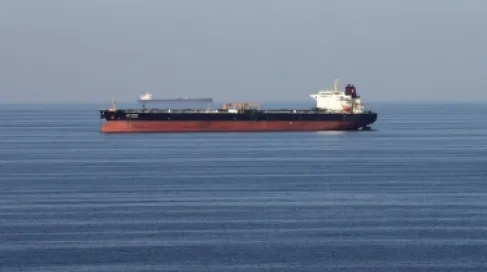
Trump had called on countries that depend on the oil passing through Hormuz to send naval vessels to secure the passage of tankers through the strait, which is experiencing almost a complete halt due to Iran's threat to target all ships trying to pass without its permission.