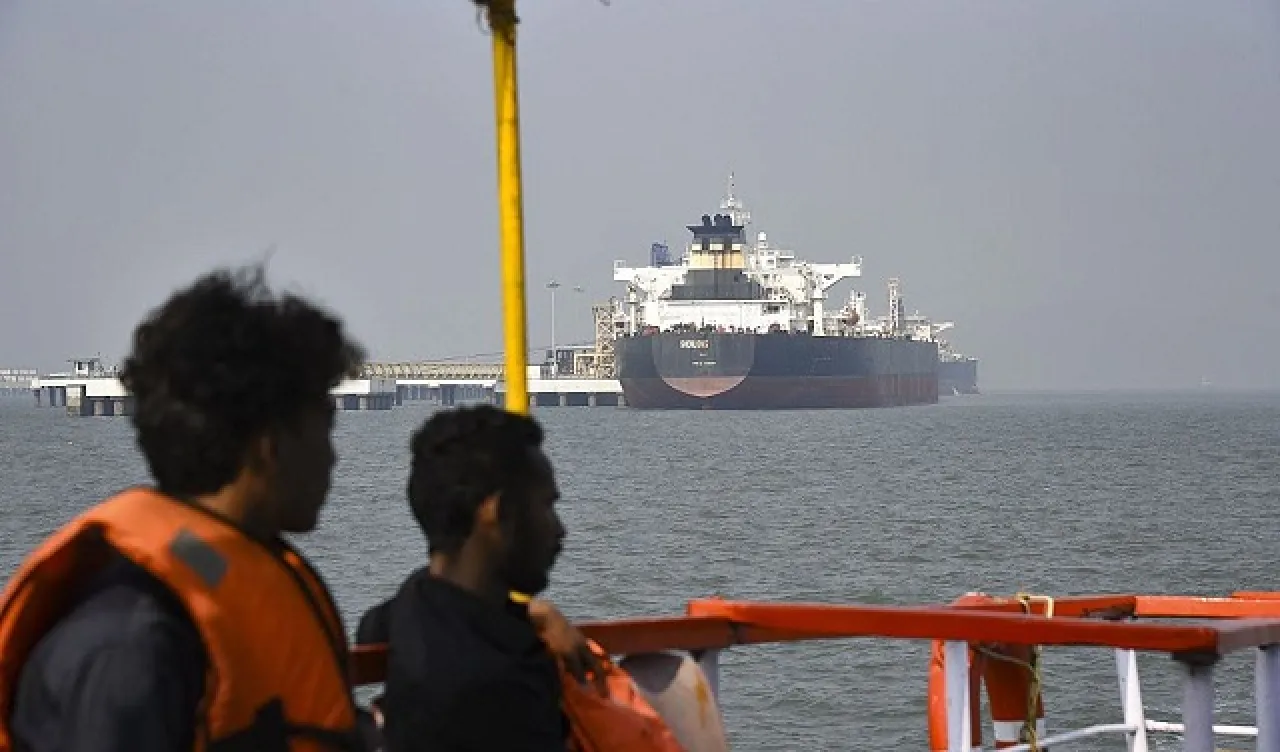
Khaberni - U.S. Secretary of Energy, Chris Wright, announced today, Thursday, that the U.S. military is "currently not ready" to escort oil tankers through the vital Strait of Hormuz, due to all military capabilities being focused on striking Iran.
Wright's statements came following an attack targeting two oil tankers off Iraq, which resulted in one death, and amid a brief spike in oil prices surpassing $100 per barrel.
Since the beginning of the war on Iran, U.S. President, Donald Trump, has sought to calm the markets by offering U.S. Navy escorts for oil tankers and providing reinsurance facilities for shipping companies. However, no escort operation has been implemented yet.
Wright told "CNBC" that "this will happen relatively soon, but it cannot happen now. Simply put, we are not ready".
He added, "All our military capabilities are currently focused on destroying Iran's offensive capabilities, and the industries that provide these capabilities".
He mentioned that it is "very likely" that escort operations will take place by the end of the month.
While Iran launches new attacks on energy facilities in the Gulf, the Paris-based International Energy Agency announced that the ongoing war in the Middle East for 13 days has caused "the largest disruption in global market oil supplies in history".
The American and Israeli strikes on Iranian targets, including energy infrastructure, have disrupted supply.
The member countries of the International Energy Agency agreed to release 400 million barrels of oil from their reserves, in the largest operation of its kind ever.
The United States will release 172 million barrels, according to Wright, under a swap agreement allowing 200 million barrels to be returned to its strategic petroleum reserve.
However, this measure did not dispel fears of an energy supply disruption in light of the closure of the Strait of Hormuz, through which one-fifth of the world's crude oil passes.
Wright said he held meetings at the Pentagon on Thursday to discuss the possibility of providing U.S. naval escorts for oil tankers.
The U.S. Secretary of Energy told CNN on Thursday that he believes the markets "currently have a large surplus of oil", and that short-term prices "are more based on psychological factors than on oil flows".
The United States also took steps to ease sanctions on some Russian oil in transit at sea, particularly granting India a temporary exemption to purchase this oil to address supply issues resulting from the war.
Wright told "CNN", that this exemption is not considered "a relaxation of sanctions" imposed on Russia, noting that the oil was headed to China.
He said, "Russia is not receiving a relaxation of sanctions. All this oil is in transit at sea, waiting its turn to be offloaded in China", considering the exemption a "practical solution" in the current crisis.
Wright's statements come the day after a meeting between a Russian envoy for President Vladimir Putin and American representatives in Florida, in the first talks between Moscow and Washington since the start of the American-Israeli war against Iran.
The Russian envoy, Kirill Dmitriev, described the meeting as "productive" and stated that Washington "has begun to understand better" the importance of Russian oil.