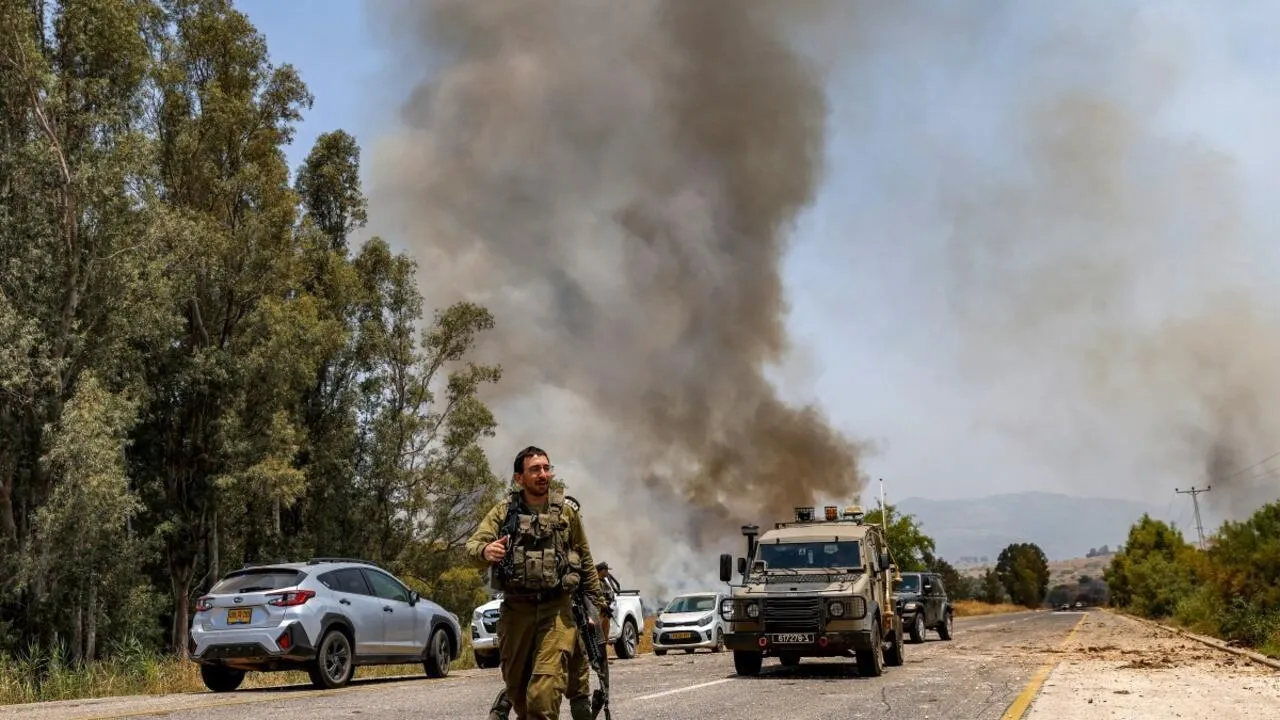
Khaberni- Israel has dubbed the area extending between the Litani River and Ras Naqoura as the "Death Zone," in a step reflecting a fundamental shift in Israeli rhetoric from deterrence to open escalation, amidst a military buildup of 5 brigades which raises serious concerns about an imminent ground operation in southern Lebanon.
The political analysis segment observed multiple indicators that this buildup is not merely a show of force. Writer and political analyst Ibrahim Haider mentioned that Tel Aviv is actually aiming to impose a security zone extending between 7 to 10 kilometers inside Lebanese territory by force of arms, regardless of any diplomatic settlement, pointing out that Israel has explicitly informed the Americans of its lack of interest in withdrawing in the foreseeable future.
Specialized researcher in Israeli affairs, Adel Shadid, noted that the Israeli war on Lebanon has not actually ceased since the ceasefire agreement was signed on November 27, 2024, despite Hezbollah's full compliance, which has not fired a single bullet during that period, adopting a narrative that holds the Lebanese government responsible for responding.
In contrast, the Lebanese government has dealt with the ongoing Israeli raids on the entire Lebanese geography as something that can be adapted to, while pointing fingers at Hezbollah's arms.
Shadid clarified that a noticeable shift occurred in the Israeli internal stance in the last two days, as Hezbollah's military performance sparked sharp criticisms against Prime Minister Benjamin Netanyahu - who is wanted by the International Criminal Court - and his defense minister Yisrael Katz, after they promoted a narrative that Hezbollah was deterred and incapable of acting.
This embarrassment has led the government to raise the bar of its escalatory rhetoric and introduce the concept of the "Death Zone" as an alternative to the option of withdrawal.
Hezbollah's capabilities
In the same context, Shadid observed that the rockets recently launched by Hezbollah reveal that the group has significantly rebuilt its military capabilities in south of the Litani, which constitutes a pressure card against Israel which had bet that Hezbollah gained nothing from the previous round.
He added that the negotiation process in the "Mechanism" committee has reached a deadlock at the political level, which pushes Israel towards imposing military facts on the ground.
On the diplomatic front, Haider pointed to the call that took place between Lebanese President Joseph Aoun and French President Emmanuel Macron and Syrian President Ahmad al-Shara, in an attempt to contain any fallout from a potential widespread Israeli war.
However, these efforts collide with the reality that Israel seeks to impose a security and political agreement according to its own terms, not according to what negotiations dictate, in a scene that portends an extremely dangerous phase for the stability of southern Lebanon.
The scope of the American-Israeli war on Iran regionally expanded to include Lebanon on March 2, after Israel and the United States initiated a military attack on February 28 last year, resulting in 1332 deaths including the Supreme Leader Ali Khamenei.
On March 2, Hezbollah attacked a military site in northern Israel, in response to its continuous attacks on Lebanon despite the ongoing ceasefire since November 2024, and the assassination of Khamenei.
On the same day, Israel launched a new aggression on Lebanon through air strikes on the southern suburb of Beirut and areas in the south and east of the country, and began a limited ground incursion in the south on March 3.