Khaberni - In today’s world, the smartphone is no longer just a communication device, but has become an extension of the personal and professional life of the user. With the increasing presence of the phone in the details of everyday life, privacy is no longer a later option to consider, but has become a fundamental requirement in the user experience, especially in the face of increasing digital challenges and the overlap of personal spaces.
Imagine a moment when someone sitting next to you in a café or standing behind you in an elevator, takes a fleeting glance at your phone. Until recently, the ways to handle this challenge were limited, involving the use of external protective screens that stick to the phone and rarely last long, prompting Samsung Electronics, a leader in the innovation path in the phone market, to present a completely different approach that redefines the relationship between the user and their phone even in the most crowded public places, starting from the screen itself.
In this context, the company introduced a new vision for the concept of security, specifically visual security; where the phone screen in the Galaxy S26 Ultra itself acts as the first line of defense and advanced display engineering making privacy an integral part of the design.
Privacy designed at the pixel level
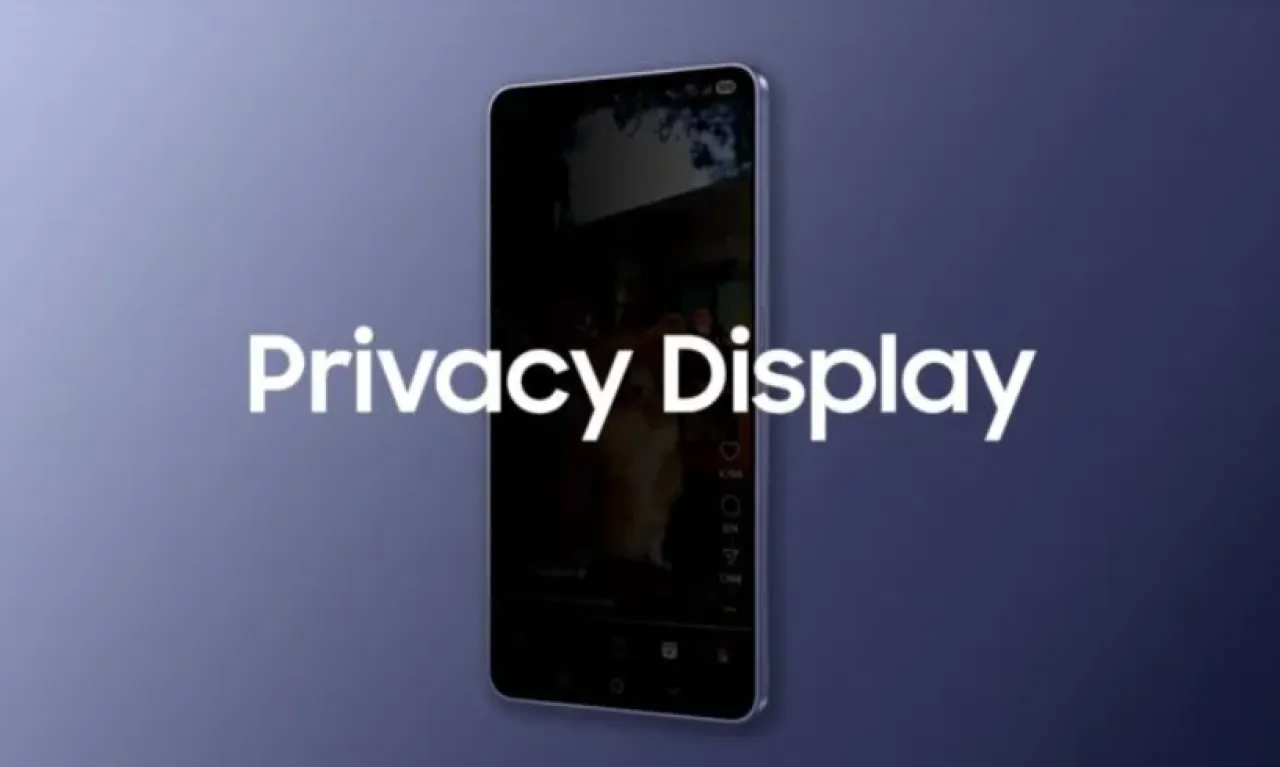
In realization of its architectural vision, Samsung Electronics has ensured the development of the phone relying on the built-in Privacy Display technology in the display structure itself, a technology that controls how light emitted from pixels spreads, where tight-directional pixels direct light straight ahead, while wide-spread pixels distribute light across wider angles for a natural viewing experience.
Thus, the company introduced for the first time in a smartphone a "Privacy Mode", which reduces thanks to the types of pixels in the screen, others' intrusion on the user’s phone content, and limits their ability to detect it from a side viewing angle, while remaining completely clear to the user facing the screen, a precedent that transforms the screen from a display surface to a smart optical system that controls how light reaches the eye, and thereby how it protects the information displayed on it at the same moment.
Smart flexibility that protects your privacy without isolating the user
Because true privacy for the company does not mean sacrificing ease of use, it designed the privacy on the phone to be fully flexible and customizable depending on the context of use, and not designed as a permanent mode that restricts the experience, so it can be activated during the entry of a PIN or password, or customized to work within specific applications such as messaging or banking applications, and can be confined to sensitive notifications without affecting the rest of the displayed content, meaning the ability to share a video clip with friends naturally, without any restrictions on viewing angles, but when a private notification arrives, that notification alone is blocked from others' eyes.
Stronger protection without compromising display quality
Enhancing the protection that not only blocks the sides when Privacy Mode is activated but also covers viewing angles from the top and bottom as well, significantly raises the level of visual protection, providing the user with a high level of advanced privacy without paying the price from the visual experience quality expected from a premium and flagship phone, unlike traditional solutions like external privacy screens, which often affect the display quality, making the screen less bright or clear, and typically only blocking the view from the sides in most cases.
An extension of a comprehensive security system
With the integration of the Privacy Display feature in the Galaxy S26 Ultra, the company moves protection to a new dimension, not just protecting data within the system, but protecting what appears on the screen at that moment, since this innovative feature comes as part of a broader security system adopted by Samsung Electronics in its flagship phones, including the Samsung Knox platform, which is a multi-layered security platform that provides protection at the hardware and software levels, isolating sensitive data and protecting it from advanced threats.
This integration between digital security and visual security reflects a clear strategic vision that protection must be comprehensive, proactive, integrated, and connected to all details of the user experience, invisible but always present.
In fact, the Galaxy S26 Ultra alone can offer; as it embodies the idea that real innovation is not only about what the user sees on the screen, but also about who cannot see it, and this is the approach through which Samsung Electronics translates its belief that privacy is a fundamental right of the user, and advanced technology should operate smoothly and intuitively without complicating the user's life.