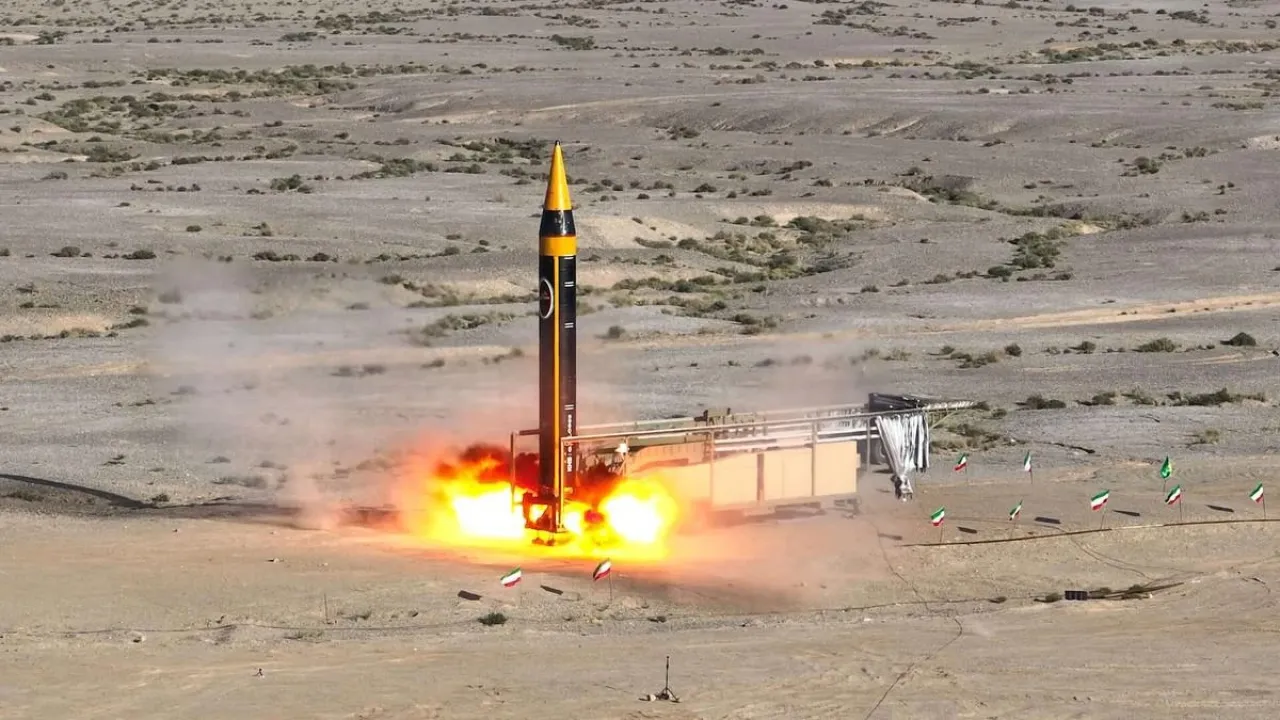
Khaberni - In the era of advanced military technology, ballistic missiles are considered one of the most controversial and interesting weapons, due to their ability to travel thousands of kilometers at high speed and achieve astonishing accuracy in hitting targets, but what makes these missiles precise and effective?
The Rocket's Journey
Ballistic missiles usually go through three main stages on their long journey. The first stage is the boost phase, where the missile begins its journey from a ground platform, submarine, or mobile vehicle, and its rocket engine, using either solid or liquid fuel, propels it rapidly to a high altitude or out of the atmosphere. This stage lasts only a few minutes, after which the boost part separates.
The second stage is the free flight, which is the longest in terms of time, where the rocket or warhead moves in space approximately along a ballistic trajectory that depends on gravity and the velocity it has gained. In some modern missiles, this may include several warheads or decoys to evade air defenses.
The third stage is the re-entry phase, where the warhead re-enters the atmosphere at a tremendous speed, endures intense heat due to friction, and the success of hitting the target relies on the accuracy of the calculations made during the boost phase and the guidance systems.
Guidance Techniques
Most ballistic missiles rely on inertial guidance systems that use gyroscopes and accelerometers to precisely determine position and speed without the need for external signals.
With technological advancements, some modern missiles have begun to utilize satellite signals to correct deviations and improve accuracy, while some advanced warheads can make minor adjustments during the descent to ensure higher precision in hitting the target.
Types of Missiles
Ballistic missiles are classified by range into short and medium range, and intercontinental, which can travel more than 5500 kilometers.
Regardless of their types, these missiles remain a pivotal strategic tool, as nations rely on them for their defensive and offensive capabilities, making understanding their technology crucial for both civilians and military personnel alike.
Missiles can carry conventional warheads containing ordinary explosives like TNT or highly explosive materials, and are used to strike military targets or infrastructure. They can also carry nuclear warheads, which are the most destructive type, and can be built with varying capacities from tens of kilotons to several megatons.
Nuclear warheads are typically used in intercontinental and medium-range ballistic missiles, and some advanced types can be designed with multiple independently targetable warheads, so that each warhead separates and targets a different point, increasing the missile's ability to overcome defenses.
In addition, ballistic missiles can carry chemical or biological warheads containing dangerous chemical or biological agents, which are banned from use under international treaties.
In conclusion, ballistic missiles are not just weapons, but advanced technological artifacts where physics, engineering, and military strategy intersect. Their accuracy and efficiency depend on precise design, sophisticated guidance systems, and the ability to withstand harsh conditions, making them symbols of technological and defensive power in the modern world.