Khaberni - The United States and Israel began striking Iran on Saturday, a move that plunges the Middle East into a new conflict, according to President Donald Trump, one that will end a security threat to the United States.
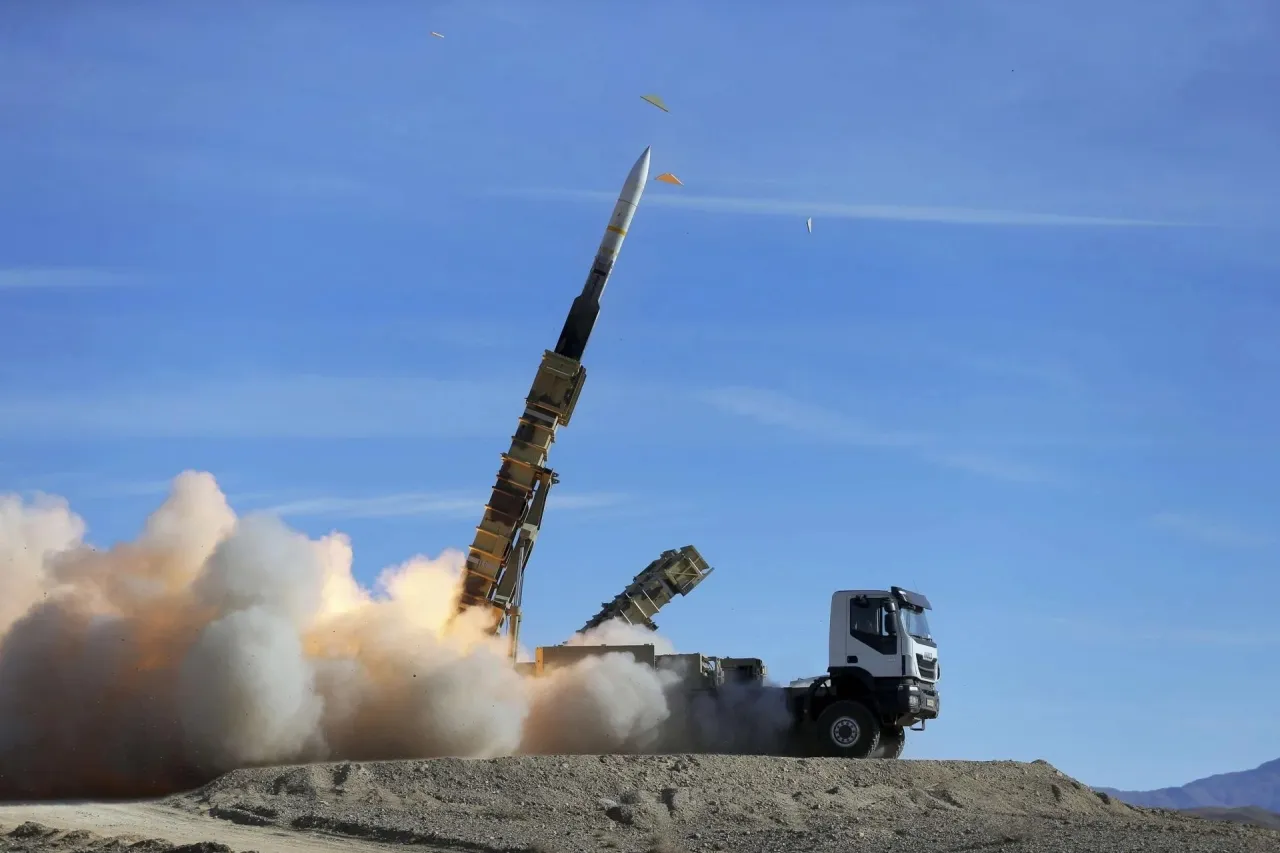
The Israeli military announced that Iran had fired missiles toward Israel. What are Iran's capabilities in the field of ballistic missiles:
Types and range of Iranian missiles
The US Office of the Director of National Intelligence states that Iran possesses the largest stockpile of ballistic missiles in the Middle East. The declared range of their missiles is about 2000 kilometers, which Iranian officials deem sufficient to protect the country as it can reach Israel.
Many Iranian missile sites are located around the capital Tehran and its suburbs. There are at least 5 known "missile cities" underground in various provinces including Kermanshah and Semnan, as well as near the Gulf area.
According to the Center for Strategic and International Studies, Iran owns a number of long-range ballistic missiles that can reach Israel.
The list includes the Sejjil missile with a range of 2000 kilometers, Emad with a range of 1700 kilometers, Qadr with a range of 2000 kilometers, Shahab-3 with a range of 1300 kilometers, Khorramshahr with a range of 2000 kilometers, and Houijeh with a range of 1350 kilometers.
In April 2025, the semi-official Iranian Student News Agency published a graphic showing 9 Iranian missiles capable of reaching Israel.
These missiles include the Sejjil missile, which the agency said can fly at speeds exceeding 17,000 kilometers per hour and has a range of 2500 kilometers, the Khyber missile with a range of 2000 kilometers, and the Haj Qasem missile with a range of 1400 kilometers.
The Arms Control Association, a Washington-based research institute, states that the Iranian ballistic arsenal includes the Shahab-1 missile, which has a range of about 300 kilometers, the Zolfaghar missile, with a range of 700 kilometers, and the Shahab-3 missile, which range varies between 800 and 1000 kilometers, in addition to the Emad-1 missile, still under development with an expected range of 2000 kilometers, and a version of the Sejjil missile under development expected to have a range between 1500 and 2500 kilometers.
Iran says its ballistic missiles are a significant deterrent and retaliatory force against the United States, Israel, and other potential regional targets.
A 2023 report by Behnam Ben Taleblu, a senior fellow at the Foundation for Defense of Democracies based in the United States, states that Iran continues to develop underground missile warehouses equipped with transport and launch systems, as well as centers for missile production and storage.
The report added that in June 2020, Iran launched a ballistic missile from underground for the first time.
The report states that Iran, by dismantling foreign missiles and studying their components, has learned how to modify and manufacture enhanced versions of them.
This has allowed them to lengthen missile structures and use lighter materials, which helped increase the range of the missiles.
In June 2023, Iran unveiled what officials described as their first domestically produced hypersonic ballistic missile.
Hypersonic missiles can fly at speeds at least 5 times faster than the speed of sound and on varying trajectories, making them difficult to intercept.
The Arms Control Association says that the Iranian missile program relies heavily on North Korean and Russian designs and has benefited from Chinese assistance.
Iran also possesses cruise missiles like the KH-55 air-launched missiles capable of carrying nuclear warheads with a range of about 3000 kilometers.