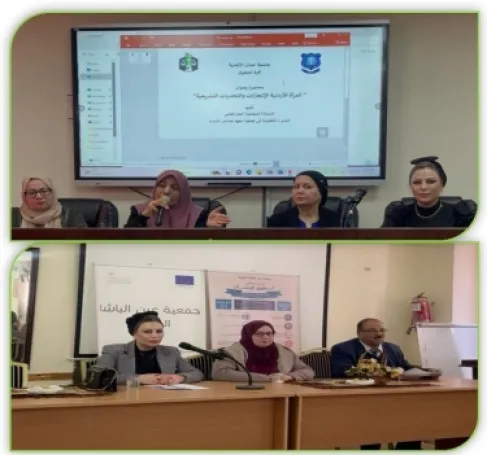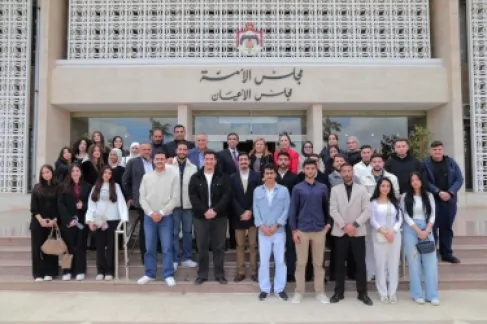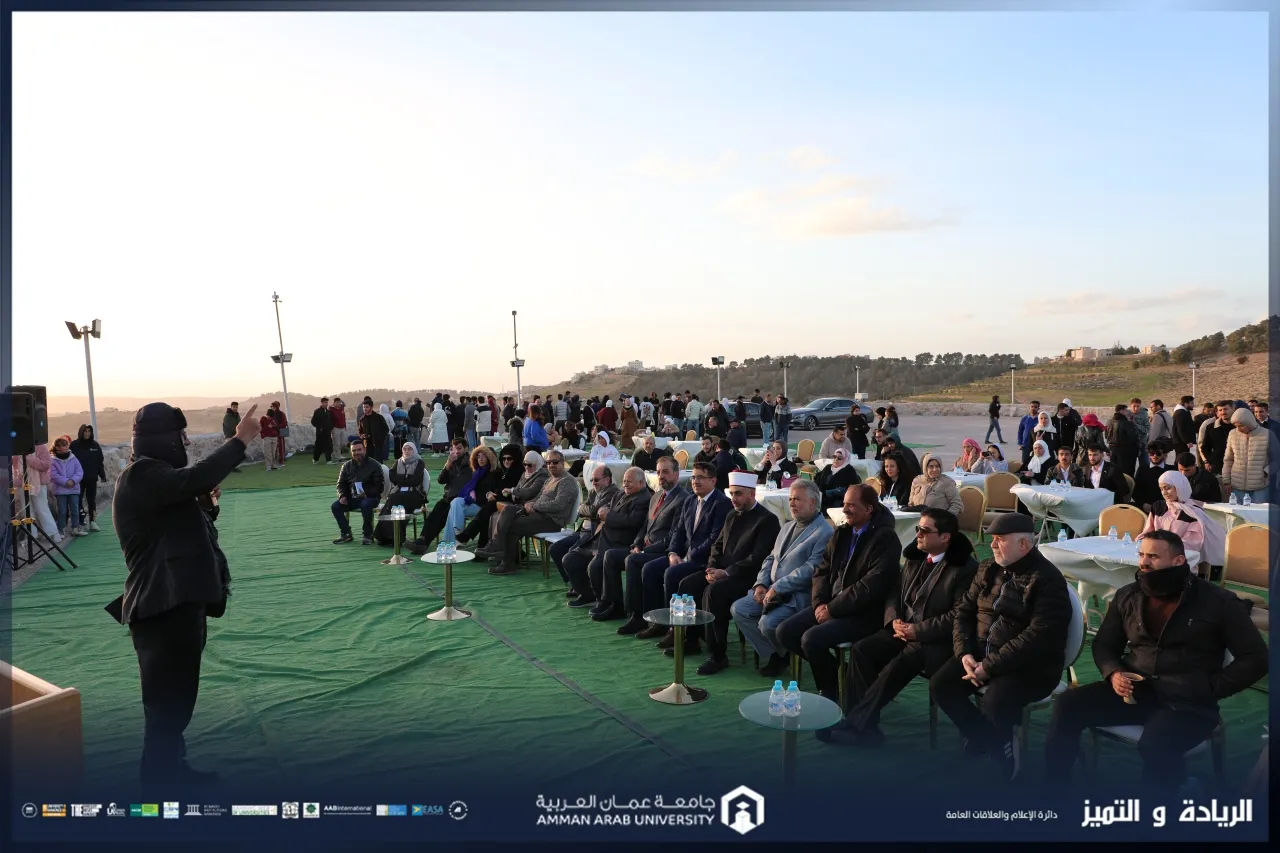
Khaberni - Stemming from its mission to serve the community and enhance integration among national institutions, Amman Arab University hosted a national event for sighting the crescent of the holy month of Ramadan on Wednesday, February 18, 2026, with the participation of the Jordanian Astronomical Society, the General Iftaa' Department of Jordan, and the Jordan Meteorological Department, attended by: Professor Dr. Hossam Al-Hamd, Vice President of the University for Planning and Quality Assurance representing Professor Dr. Mohammed Al-Widian, President of Amman Arab University, Dr. Ammar Al-Sakaji, President of the Jordanian Astronomical Society, Dr. Ahmad Al-Assaf, Vice Mufti of the Hashemite Kingdom of Jordan, Engineer Raed Al-Khattab, Director of the Jordanian Meteorological Department, along with astronomy enthusiasts and astrophotographers from various community groups, in a scene that reflects the spirit of institutional cooperation and joint national work, with the participation of students from Amman Arab University, members of IEEE clubs, students from the University of Jordan, Yarmouk University, and Al-Balqa Applied University, along with members of the Jordanian Astronomical Society in an atmosphere characterized by precision, organization, and national responsibility.
In this regard, Dr. Al-Hamd mentioned that hosting this scientific gathering aligns with Amman Arab University's mission to serve the community and enhance integration among national institutions, affirming that the university believes in its pivotal role in supporting initiatives that combine scientific accuracy and Sharia reference within an organized institutional framework. He clarified that Amman Arab University is keen to be a platform for dialogue between religious, scientific, and academic entities, contributing to fostering a culture of cooperation and joint efforts, and enhancing community trust in outcomes based on evidence and verification. He emphasized the importance of utilizing such events to provide practical educational opportunities for students, enabling them to actively participate in scientific field experiments, and developing their skills in research, analysis, and scientific discipline, in line with the university's motto towards leadership and excellence.
During the event, the crescent was observed using specialized astronomical telescopes and professional high-sensitivity cameras, where the crescent's exact original images were documented, accompanied by precise observation data including the timing, geographical location, lens characteristics, and camera settings. The observation results showed that the crescent – although its astronomical age exceeded 27 hours – remains a thin, delicate crescent, in alignment with the pre-calculated astronomical projections and the scientific standards used in visibility possibility, which depend on angular elongation, altitude above the horizon, duration of stay after sunset, and illumination percentage.
The participants confirmed that this event represents a practical model of integration between the Sharia vision and the scientific approach, where the Sharia entities relied on precise astronomical data to determine the visibility possibility, while the astronomical teams undertook the task of field observation and scientific documentation, enhancing trust in the outputs and confirming the correctness of the followed procedures. The students were offered the opportunity to learn about the mechanics of aiming telescopes, adjusting coordinates, handling astronomical devices, and reading direct observational data, in a practical educational experience that contributed to fostering a culture of research, verification, and linking theoretical knowledge with practical application.
At the conclusion of the event, the participants expressed their pride in this scientific field experience, which depicted a bright image of cooperation between official institutions and the academic community, affirming that documenting the sighting of the crescent with photos and precise data reinforces the reassurance among citizens that the entry of the holy month came according to sound Sharia and scientific foundations.