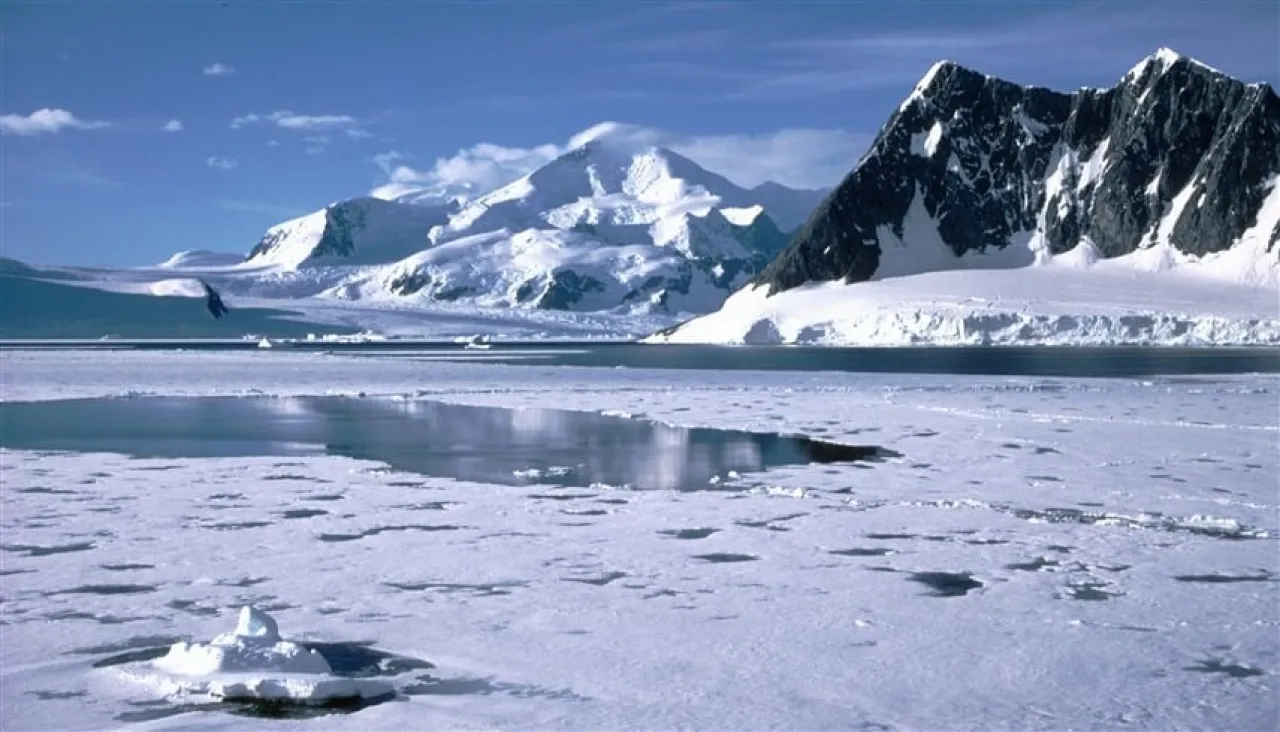
Khaberni - In a scientific discovery that opens a new window onto the secrets of life in the depths of the seas, researchers have successfully documented a rare sighting of a mysterious shark in the semi-frozen waters off the coast of Antarctica, in a scene that surprised scientists who long believed that these predators do not live in such harsh environments.
The extraordinary footage showed a huge shark moving slowly above a dark seabed, at a depth where sunlight cannot reach, estimated to be between 3 and 4 meters long, which made it look, according to scientists, like a "marine tank" silently traversing an extremely cold environment, according to "New York Post".
Marine researcher Alan Jamieson explained that his team never expected to spot sharks in that area, saying that the prevailing scientific belief was that they did not exist in the Southern Antarctic waters.
Site and depth of the discovery
The scene was recorded via a research camera belonging to the "Minderoo-UWA Deep-Sea Research Centre", associated with the University of Western Australia, off the coast of the South Shetland Islands near the Antarctic Peninsula.
The shark was observed at a depth of about 1600 feet within the Southern Ocean's icy range, where the temperature of the water approaches the freezing point, making the survival of large creatures in this environment extraordinary.
A new scientific mystery
The images published by the Associated Press also showed a stationary ray fish on the seafloor, seemingly unaffected by the shark's passage, a scene that did not surprise the scientists due to these creatures‘ known ability to adapt to cold waters.
In turn, Peter Ken, a biologist specializing in environmental conservation from Charles Darwin University, confirmed that this observation might be the first of its kind in that region, indicating that the lack of scientific data about the depths of the Southern Ocean makes such discoveries extremely important.
Is climate change behind this appearance?
Scientists believe that the warming of the oceans may push some shark species to expand southward into colder waters, although another hypothesis suggests that these sharks have been in the region for a long time without being observed due to the difficulty of reaching those depths.
Researchers believe that these sharks may feed on the remains of large marine creatures such as whales and giant squids that sink to the bottom after dying.
Secrets still hidden
Scientists confirm that the scarcity of research cameras in those depths, along with their limited operation during the summer months only in the Southern Hemisphere, means that a large part of the marine life there remains unknown.