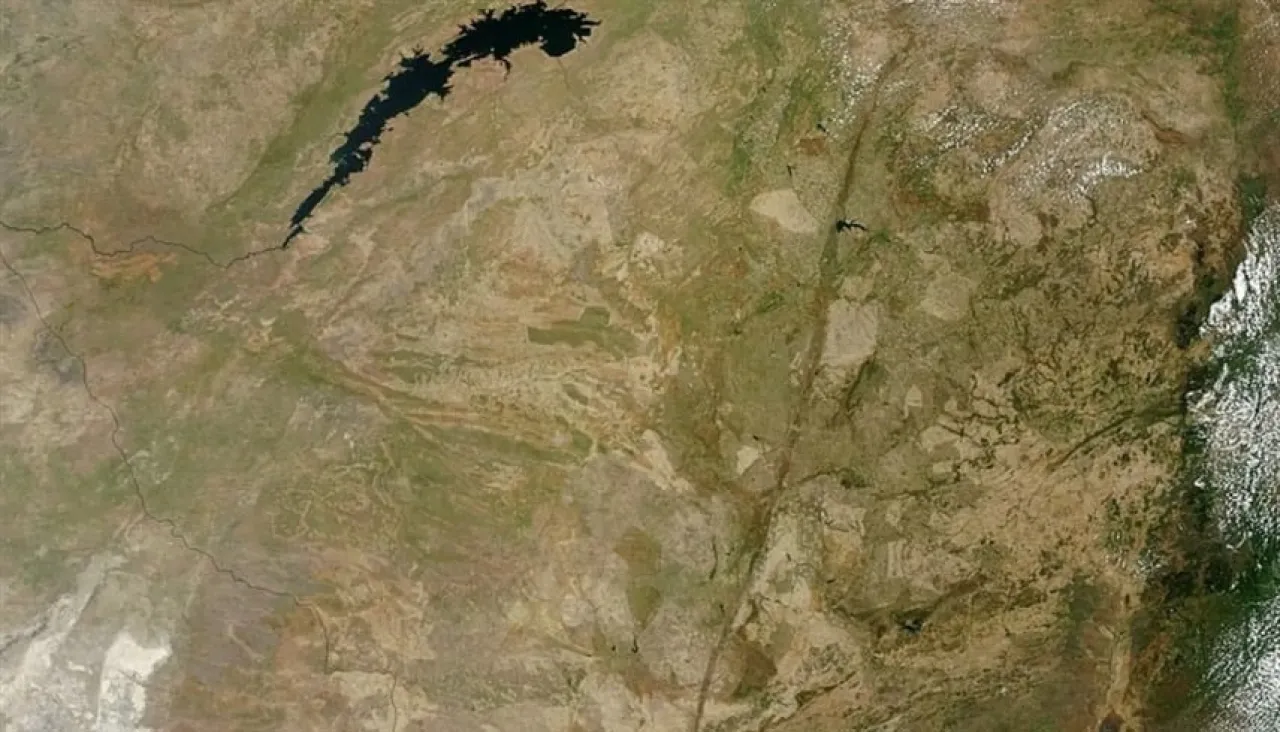
Khaberni - An astronaut recently revealed the hidden beauty of "The Great Dyke" in Zimbabwe, one of the greatest geological marvels on Earth, where this massive rocky structure stretches approximately 550 kilometers from the suburbs of the capital, Harare, in the northeast to near the city of Bulawayo in the southwest.
Despite its name, this "Dyke" is not a dam in the traditional sense, but a "lopolith" - a flat, deep, igneous rock layer that resembles a huge dish or lens - formed by magma that froze as it penetrated rock layers about 2.5 billion years ago, which is more than half the age of the Earth, according to the "Live Science" website.
The Great Dyke is considered the longest continuous igneous rock intrusion on the face of the Earth, according to the Zimbabwe Geological Survey, and includes hills that rise up to 450 meters above the surrounding plateaus, with its width varying between 3 and 13 kilometers.
A tremendous mineral wealth beneath the surface
The significance of the Great Dyke is not limited to it being a natural wonder, but its economic impact extends through its containment of rich precious minerals, including gold, nickel, copper, titanium, iron, vanadium, and tin.
The area is also renowned for its extensive platinum deposits and pure chromite, making it one of the foremost mining centers in the world.
Today, six major mines operate along this massive structure, and the suitable rocks for sculpting provide an "artists’ paradise," according to local artist Michael Nyakusvora, pointing out their similarity to Greek marble quarries.
Stunning satellite shots
Astronauts aboard the Challenger shuttle in 1983 captured images of the southern half of the structure, while NASA's Terra satellite covered its entire length in 2003, with recent pictures displaying the stunning details of the rock layers, showing how natural beauty can remain hidden for decades until discovered by humans from space.
The "Mining in Zimbabwe" website describes the Great Dyke as "more than just a line on the map, but rather a lifeline for economic opportunities and a geological marvel," combining its long earthly history, rich mineral wealth, and hidden natural beauty to become one of the most important natural landmarks that link science, economy, and art in one place.