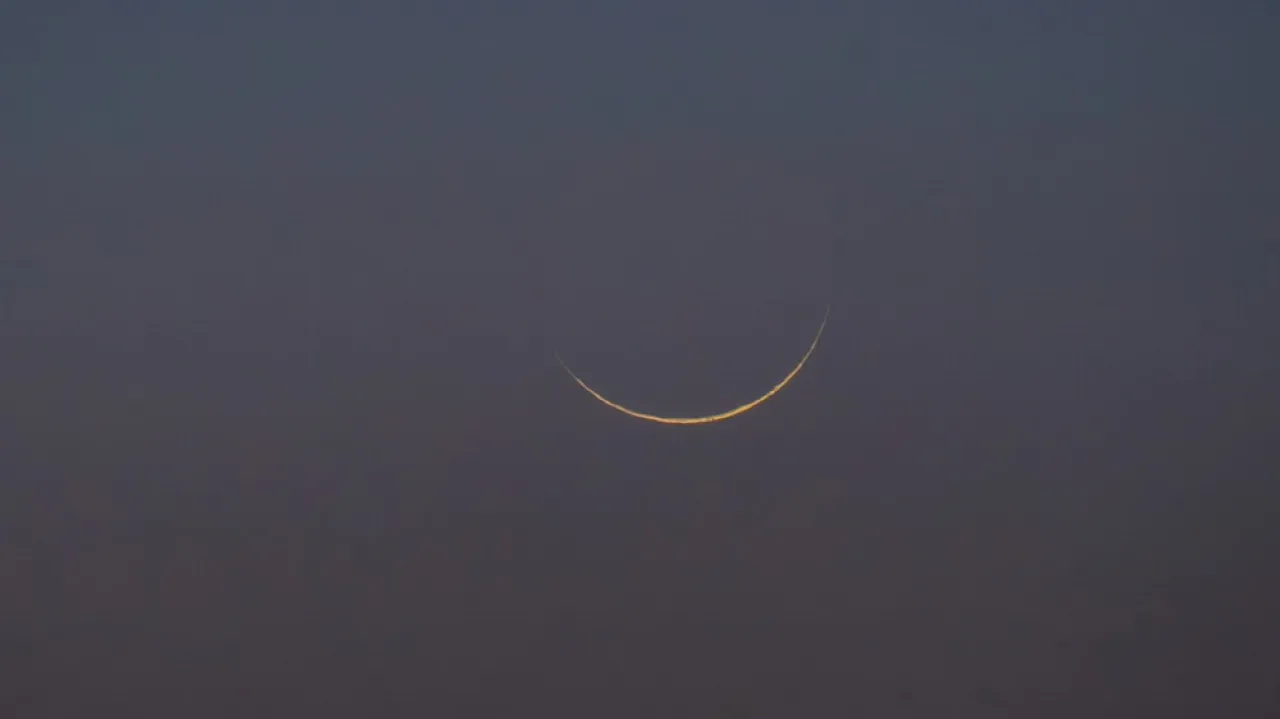
Khaberni - In Amman, on Wednesday evening, an event for photographing the crescent of Ramadan commenced, utilizing astronomical telescopes and professional high-sensitivity cameras. The crescent was documented with its complete original images, accompanied by precise observational data regarding the timing, geographic location, lens characteristics, and camera settings, according to the Jordanian Astronomical Association.
The president of the Jordanian Astronomical Association, Ammar Al-Sakaji, stated that the images clearly showed that the crescent of Ramadan – even though its astronomical age exceeded 24 hours – was still "slender and delicate," which fully aligns with the previous astronomical calculations.
Al-Sakaji explained that "the astronomical significance is not measured only by the temporal age of the crescent, but by actual visibility standards such as angular elongation, altitude above the horizon, the duration it remains visible after sunset, and the percentage of illumination."
The event, held at Amman Arab University, represents a practical model of the integration between the legal view and the scientific approach, with the Department of Ifta' relying on precise astronomical data to determine the possibility of sighting, while the astronomical teams took on the task of documentation and field observation, according to Al-Sakaji.
Al-Sakaji confirmed that photographing the crescent and its properties provides compelling scientific evidence of the correct commencement of Ramadan. It confirms that beginning fasting on Thursday is correct fasting in accordance with both legal and astronomical standards, "far from undocumented deliberations or mere visual impressions."
The observation and photography event involved the General Ifta' Department, the Jordanian Meteorological Department, and the Jordanian Astronomical Association, along with dozens of students, enthusiasts, and amateur astronomers from various Jordanian universities.
The event was attended by students from the University of Jordan, Yarmouk University, and Al-Balqa Applied University, as well as students from Amman Arab University and members of IEEE clubs and Jordanian Astronomical Association. The atmosphere was characterized by precision, discipline, and a desire for verified observation.
The event was notably youthful, with students from various academic disciplines participating, adding an important educational and formative dimension to the event. Students had the opportunity to learn about how telescopes are aimed, coordinate adjustments, taking astronomical photos, and directly reading observational data from devices.
The organizers confirmed that such activities contribute to the establishment of a culture of scientific documentation and enhance confidence in national institutions, linking new generations to a methodology based on evidence and verification.
This event sent a clear message that Jordan, with its religious and scientific institutions, adheres to a robust approach that blends text and precise scientific deliberation, and it strives to unify discourse and present documented evidence to the public, according to Al-Sakaji. He noted that the event embodied the spirit of cooperation between official institutions, the academic community, and scientific associations, reflecting a sophisticated national awareness in handling legal issues with an astronomical dimension.
Participants also affirmed that sighting the crescent and documenting it with precise images and data represent the highest forms of commitment to the scientific method, reinforcing the public's confidence that their fasting is based on solid and well-established foundations.