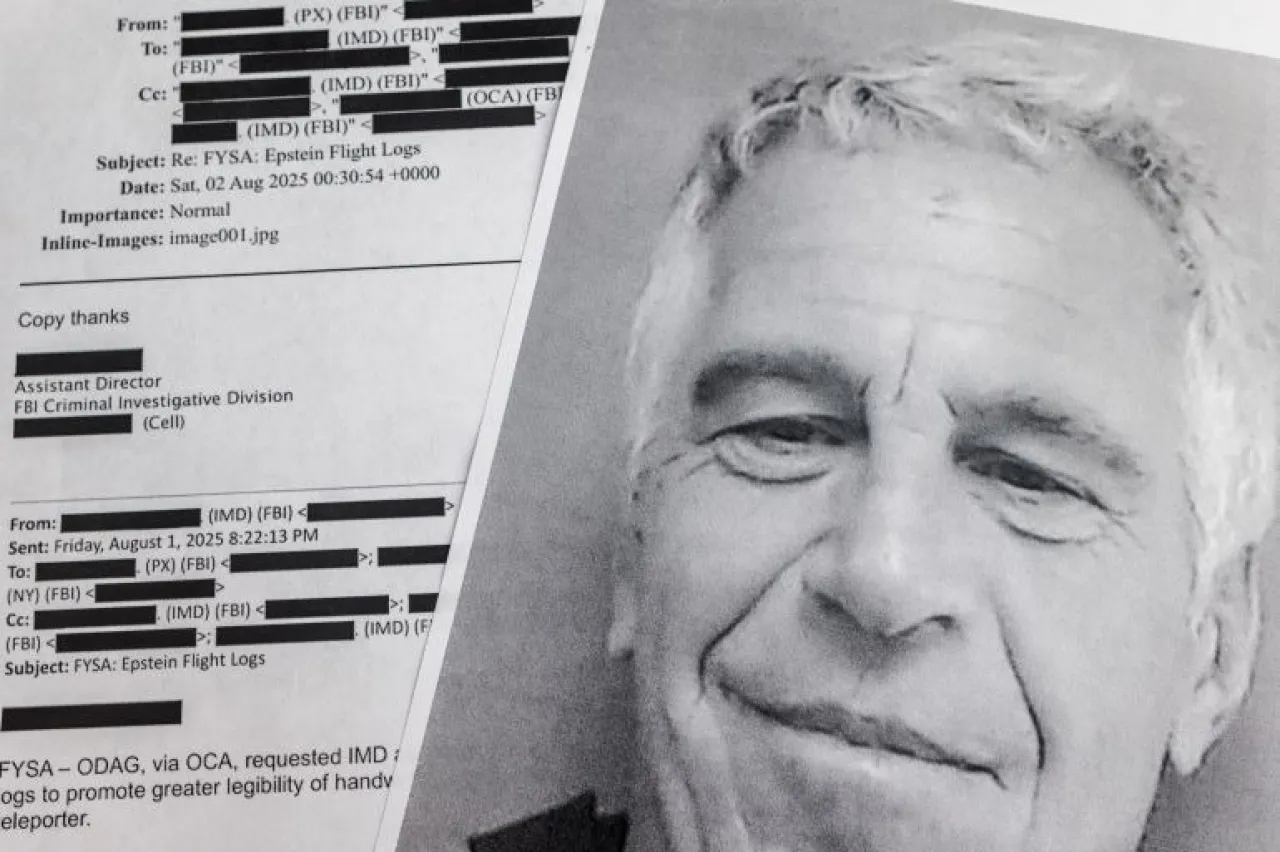
Khaberni - When an emerging hedge fund manager in Palm Beach contacted Jeffrey Epstein, on February 2, 2016, and wrote to him: "Eva Dubin gave me your email to follow up on the Peter Thiel meeting we briefly discussed," it was not merely a message exchange, but a step that opened up major financing opportunities.
Epstein responded on the same day and set a meeting two days later, according to documents released by the US Department of Justice and reported by Bloomberg.
Eva Andersson-Dubin, a Swedish-American doctor and wife of hedge fund manager Glenn Dubin, had a previous relationship with Epstein, who was convicted in 2008 of soliciting a minor for prostitution.
A Referral that Forged an Early Partnership
Bloomberg explains that the introduction was made through Eva Anderson-Dubin, Epstein’s close friend, allowing David Vizel to secure a key investor for his "Hanicomb Asset Management" fund.
The documents indicate that Epstein later became "a day-one investor and a partner in joint investments," continuing to inject millions of dollars into the fund for several years, even just before his arrest and death in 2019, although major financial institutions had severed ties with him by then.
The documents also show, according to Bloomberg, that the Dubin family played a recurrent role in introducing Epstein to hedge fund managers, and that his relationship with Eva dated back to the 1980s, before she married Glenn Dubin.
Differing Numbers about "High Bridge"
In a deposition dated 2011, Epstein said he initially invested between $50 and $100 million in "High Bridge Capital Management," later increasing his total investments to more than $300 million over the following years.
However, a spokesperson for Glenn Dubin told Bloomberg that the initial investment was only "10 million dollars," which rose to about 38 million dollars before being fully recovered in 2013.
Bloomberg reported that Epstein claimed he earned $20 million for arranging an introduction that contributed to J.P. Morgan's acquisition of "High Bridge" in 2004, adding: "I knew J.P. Morgan well, and I knew Glenn Dubin well."
Conversely, a spokesperson for Dubin described the claim that Epstein could have bought the company as "ridiculous."
Dispute over "DB Zwirn" Fund
The documents, according to Bloomberg, indicate that Glenn Dubin played the role of intermediary in Epstein's investment in the "DB Zwirn" fund. Epstein initially invested about $20 million, later increasing his allocations.
In October 2006, after discovering accounting irregularities inside the fund, Epstein demanded the return of over $140 million, later reducing his request to $80 million, leading to a financial dispute that persisted for years.
Bloomberg states that Epstein described Dubin in a 2011 letter as "a person not worthy of trust," while a spokesperson for Dubin said he had tried "to mediate the strained relationship" between the two.
Banking Restrictions and Continued Investment
Bloomberg clarifies that Epstein's banking transactions faced increasing restriction after 2011, amid escalating charges against him, and "J.P. Morgan" closed his accounts in 2013 due to regulatory scrutiny and reputational concerns.
Despite this, some hedge funds continued to manage his money. A 2019 valuation report showed entities associated with him retained more than $55 million in "Boothbay Fund Management" and over $2 million in "King Street Capital Management." Another document revealed he had invested more than $28 million in two funds belonging to "Valar," which he co-founded with Peter Thiel.
Expansion of "Hanicomb" and Then Its Decline
Bloomberg recounts that Epstein's total investments in "Hanicomb" amounted to at least $70 million, including a new investment in April 2019, mere months before his death. In an April 2017 letter, Vizel wrote to Epstein: "You are a great partner," adding that the fund was then managing "more than $325 million in assets."
The assets of "Hanicomb" rose to about $1.5 billion in 2020, before falling to $552 million in August 2025, according to Bloomberg.
Vizel later announced the closure of the fund, confirming in a letter to investors: "This is not an exit from investment," but "a reaffirmation of principle."
The documents, as relayed by Bloomberg, demonstrate that a network of personal and professional relationships enabled Epstein to continue managing tens and hundreds of millions of dollars within hedge funds until 2019, when some managers asserted that their relationship with him was "strictly a business one," while this financial entanglement remained under ongoing legal and media scrutiny.