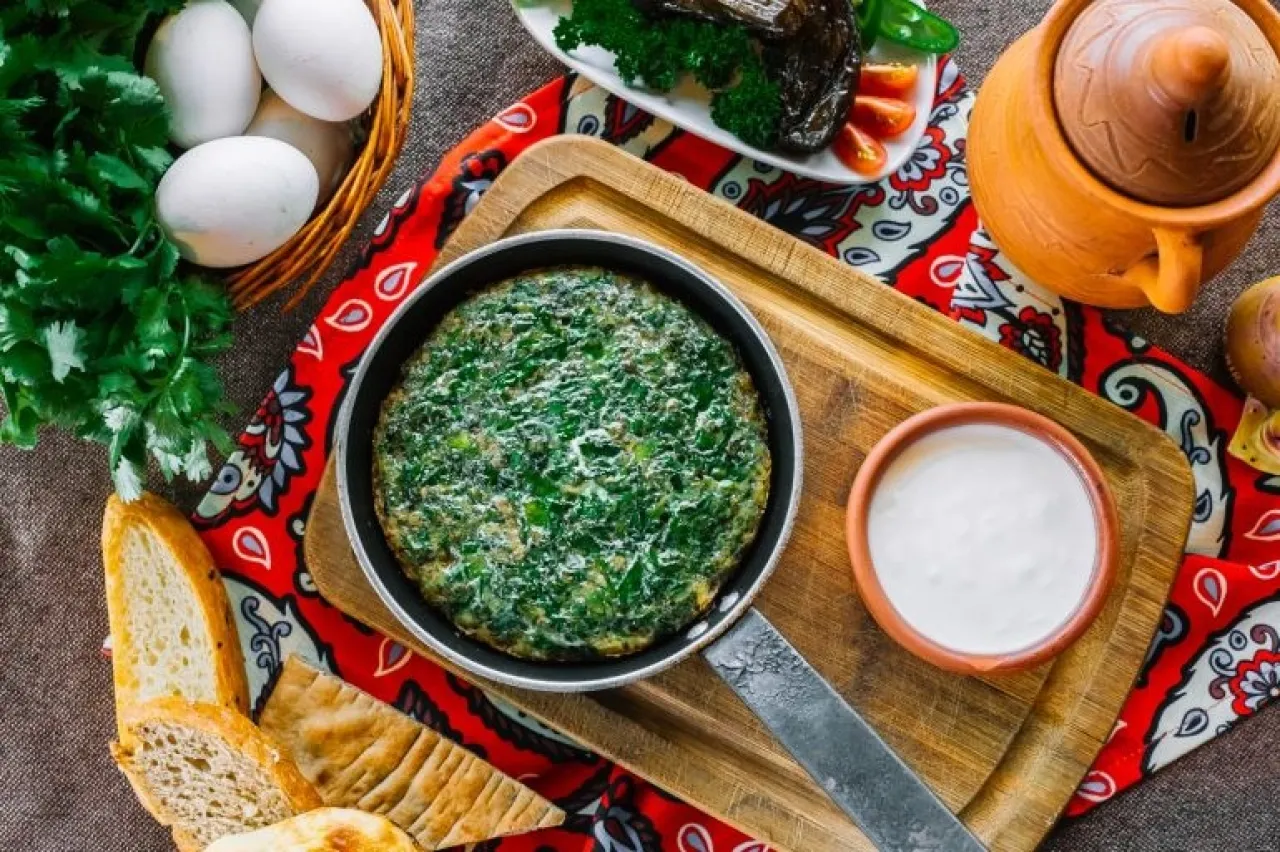
Khaberni - From the land of magic and beauty, the land of Nubia in Aswan Governorate, southern Egypt, where customs blend with heritage and the daily details transform into clear identity features, emerges the Nubian cuisine, carrying the warmth of the place and the simplicity of its people in every recipe, among these inherited recipes, the dish "Molokhia with eggs" or "Jasketi with Jakoud" stands out, according to the original naming by the Nubian people.
The Nubian Cuisine.. A Unique Signature in Cooking
Samah Abdel Momen, one of the Nubian ladies in Abu Hor village, says that the Nubian cuisine is always characterized by its unique style in cooking methods and flavor arrangement, adding that sharing these recipes to this day is an important way to preserve heritage and transmit it to the coming generations.
Samah adds to Al Jazeera Net that among the inherited dishes in Nubia, Molokhia with eggs stands out. Despite the popularity of Molokhia, or "Jakoud" as it is called in Nubia, in most Egyptian households, the Nubian method gives it a unique taste and different spirit.
Regarding the preparation of this dish, Samah explains that the ingredients of Jakoud are simple, involving a vessel containing water or broth with salt and an onion, kept on the heat until it boils, then Molokhia leaves along with some green coriander and dill leaves are added, after plucking and washing them well. A little "carbonate" is added to the mixture, and it is left over heat with care not to cover the vessel to avoid spilling.
After the vegetables are cooked, they are mashed using a "mifrak", a method different from the use of "makharta" in Cairo and the northern region, where Molokhia is grounded before being added to the water or broth.
The mashing tool in Nubia is known as "nibr" or the wooden mifrak, still used by Nubian women today in preparing "atr" or Nubian "Jakoud", and even the okra dish called Weika. It is a wooden stick, usually topped with a wooden bump shaped like a rose, held between the hands and rotated quickly inside the vessel to mash the Molokhia leaves into a distinctive creamy texture.
After mashing the Molokhia, Samah adds "Tashet", which is minced garlic fried in ghee with a spoonful of ground dry coriander. As for "Jasketi", or fried eggs, the preparation does not differ from the traditional method practiced in other places, where three eggs are beaten and poured into a pan on heat containing a little olive oil or local ghee, and the eggs are cooked until done as desired, with salt and black pepper added. In the final step, the prepared Molokhia is added to the eggs.
Nubian Douka Bread
Nubians prefer to eat "Molokhia with eggs" with thin Nubian bread known as "Aish al-Douka". This bread is prepared with simple ingredients, mixing a cup of flour with a cup of water and half a teaspoon of salt and half a teaspoon of instant yeast or baking powder until the mixture becomes slightly thinner than tahini, and after fermenting for an hour or half an hour, part of the mixture is poured onto a Douka plate and spread out just like preparing a crepe in a non-stick pan, and the Douka, present in all Nubian houses, is a circular iron plate placed over fire and the dough is spread on it.
A Complete Healthy Dish
In her capacity as a nutrition specialist, Dr. Jehad Fouad says, we all may use the same ingredients when cooking, but tastes vary from place to place and person to person, influenced by inherited customs and traditions, so the most important standard is the health benefits the meal offers.
Fouad points out that Molokhia with eggs combines great taste and high nutritional value, considering it a complete meal if prepared correctly, as Molokhia is a rich source of fibers that improve digestion, and contains Vitamin A, essential for skin and eye health, and Vitamin E, an antioxidant, along with essential minerals like manganese and phosphorus.
She adds that the "Talqiyat" consisting of garlic and dry coriander adds a health dimension to the dish, as garlic acts as a natural antibiotic and helps lower blood pressure, while coriander enhances digestion. The egg, a key part of the recipe, is among the best sources of complete protein, containing all essential amino acids, and is also rich in choline, which supports brain health, and vitamins B12 and D.
Fouad confirms in her talk to Al Jazeera Net that this dish is nutritionally complete when eaten with whole wheat bread or Nubian Douka bread, provided that the ingredients are cooked well to ensure the elimination of any potential microbes, and she sees that lunch is the optimal time to eat this dish, due to the ability of fibers and proteins to provide a feeling of fullness for a long time and supply the body with energy without feeling sluggish, and she advises against eating it late at night and especially for those suffering from acid reflux, suggesting adding a few drops of lemon juice to the Molokhia to enhance iron absorption.
Between the Strange and Nutritional Sustainability
Dr. Fouad concludes her talk by pointing out that what may seem strange or unfamiliar to some (adding Molokhia to eggs) is in fact a model of nutritional sustainability practiced by ancient societies, using simple and available ingredients to maximize nutritional value. She affirms that adding eggs to Molokhia is a smart way for Nubian women to increase protein content at a lower cost than meat while maintaining harmony in taste and texture, making Molokhia with eggs a healthy and balanced heritage meal.