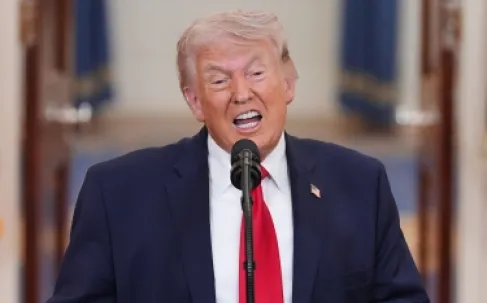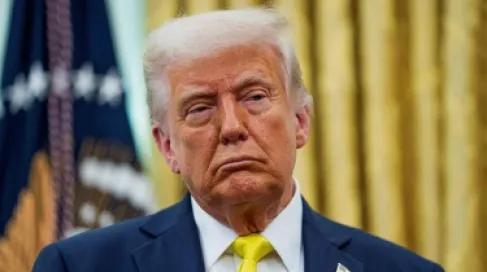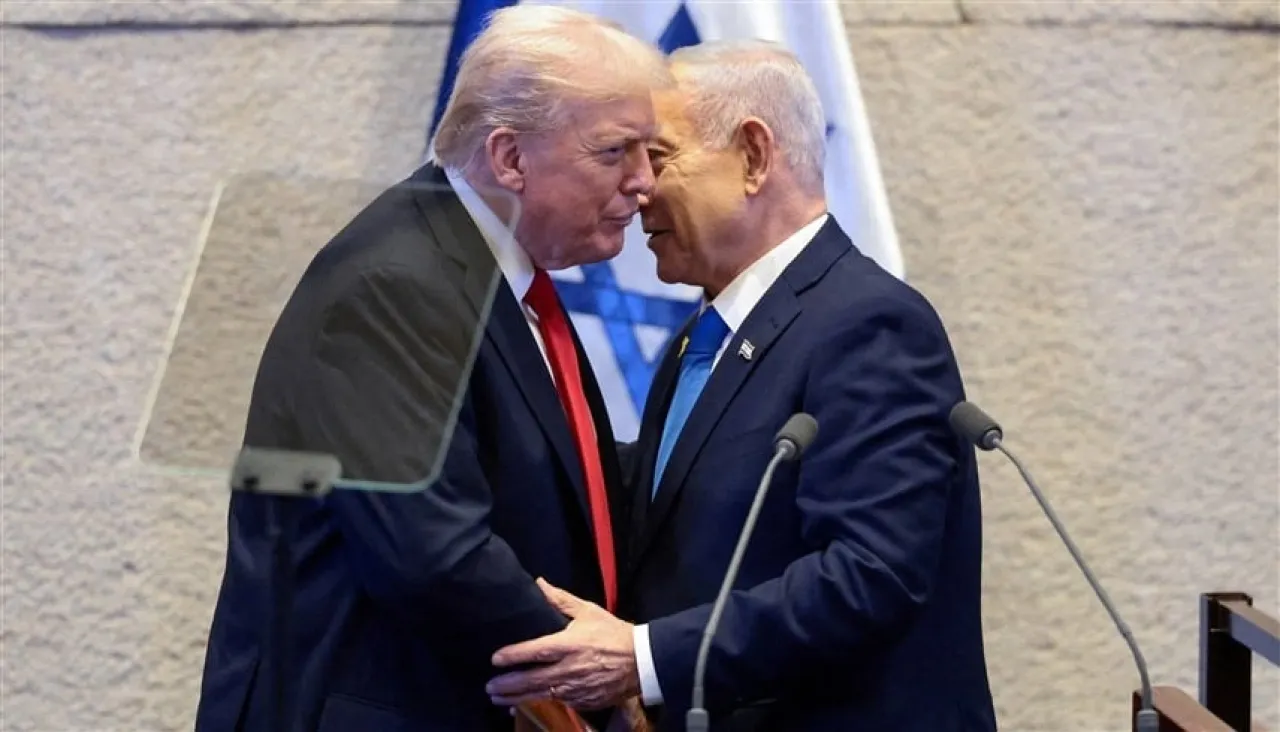
Khaberni - U.S. President Donald Trump held talks with Israeli Prime Minister Benjamin Netanyahu on Wednesday, discussing the latest negotiations between the United States and Iran, saying he informed Netanyahu that negotiations with Tehran would continue to see if an agreement could be reached.
It was expected that the Prime Minister would press during his meeting with Trump for an expansion of the American talks with Iran to include imposing restrictions on Tehran's missile arsenal and other security threats that go beyond its nuclear program.
In his seventh meeting with Trump since the U.S. President returned to office about 13 months ago, Netanyahu will seek to influence the next round of U.S. talks with Iran following the nuclear negotiations that took place in Oman last Friday, amid rising tensions in the Middle East.
Three-Hour Meeting
The leaders met for nearly 3 hours, and Netanyahu's arrival at the White House was less noisy than usual, with no meeting with journalists.
Trump threatens to strike Iran unless an agreement is reached, while Tehran threatens to retaliate if attacked, raising fears of a broader regional war.
Trump always expresses his support for the security of Israel, a close ally of the United States in the Middle East and a sworn enemy of Iran.
Trump repeated his warning in a series of media interviews last Tuesday, saying that while he believes Iran is looking to reach an agreement, he intends to take "a very firm action" if it is refused.
Trump wrote on Truth Social platform today after his meeting with Netanyahu "No final decision was reached except my insistence on continuing negotiations with Iran to see if an agreement can be made."
He added, "If possible, I will inform the Prime Minister that this would be a preferred option."
He added: "Last time, Iran decided it was better for them not to reach an agreement and faced American strikes", and continued: "I hope this time they will be more rational and responsible."
Netanyahu's Stakes
For his part, Netanyahu "emphasized the security needs of the State of Israel in the context of negotiations" between the United States and Iran.
His office stated in a statement that the leaders "agreed to continue close coordination and communication between them."
Before arriving in the United States, Netanyahu said that negotiations between Washington and Tehran should include the Iranian missile program and freezing support for the "Iranian axis," i.e., the armed groups supported by Tehran in the Middle East.
The Iranian ballistic missiles concern Israel, which is no more than two thousand kilometers away from the Islamic Republic, putting it within the range of these missiles.
Israeli officials warn that Iran is capable of striking Israel without prior notice, and it can also exhaust Israel's air defense systems by launching intense missile barrages in a prolonged conflict.
Netanyahu asserts that military action is the only way to permanently solve the Iranian nuclear issue.
No Nuclear Weapons, No Missiles
Earlier, Trump told Fox Business that a good agreement with Iran means "no nuclear weapons, no missiles," without providing further details.
He also told Axios that he is considering sending a second aircraft carrier group as part of major reinforcements of U.S. forces near Iran.
Informed sources indicated that Israel is concerned about a potential U.S. effort to reach a limited nuclear deal that does not include restrictions on Iran's ballistic missile program or an end to the Islamic Republic's support for allied armed groups like Hamas and Hezbollah.
Israeli officials urged the United States not to trust Iran's promises.
One source mentioned that the leaders might also discuss the possibility of military action in case diplomacy between the United States and Iran fails.
Iran said it is ready to discuss imposing restrictions on its nuclear program in exchange for lifting sanctions, but it ruled out linking this issue with missiles.
Ali Shamkhani, advisor to Iran's Supreme Leader, said today, Wednesday, "The missile capabilities of the Islamic Republic are non-negotiable."
Peace Council
During Wednesday's meeting with U.S. Secretary of State Marco Rubio, Benjamin Netanyahu endorsed Israel's participation in the "Peace Council" chaired by Donald Trump, according to his office.
The Prime Minister did not wait for the official opening meeting in Washington for this new council, which was established on February 19.