Khaberni - Millions of Muslims around the world are anticipating the moment of sighting the crescent of the holy month of Ramadan, marking the beginning of the fasting month and spirituality, in a renewed atmosphere of faith each year.
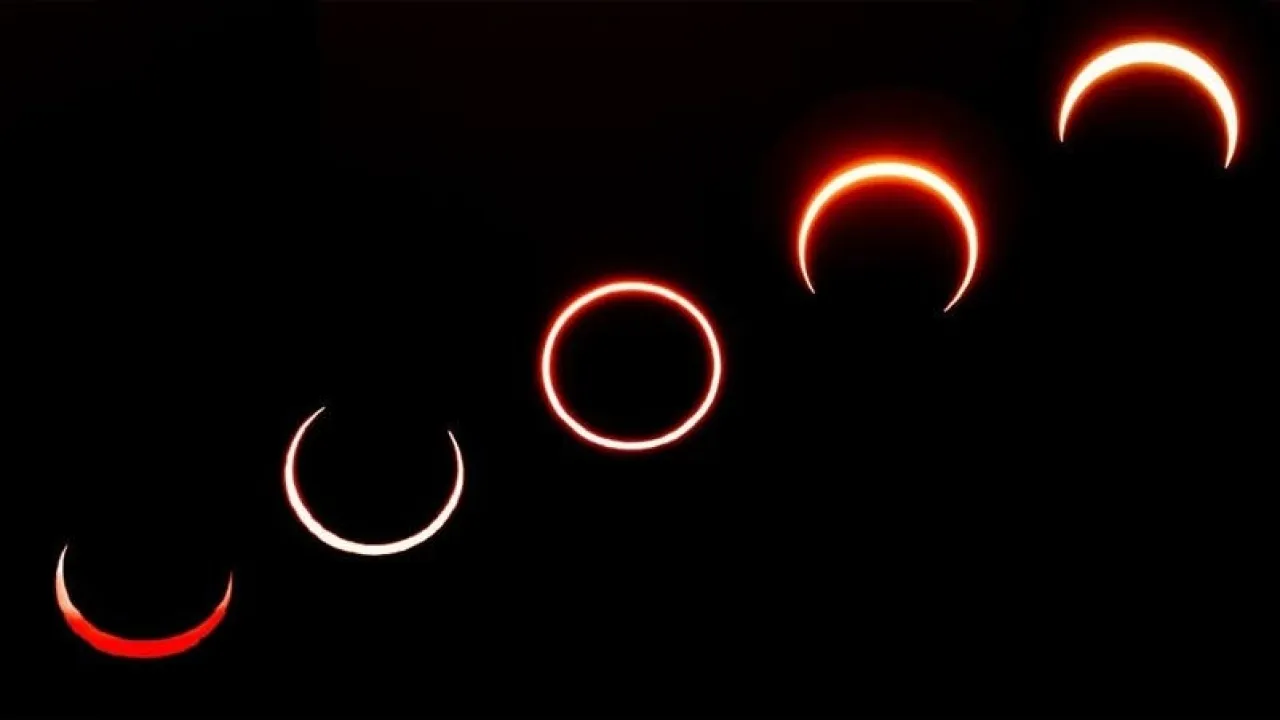
This year coincides with a notable astronomical event, as the upcoming Tuesday, February 17 (February), witnesses an annular solar eclipse, which happens on the same day as the sighting of the crescent of Ramadan, in a rare scene that combines two events carrying both religious and scientific significance simultaneously.
So, does this eclipse affect the sighting of the crescent of Ramadan?
For his part, Dr. Mohamed Ghareeb, a professor at the National Research Institute of Astronomy and Geophysics, said in a special statement to "Alarabiya.net" and "Alhadath.net", that the occurrence of an annular solar eclipse is an astronomical indication of the moon's conjunction with the sun and the beginning of the lunar month astronomically, although the Hijri month in Islamic law is calculated from crescent to crescent, not just based on the eclipse or conjunction phenomenon.
Two separate phenomena
He confirmed that the annular solar eclipse does not completely obstruct the sighting of the crescent of Ramadan, clarifying that the two phenomena are separate in terms of their practical impact on the observation process, and that sighting the crescent depends on other factors, such as its duration after sunset, its height above the horizon, and weather clarity.
He pointed out that the last annular eclipse was not seen in the Arab region at all, as its full appearance was confined to the Antarctic continent, while it was seen partially in some regions of Argentina and Chile only, and had no visual impact in Arab countries.
Ring of light
He clarified that the annular eclipse occurs when the moon is positioned between the sun and the Earth at the moment of conjunction, blocking the sun's disk without completely covering it, due to the moon being at a relatively farther point from the Earth, making its apparent size smaller than that needed to fully cover the sun, causing the sun to appear as a bright ring surrounding the black disk of the moon, hence it is called an "annular eclipse".
He added that the duration of this type of eclipse is relatively short, and may last up to about two minutes in some areas, as occurred within the full visibility range in the Antarctic continent, confirming that such phenomena undergo precise astronomical calculations and are not linked to any exceptional changes that affect the regularity of the lunar months or the process of sighting the crescent.