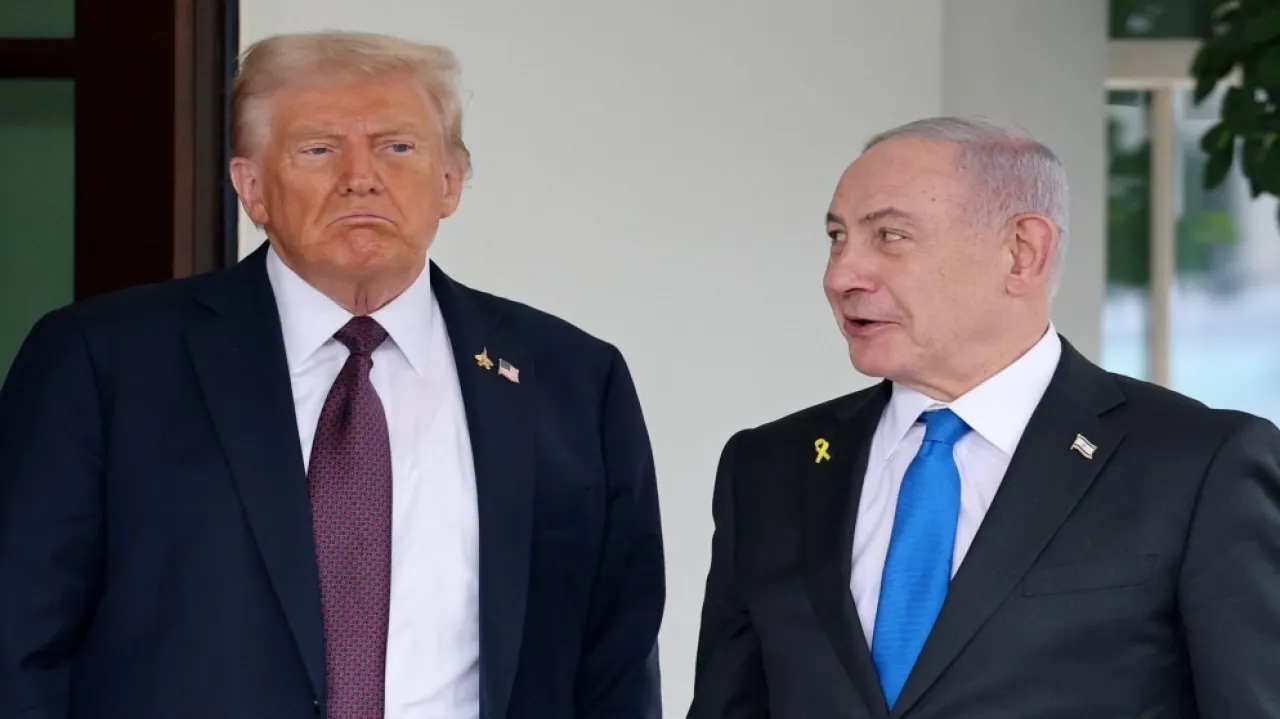
Khaberni - Israeli Prime Minister Benjamin Netanyahu arrived at the White House on Wednesday to hold talks on Iran with US President Donald Trump.
A black SUV carrying Israeli and American flags transported Netanyahu through a side road from Blair House, a nearby guest house where visiting dignitaries stay.
On Wednesday, US President Donald Trump welcomed Israeli Prime Minister Benjamin Netanyahu, who seeks to persuade him to exert maximum pressure on Iran.
Prior to this meeting, Trump sent mixed signals, expressing hope to reach an agreement with Iran, while also militarily threatening it.
This meeting is the seventh since Trump's return to the White House, with their last meeting having taken place at Trump's residence in Mar-a-Lago, Florida, in late December.
The meeting follows days of negotiations between Iran and the United States in Oman, after which Trump announced a second round of talks would follow.
On Wednesday, Iranian President Masoud Bazshkian announced that his country is ready for "any operation to verify" the peaceful nature of its nuclear program, reiterating that it does not seek to possess nuclear weapons.
Bazshkian stated on the forty-seventh anniversary of the Islamic Revolution, "We are not in pursuit of nuclear weapons. We have repeatedly stated this," emphasizing at the same time that his country "will not succumb to excessive demands."
Iranian Missiles
Netanyahu said that any negotiations between Washington and Tehran should include restricting the Iranian missile program and freezing support for the "Iranian Axis," i.e., the armed groups that Tehran supports in the Middle East.
Iranian ballistic missiles worry Israel, which is only about two thousand kilometers away from the Islamic Republic, making it within these missiles' range.
During the twelve-day war that the countries faced in June, Iran launched waves of ballistic missiles and other projectiles towards Israeli territory, hitting both military and civilian areas.
Israeli officials warn that Iran is capable of striking Israel without prior warning, and can exhaust Israeli air defense systems by launching dense volleys of missiles in the event of a prolonged conflict.
Iran still refuses to broaden the scope of its talks with the United States to include non-nuclear weaponry issues.
Before the visit, a spokesman for the Iranian Foreign Ministry, Ismail Baqai, warned on Tuesday of "destructive pressures and influences" on diplomatic efforts.
This visit is of great significance for Netanyahu, who faces early elections and needs to secure political gains.
On Wednesday, Israeli President Isaac Herzog said during his visit to Australia he hopes that the talks between Trump and Netanyahu will undermine the "evil empire" of Iran.
Trump's Stance
On Tuesday, Trump told Fox Business that he prefers to reach an agreement with Iran "that is a good one: no nuclear weapons, no missiles, neither this nor that."
He said the Iranians would be "fools" if they refused to make a deal, while also doubting the credibility of the Iranian authorities.
Trump stated to Axios that he is considering bolstering the naval force he has sent to the Middle East with a second aircraft carrier.
Guy Ziv, a professor of foreign policy and global security at the American University in Washington, believes that Trump wants to demonstrate that any agreement he reaches will be much better than the Vienna agreement made under Barack Obama in 2015, from which Trump withdrew in 2018.
He told Agence France-Presse, "One way to achieve this is to include the missile issue."
Oman Talks
After the first round of talks on February 6 in Oman, Washington and Tehran said they were keen to continue the dialogue, although their positions appear far apart.
Iran says the negotiations will only cover its nuclear program, while Washington wants it to also address the ballistic missile program.
The meeting also coincides with escalating international reactions to Israeli measures aimed at deepening control of the occupied West Bank, especially by allowing Israelis to purchase land there and weakening the Palestinian Authority.
An official in the US administration reiterated on Monday evening Trump's stance "opposed to Israel's annexation of the West Bank."