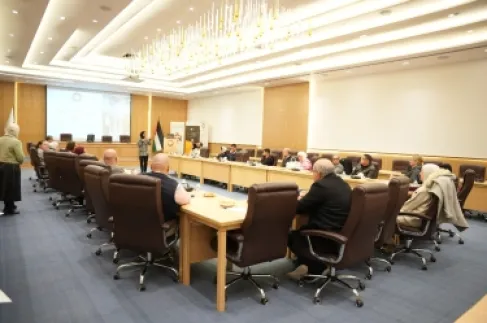
Khaberni - The Minister of Justice, Bassam Talhouni, chaired on Wednesday, the first meeting of the Expertise Affairs Regulation Council for the year 2026, attended by the council members, where various regulatory and technical files listed on the agenda were reviewed and the council's action plan for the current year was approved.
Talhouni underlined at the beginning of the meeting the pivotal role played by the Expertise Affairs Regulation Council in developing the expertise system and enhancing its efficiency, which contributes to reinforcing the principles of justice and transparency, and improving the quality of specialized technical reports provided to judicial and official authorities.
He emphasized the need to continue updating the regulatory and legislative frameworks governing the work of experts, aligning them with best professional practices and enhancing trust in the expertise sector.
During the meeting, the council discussed a series of main topics, notably the reconsideration of procedures related to the accreditation of experts, reviewing technical committee recommendations regarding accreditation applications, in addition to addressing complaints filed against several experts and making appropriate decisions according to established legal standards.
The agenda also included reviewing reconsideration requests submitted by some applicants whether for accepting their applications or rejecting them, considering requests for changing geographical specialties, temporary suspension requests, and requests for canceling such suspensions, in addition to discussing requests to remove names of experts from the register for not meeting one of the registration conditions.
The council also discussed recommendations from the technical committee regarding the adoption of main and subsidiary expertise classifications covered by the expertise system, where the types of accredited expertise were expanded to become (40) main expertise areas instead of (27) and (141) subsidiary expertise areas instead of (52)
The council approved a set of important decisions regulating the work of experts in courts, in addition to authorizing the Minister of Justice, who chairs the Expertise Affairs Council, to form a number of committees, notably a committee to address complaints against accredited experts, a committee for assessing expert fees, and an objections committee.
Talhouni confirmed at the end of the meeting the necessity of adhering to professional and objective standards in all procedures and decisions, following up on the implementation of recommendations within clear time frames, which ensures the development of the experts' work environment, enhances institutional performance efficiency, and achieves the highest levels of integrity and independence.
This meeting is part of the ongoing efforts made by the Expertise Affairs Regulation Council to organize the sector and enhance it, thereby boosting confidence in its outputs and supporting the journey of justice and the rule of law.
It is noted that the Expertise Affairs Council is constituted in accordance with the Expertise System in Regular Courts number 35 of 2018 and its amendments, comprising a council called (Expertise Affairs Regulation Council) chaired by the Minister of Justice and membership of the Secretary General of the Ministry of Justice for Judicial Affairs, presidents of the Courts of Appeals in the kingdom, the Bar Association president, and five individuals from relevant professions or specialties appointed by the Minister of Justice for a term of 3 years.