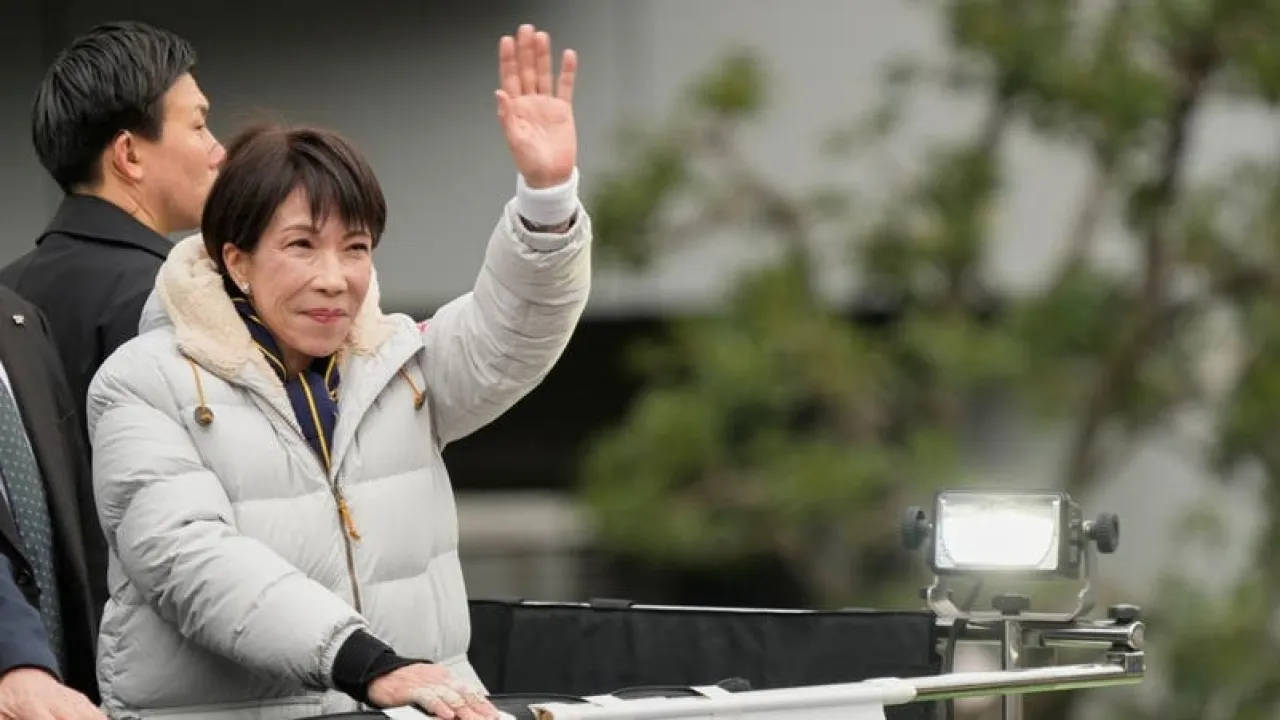
Khaberni - On Sunday, the Japanese will head to polling centers for early legislative elections expected to solidify Prime Minister Sanai Takaishi's party's status.
As the first woman to hold the government's leadership in Japan, she announced on January 19th the dissolution of the parliament and called for early elections soon, benefiting from public support for her.
Takaishi has made the election a personal test. She asked during an electoral rally, "Is Takaishi qualified to be Prime Minister? I wanted to leave the decision to the people."
The 46-year-old Prime Minister is betting on her strong performance in opinion polls to increase the Liberal Democratic Party’s (nationalist right) share, her party, while the ruling coalition currently only has a marginal majority in the parliament.
Despite a slight decline in recent weeks, her government enjoys approval ratings close to 70%, surpassing previous administrations.
Observers expect Takaishi, who has been in power since October, to succeed in her bet and lead her party to win the majority.
Polls conducted before the elections indicate that the party will comfortably pass the threshold of 233 seats needed to guarantee the majority. The ruling coalition, consisting of the Liberal Democratic Party and the Japan Innovation Party, may secure more than 300 seats out of 465.
The new centrist reform coalition, which includes a prominent opposition party, the Constitutional Democratic Party, and "Komeito," the former partner of the Liberal Democratic Party, might lose half of its current 167 seats.
Takaishi adopted a harsh rhetoric toward immigration that is likely to cut off the road for the populist "Sanseto" party, which operates under the slogan "Japanese First."
Mikitaka Masuyama, a professor of Japanese politics at the National Institute of Policy Studies, told Agence France-Presse that Takaishi "uses vocabulary that is easy to understand," while her predecessor Shigeru Ishiba "had many ideas but spoke as an academic."
Apart from the Prime Minister's personality, the electoral campaign focused on the purchasing power of the Japanese.
Professor of Political Science Hiroshi Shiratori said, "It seems that the public's concern during the electoral campaign was exclusively focused on inflation issues," which has remained above a two percent rate for about three years.
He noted that "a resounding victory for the Liberal Democratic Party would mean giving it a mandate to continue these policies."
The Prime Minister, who is the fifth person to hold this position in five years, promised to exempt food from the 8% consumption tax to mitigate inflation's impact on households.
Politically, the developments in the relationship with China remain a concern.
Takaishi caused a diplomatic crisis shortly after taking office, hinting that Japan might militarily intervene if Beijing attacked Taiwan.
On Friday, Takaishi received support from US President Donald Trump, who wrote on the Truth Social platform that she "proved... to be a strong, effective, and wise leader," adding that he "looks forward" to welcoming her to the White House on March 19.