Khaberni - The Abdul Hameed Shoman Foundation celebrated, today Saturday, the academic and researcher Dr. Zaidan Kafafi, in a symposium titled "Zaidan Kafafi.. Academically and Researcher", as part of the "Guest of the Year" program.
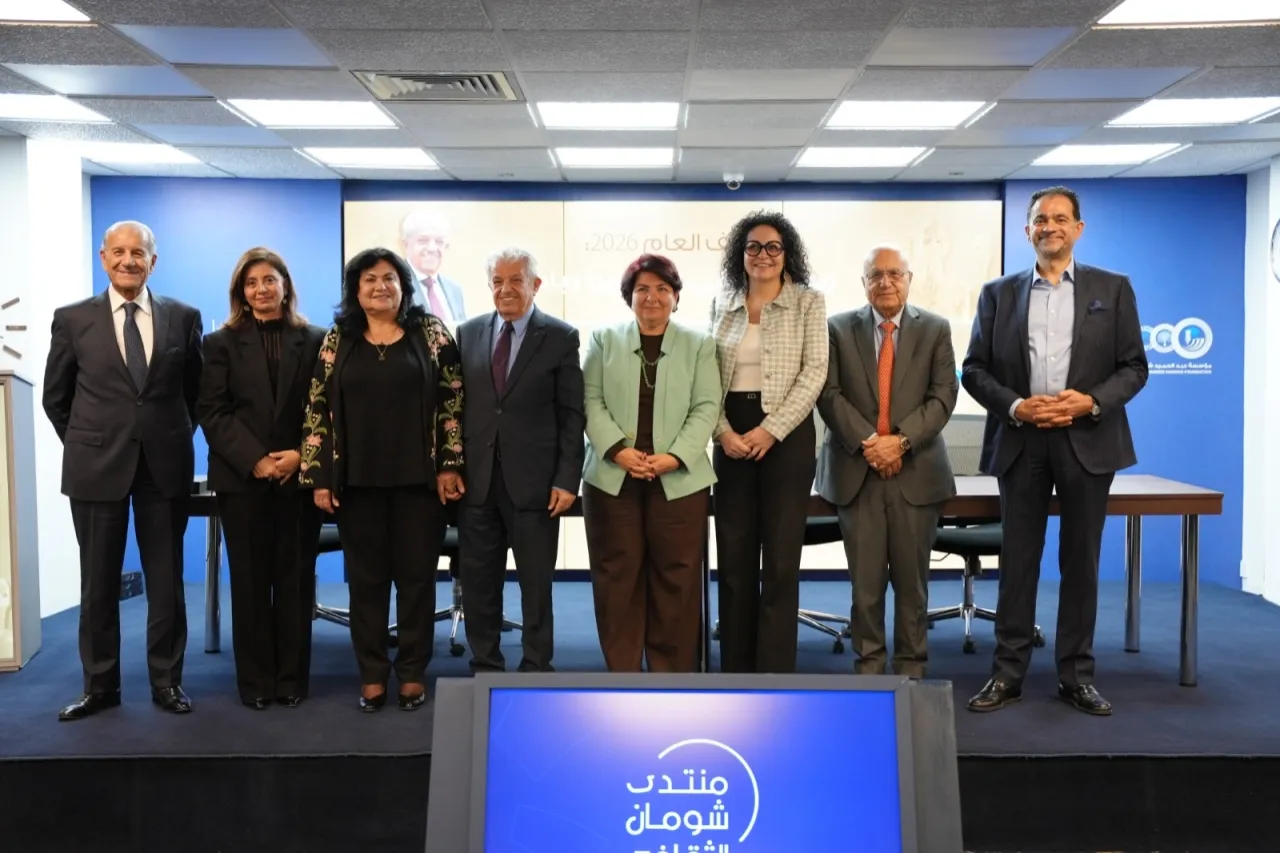
The celebration was attended by Her Royal Highness Princess Dana Firas, Sharifa Nouf bint Naser, and a selection of thinkers, academics, and stakeholders.
Valentina Qussisiya, the CEO of the Abdul Hameed Shoman Foundation, noted in her speech that Dr. Zaidan Kafafi was a unique figure in the academic world. He refused to be confined to lecture halls or theoretical authorship, rather, he sided with the field as a researcher and excavator, leading dozens of significant archeological digs at pivotal sites such as: Ain Ghazal, Al-Husn, Deir Alla, Tell Damiyah, Abu Hamid, and Jabal al-Qal'ah in Amman. These excavations brought new revelations about the world of human settlements, thus establishing him as an example of a scholar close to the land, memory, and history. His role was central in the scientific excavation and study at the site of Ain Ghazal, which contributed to positioning Jordan at the forefront of prehistoric studies in the region.
She said, "Our guest has published more than twenty books as author and editor, and 250 papers both solo and collaborative, most of which discuss the archaeology of Jordan specifically, and the Levant and the Arabian Peninsula in general, confirming him as one of the most significant pillars of archeology in the Arab world," highlighting that his scientific contributions have formed a significant reference for researchers and scholars, and his efforts have uncovered new layers of our history, deepening our understanding of the civilizations that have passed through this land. He also had a clear impact in preparing generations of students and researchers, and established values of precision, methodology, and scientific responsibility within them.
Qussisiya confirmed that the Abdul Hameed Shoman Foundation is always keen to honor science, scientists, writers, and intellectuals who have made a clear mark on public life in Jordan, in appreciation of their great efforts and their impact on our lives. The annual "Guest of the Year" program has been a significant milestone in this path that we have pursued for more than a quarter century, serving as our tool to honor scientists and intellectuals.
The celebration included a commemorative symposium comprising a series of sessions that discussed the biography and achievements of Dr. Kafafi, where in the first session, managed by Dr. Omar Al-Fajawi and titled "The Beginnings," Dr. Mohammad Adnan Al-Bakhit spoke, and his paper was titled "Zaidan Abdul Kafi Kafafi: From the village of Nuba in the Hebron Mountains to the precincts of the Jordanian University"; Dr. Hind Abu Al-Sha'r and her paper was titled "The Firm Beginnings: Zaidan Kafafi and the Jordanian University"; Ramadan Kafafi and his paper was titled "Village Phase"; and Dr. Nu'man Jibrin, with his paper titled "Zaidan Kafafi as I Knew Him as a Student at the Jordanian University."
The speakers pointed out that Dr. Zaidan is a personality closely associated with the field of archaeology both locally and internationally, known for his kindness and impeccable manners, who enlightens others with his informed thoughts and respects the thoughts of others.
They also reviewed aspects of Dr. Zaidan's beginnings in his village Nuba in the Hebron Mountains as well as his academic journey.
In the second session, managed by Dr. Omar Al-Ghoul and titled "In the Field of Work and Study", Dr. Nizam Abbasi spoke with a paper titled "From Freiburg to Berlin: Humanizing Alienation"; Dr. Hans Gebel (via video call), Dr. Suzann Kerner, and Ihab Amarin with his paper titled "Dr. Zaidan Kafafi from the Jordan Archaeological Museum to the Jordan Museum: Fifty Years of Distinctive Museum Work"; and Dr. Fawzi Abu Danneh with his paper titled "A Milestone in Zaidan Kafafi's Professional Journey: The Department of Antiquities".
They explained that the alienation that started from Freiburg and extended to Berlin was not just a geographical move or a transient phase, but a comprehensive existential experience that significantly contributed to reshaping his scientific and human awareness, as they also discussed multiple aspects of his scientific and professional career in the field of archaeology.
In the third session, titled "In Academia and the Field" and managed by Dr. Musleh Al-Najjar, Dr. Adnan Badran spoke with a paper titled "Zaidan Kafafi and Yarmouk University: A Scientific Path in Establishment and Academic Innovation"; Dr. Munther Al-Shar'a with his paper titled "Archaeology and Excavations in Clarifying Historical Narratives: Glimpses from the Work of Professor Zaidan Kafafi"; and Dr. Adib Abu Shmais with his paper titled "Where Time Breathed and Stucco Spoke: The Memory of Past from Clay of Amman’s Flood"; also, Dr. Muawiya Ibrahim with his paper titled "Contributions of Prof. Dr. Zaidan Kafafi in Field Studies and Works"; and Dr. Jerry Rolfsen.
The speakers noted that speaking of Dr. Zaidan Kafafi is to discuss a comprehensive academic experience associated with Yarmouk University during its foundational and growth phases, contributing to establishing a model of a university open to knowledge, rooted in its community, and connected to the world.
They said that honoring Dr. Kafafi is not just about honoring an individual, but rather a celebration of a generation of academics who believed that education is a long-term national project, and that a university is not just a building or a diploma, but a mission and responsibility.
They added that his contributions in excavation, especially at sites like "Ain Ghazal", remain a living testimony to his dedication to his profession and his devotion to science, as Dr. Kafafi was not just a researcher behind closed doors, but an inspiring field leader who unearthed knowledge treasures that changed the human history map.
The fourth session, managed by Dr. Ziad Abu Labn and titled "Working with the Ministry of Tourism: The Most Important Works and Discoveries", featured former Minister of Tourism Lina Annab with a paper titled "The Best People Benefit Others"; Dr. Omar Al-Ghoul with his paper titled "The Knowledge Rebellion"; Dr. Khaled Al-Bashaireh with his paper titled "Highlights on Zaidan Kafafi's journey following the footsteps of civilizations"; and Dr. Maysoon Al-Nahar with her paper titled "Dr. Zaidan Kafafi’s Discoveries of Neolithic Sites".
The participants emphasized in their papers that Dr. Zaidan’s experience is a comprehensive national school in scientific research, institutional management, community service, and identity protection, noting that
Dr. Zaidan teaches us that archaeology is not just stones to be discovered, but a narrative to be built, and that protecting sites is not a transient project, but a long-term vision that invests in people before stones.
They pointed out that Dr. Zaidan left a clear mark in every site he worked at, in every institution he helped build, and in every student he mentored, and in every archaeological project that bore his name.
The fifth and final session titled "Students of Dr. Zaidan Kafafi", managed by Dr. Zuhair Tawfiq, featured Dr. Hashem Khreis with a paper titled "Zaidan Kafafi in his Students' Memory: A Scientific and Human Experience"; Dr. Firdous Al-Ajlouni with a paper titled "My Scientific Journey with Professor Kafafi: The Voice of the Past in Jordan's Present"; also, Dr. Fayza Al-Shroof with a paper titled "Me and Zaidan: A Lifetime Journey".
The speakers in the session said that what distinguished Dr. Zaidan Kafafi, in his students' view, was that he was not just an individual professor whose impact was limited to a classroom or a university course, but rather he was the founder of a comprehensive scientific school, based on a clear system of values and methodologies, and formed a shared intellectual and cognitive framework for generations of researchers. A school that at its core, relied on methodological rigor, respect for the scientific method, precision in the use of terms, strict commitment to documentation and sources, linking theory to practice, and connecting archaeological research to comparative historical knowledge, within a firm commitment to the ethics of scientific research.
Dr. Kafafi always emphasized that the value of scientific research is not in the boldness of its results or in the exciting nature of its conclusions, but in the soundness of its method, as any flaw in the method necessarily reflects on the credibility of the results, no matter how striking or novel they might seem. He continuously alerted his students to the fact that the archaeological researcher bears an increased responsibility, as he deals with non-replicable material, with evidences that form part of the historical and cultural memory, and that any inaccurate reading not only discredits the researcher himself but history as well.
Dr. Zaidan Kafafi's wife, Dr. Fayza Al-Shroof, said in her paper: "Choosing Dr. Zaidan as the Guest of the Year is an honor for the journey of a man who lived his life sincerely, gave without expecting anything in return, made his home a model of love, and his presence a source of reassurance for everyone who knew him.".
She added "Zaidan is more than just a husband, or father, or grandfather, or in-law, or brother; he is a heart beating with life, overflowing with love, and provides support without expecting anything in return. His presence in the lives of those around him is reassuring, his word supportive, and his action a true translation of the meaning of genuine giving. He combined in his persona wisdom and tenderness, strength and compassion, thus being the family’s pillar and its safe haven at all times. Such is Zaidan... A human being whose value is measured by the love he spreads, and by the lasting good impact he leaves."
At the end of the commemorative symposium, the "Guest of the Year", Dr. Zaidan Kafafi, expressed his gratitude and appreciation to the "Shoman" Foundation for organizing this honoring celebration, recounting his scientific and professional life journey.
Dr. Zaidan Abdul Kafi Kafafi is a prominent Jordanian academic and researcher in the field of archaeology. He obtained his PhD in 1982 from the Free University of Berlin, and joined the faculty at Yarmouk University where he ascended the academic ranks to be appointed as a professor in 1993, and later as the president of Yarmouk University during the period (2018 – 2020).
He held several prominent academic and administrative positions, including Dean of the Faculty of Archaeology and Anthropology, Dean of Scientific Research and Graduate Studies, and Director of the Institute of Archaeology and Anthropology, and he also worked as a visiting professor and researcher at prestigious Arab and European universities and research centers, including the French National Center for Scientific Research.
Kafafi made pioneering contributions to the study of the archaeology of Jordan and the Levant, especially in the prehistoric, Bronze and Iron Ages, and supervised and participated in dozens of local and international archaeological excavations and surveys. He published a large number of peer-reviewed books and scientific research papers, and held membership and chairmanship positions in editorial boards of specialized scientific journals.
In recognition of his scientific contributions and his role in highlighting Jordanian cultural heritage, Kafafi received widespread local and international recognition, including the King Abdullah II Award for Excellence, the State Appreciation Award in Archaeology, the Academic Palms from the French government, and an award from the Kuwait Foundation for the Advancement of Sciences.