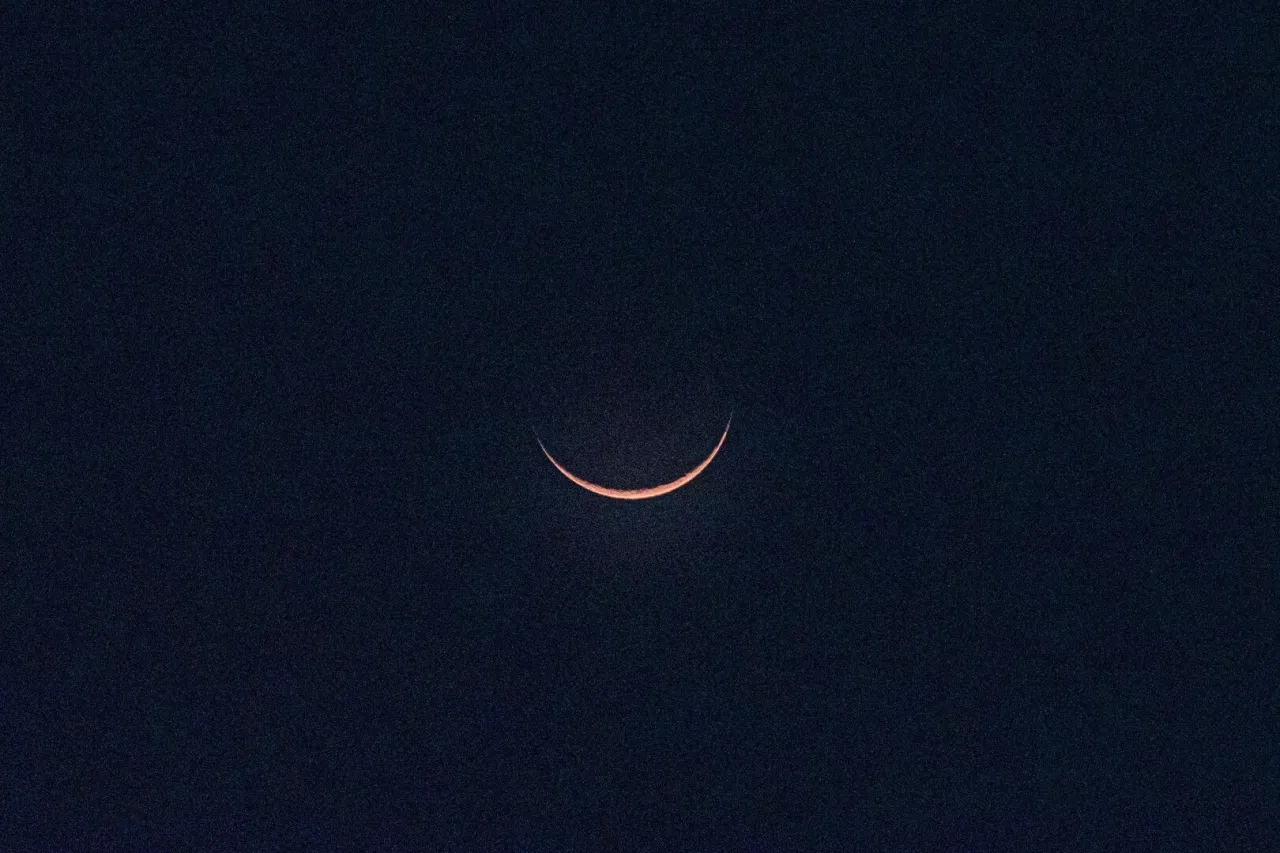
Khaberni - The Jordanian Astronomical Society confirmed that the sighting of the crescent of Ramadan on the evening of Tuesday, February 17, will be "impossible," whether with the naked eye or using a telescope or astronomical imaging techniques, in Jordan and nearby and distant regions, suggesting that the likelihood of seeing the crescent indicates that the first day of Ramadan will be on February 19.
The general manager of the society, Ammar Al-Sakaji, stated that the astronomical data in Jordan related to the blessed month of Ramadan for the year 1447 AH, for Tuesday, February 17, indicate that the central conjunction will occur at 15:03, while the surface conjunction occuring at 16:47 on the same day, according to Jordan time. The moon will linger after sunset for about 3 minutes only, while the age of the moon (centrally about 3 hours and 21 minutes, and surfacely about an hour and a half) and reaches an altitude difference of 14 arc minutes, while the angular elongation is one degree and 14 minutes, and the moon's illumination percentage does not exceed 0.01%, with a crescent thickness practically close to zero.
He clarified that "based on these astronomical data, which all fall below the global Danjon limit, the sighting of the crescent is impossible, whether with the naked eye or using a telescope or astronomical imaging techniques, in the Hashemite Kingdom of Jordan and the nearby and distant regions".
According to all the criteria of the likelihood of sighting the crescent, both ancient and modern, including the Babylonian standard, the Indian standard, the Pruyn standard, the Fotheringham standard, the Maunder standard, Ibn Tariq's standard, Elias's standard, Alawi's standard, Yallop's standard, the South African Observatory standard, and the Odeh standard (adopted by the Astronomical Society), all these standards confirm that the sighting of the crescent on that day is ranged from impossible to unfeasible in all regions of the Arab and Muslim world, whether with the naked eye or using a telescope or even astronomical imaging techniques, according to Al-Sakaji.
He added that "an annular/partial eclipse of the sun will occur on Tuesday, February 17 at 12:56 PM Jordan time, however, this eclipse will not be visible from the territories of the Kingdom, coinciding with the sunset in the eastern and central parts of the world up to the west of the Asian continent, and the solar eclipse is a visible conjunction that people can watch with the naked eye (with appropriate protection measures), which constitutes clear evidence of the impossibility of seeing the crescent during the eclipse or a few hours after it.
The following maps from the Odeh standard show the possibility of sighting the crescent of Ramadan on Tuesday, February 17, and Wednesday, February 18, from all regions of the world, such that the sighting of the crescent is impossible from the areas in red due to the moon setting before the sunset and/or due to the surface conjunction occurring after sunset.
Also, the sighting of the crescent is impossible neither by telescope nor by the naked eye from the uncolored areas, while sighting the crescent is only possible using a telescope from the areas colored in blue.
The standard indicated that sighting the crescent is possible using a telescope from the areas colored in pink, and it is possible to see the crescent with the naked eye in the case of complete atmospheric clarity and observation by an experienced observer, while sighting of the crescent is possible with the naked eye from the areas colored in green.