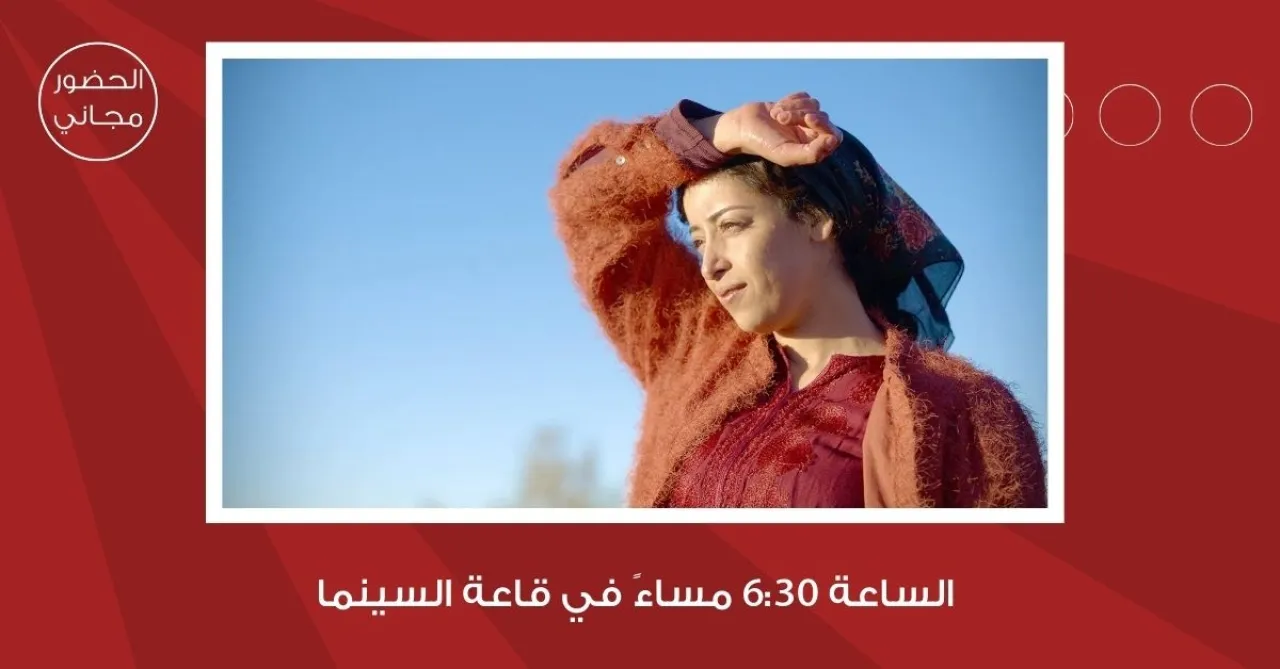
Khaberni – Tomorrow, Tuesday, the Cinema Committee in Abdul Hameed Shoman Foundation will screen the Moroccan movie "In Love with Touda" directed by Nabil Ayouch at exactly 6:30 PM, in the cinema hall at the foundation's headquarters in Jabal Amman.
The plot revolves around "Touda," a character exceptionally portrayed by actress Nesrine Erradi. Touda is a young divorced woman living in a small, marginalized village, dedicating her life to raising her only son "Yassin," who was born deaf and mute, representing her sole motivation and driving force in life. Touda works as a folk singer in night bars and local events, where she has to cater to an audience looking for superficial entertainment, but she harbors a bigger and nobler dream inside: to become a renowned "Cheikha" in the art of "Aita." "Aita" here is not just a musical genre; it is a deep-rooted cultural identity and an ancient art of resistance, always providing a free space for Moroccan women to express their pains, joys, and strength, and a means to combat social injustice.
Touda's arduous journey is evident in a series of daily struggles. She faces not only society's demeaning view of her profession but also suffers from material and physical exploitation, and encounters direct violence that leaves scars on her body and soul. She enters into tense relationships with her colleagues, where competition sometimes turns into fierce enmity, compounded by her brother's rejection of her work. All these challenges only increase her determination, pushing her to make the hardest decision to migrate to Casablanca to fulfill a dream related to her son’s education.
The film's major cinematic value lies in Nabil Ayouch's sensitive and meticulous directorial vision. He handles his story with profound transparency and respect, expertly creating a delicate balance between the harsh and painful moments experienced by his protagonist and the life-filled singing and dancing scenes that represent her outlet and window to hope. The direction here does not exalt suffering as much as it analyzes it, not imposing judgments as much as it compels the viewer to empathize and reflect.
On the visual level, the cinematography adds another layer of beauty and realism. The film uses a warm color palette and close shots of the characters, creating a deep sense of familiarity, making the viewer a partner in Touda’s journey rather than just an observer from afar. The camera not only photographs the places but also captures their spirit; from the cramped night bars filled with smoke and men's desires to the expansive dreamy horizon in Touda’s eyes as she sings. The film's pace tends to be contemplative in some parts, but it is indeed an intentional artistic choice that serves diving deep into the character’s psyche, and gives the viewer adequate time to absorb the weight of the experience and its psychological complexities, fitting for a cinematic work that offers such a profound character study.
We cannot discuss "In Love with Touda" without dwelling extensively on the historic performance by actress Nesrine Erradi. Erradi has delivered a performance beyond description, not only embodying the character but completely merging with it, as if she summoned the spirit of a real "Cheikha Aita" to reside within her. Her dedication to training for a year and a half on the art of "Aita" is evident in every movement, vocal tone, and glance. She has mastered the singing and dancing of "Aita" and, most importantly, mastered understanding its spirit as an art that combines strength and fragility, between defiance and complaint. Her performance is the backbone of the film, the lever that elevates the entire work to an international level, and makes the character of Touda an icon of a strong woman who remains unbroken, no matter what life throws at her.
This film highlights the significant cultural importance; it does not use "Aita" as a musical background or a folkloric element, but places it at the heart of the narrative, restoring its status as an active character in the story. The film presents "Aita" not only as a musical heritage but as a voice of resistance and collective memory. As "Aita" was historically a cultural weapon against the occupier, it has become Touda's personal weapon against societal oppression and marginalization in the film.
Although the film is deeply Moroccan in identity, its message transcends geographical and cultural boundaries, addressing issues from violence against women, to the challenges of single motherhood, the artist's struggle to express oneself, and the need to embrace individuals with special needs, which are universal humanitarian issues. It is a film that leaves a lasting impact on its viewer and reminds us that art, in its purest form, is an act of resistance, and that insisting on a dream is humanity's greatest triumph.