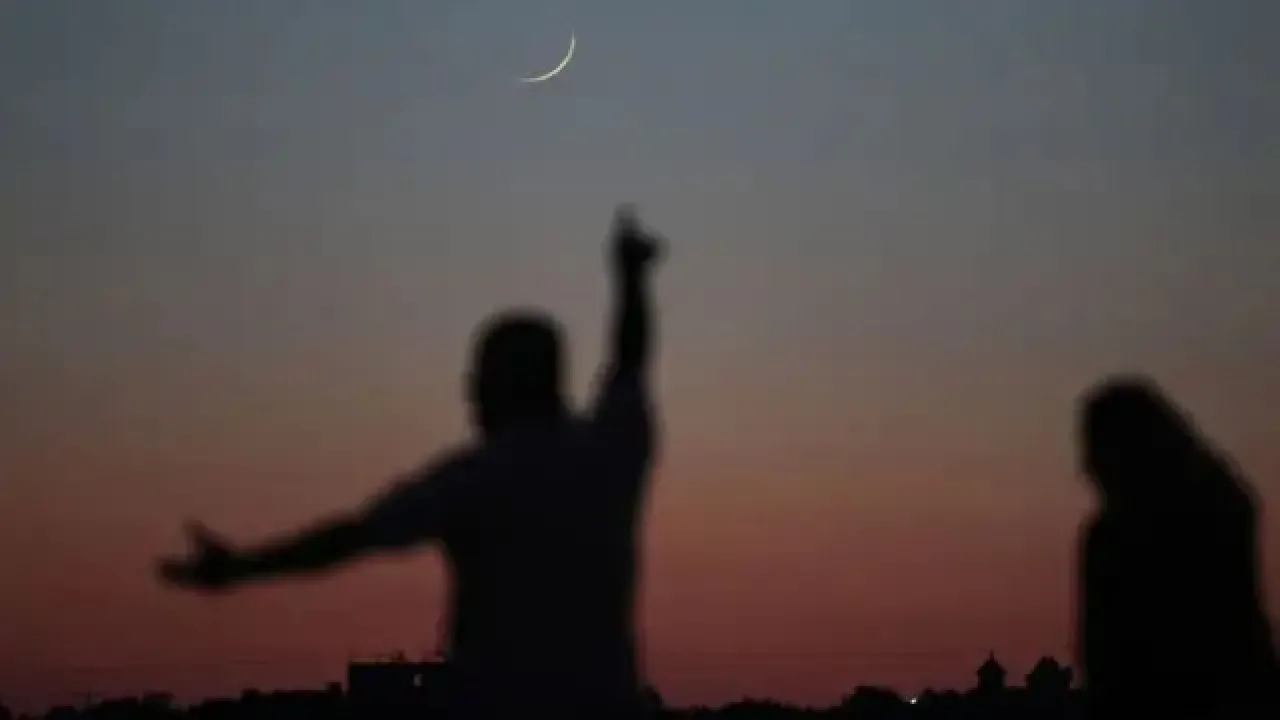
Khaberni - The International Astronomy Center stated that the sighting of the crescent of Ramadan for 1447 AH on Tuesday, February 17th, will be between impossible or not possible from all regions of the Arab and Islamic world, whether by the naked eye or using telescopes or even through high-powered astronomical imaging technologies.
The Astronomy Center attributed this to global astronomical standards that are scientifically accredited and published in peer-reviewed research. The director of the International Astronomy Center, Mohammed Shawkat Odeh, explained in an astronomical report about the conditions of sighting the crescent that most countries will seek to sight the crescent of Ramadan on Tuesday, February 17th. However, all astronomical calculations and standards, including the criteria of Ibn Tariq, Fotheringham, Maunder, Brown, Mohammed Elias, and the South African Astronomical Observatory (SAAO), Yallop, and the Odeh criterion, confirm the impossibility or improbability of sighting the crescent on that day from all the regions of the Arab and Islamic world.
The report clarified that for the countries that require the correct sighting of the crescent to start the Hijri month, Wednesday is expected to be the completion of the month of Sha'ban, and Thursday, February 19th, is expected to be the first day of the blessed month of Ramadan, without ruling out that the beginning of Ramadan could be on Wednesday, February 18th, in some countries that adopt other conditions for starting the month.
The report attributed the reason for the impossibility or improbability of sighting the crescent on Tuesday to the fact that the moon will set before the sun in the east of the Islamic world, with it in the center, and a few minutes after it in the west, which is not a sufficient duration for the moon to transition from the new moon phase to the crescent phase allowing for its observation by any optical means.
It mentioned that the calculations for the moonset timings were based on the lower edge of the moon's disk where the crescent is located, not the upper edge, given the importance of knowing the duration of the crescent itself in the sky.
The report noted that the moon will set six minutes before sunset in Jakarta, one minute before in the Emirates, and 42 seconds before in Riyadh, while it will set with the sunset in Tabuk, the area where the moon will have the longest duration in Saudi Arabia during this month, with a lunar age of one hour and 49 minutes and an angular distance from the sun of only one degree.
It indicated that the situation in Amman is similar to Tabuk, while the moon will set two minutes after sunset in Cairo, and six minutes after in Algeria.
The International Astronomy Center confirmed that the sighting of the crescent in all these areas is not possible with the naked eye or using a telescope, as they are all below the global "Danjon" limit, which establishes the impossibility of sighting the crescent if its angular distance from the sun is less than about seven degrees, a statement supported by reliable astronomical observations, in addition to conforming with all adopted global standards.
The report added that sighting the crescent on Tuesday is not possible even using the latest specialized astronomical imaging techniques, considering that the best angular distance of the moon from the sun in the Arab world does not exceed two degrees, a value that does not allow observation even with these advanced methods. Historically, no correct sighting of the crescent by the naked eye has been confirmed when its angular distance from the sun was less than 7.6 degrees, nor using a telescope when it was less than six degrees.
To support this conclusion, the report referred to an annular solar eclipse that the Earth will witness on the afternoon of Tuesday, visible from southern Africa and from the Antarctic continent, coinciding with the sunset time in the east and center of the world until the west of Asia, which serves as a visible proof of the impossibility of sighting the crescent at that time or a few hours later.
The report warned against the delusional testimonies that may occur on Tuesday evening, explaining that if they occur, they confirm an error in the illusion of sighting a crescent that does not exist, especially with the planet Venus being close to the moon's location to the west, which might cause confusion among the inexperienced, as has been recorded by official committees for sighting the crescent in previous instances.
The International Astronomy Center noted that a number of scholars and astronomers see no value in attempting to sight the crescent in regions where the moon sets before or with the sunset, as it is not present in the sky at all, citing the recommendation of the second Emirates Astronomical Conference which stipulated not to call for sighting the crescent if astronomy determines that the moon sets before the sun on the 29th day of the month, a recommendation that scholars agreed does not conflict with the prophetic tradition.
Conversely, the report clarified that some Islamic countries will attempt to sight the crescent of Ramadan on Wednesday, February 18th, as it is the 29th day of Sha'ban in those countries, such as Bangladesh, Pakistan, Iran, Morocco, Mauritania, and some non-Arab African countries, subject to the results of observation and weather conditions, with the beginning of Ramadan expected on Thursday, February 19th, or Friday, February 20th.
The report indicated that the sighting of the crescent on Wednesday, February 18th, will be possible in a number of Arab and global cities, where the moon remains after sunset for sufficient periods and the lunar ages exceed the historically recorded minimum limits, with the possibility of easily sighting it with the naked eye in cities like Abu Dhabi, Mecca, Amman, Jerusalem, Cairo, and Rabat.