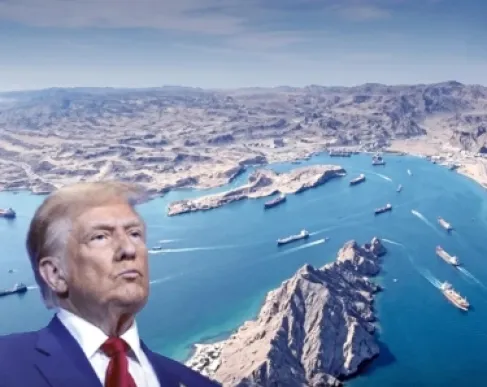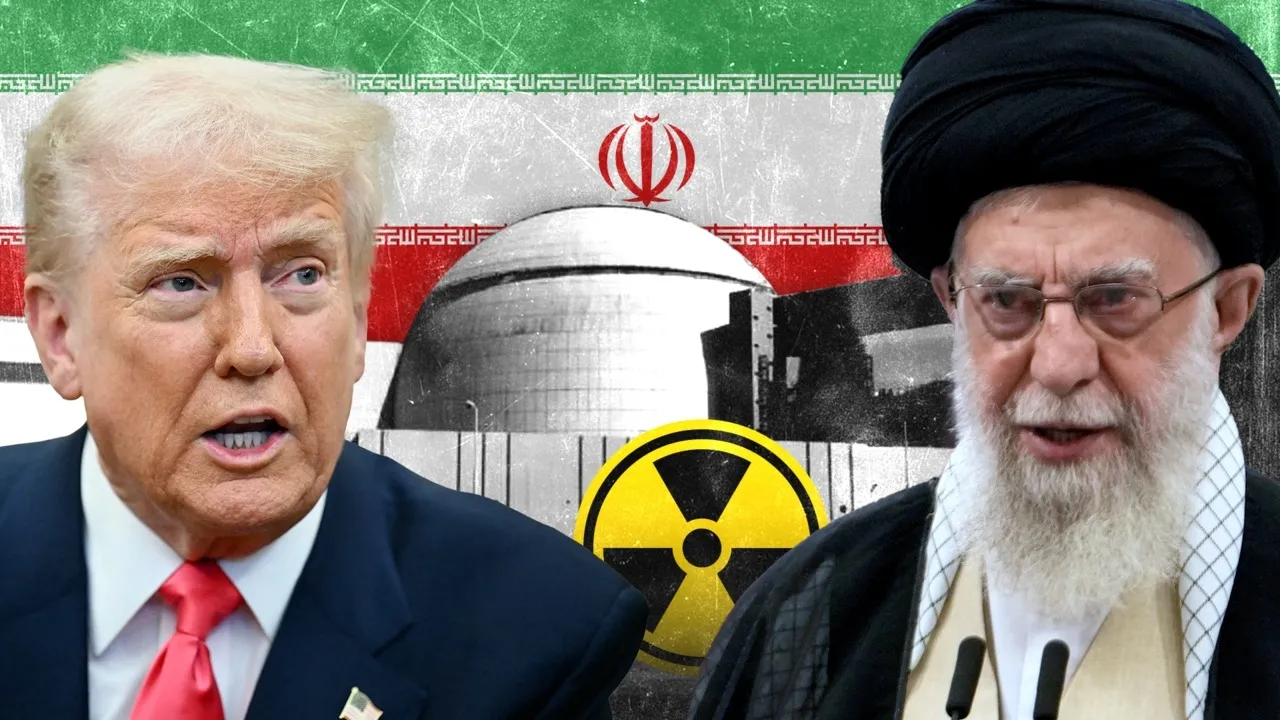
Khaberni - President Donald Trump asked his advisors to prepare quick and decisive military options against Iran that do not entail the risks of a prolonged war in the Middle East, in conjunction with the intensification of warships and American aircraft in the region, according to a report by the Wall Street Journal.
Officials in the administration say the discussion revolves around the primary goal of this escalation: Is it focused on pursuing the Iranian nuclear program, striking the ballistic missile arsenal, weakening the regime leading to its collapse—or combining these three goals—in hopes of delivering a strike that forces Tehran to accept U.S. nuclear demands and cease its pursuit of opponents.
Officials clarified that discussions have taken place around a punitive bombing campaign that could topple the Iranian government. Trump and his team also considered using the threat of military force to extract diplomatic concessions from Iran.
What Trump decides will determine the nature of any military action. Retired Vice Admiral Robert Mort, a former naval intelligence officer, said, "The kind of things you might want to do and the forces you would need differ completely."
A senior administration official said while Trump has continuously stated that Iran cannot possess nuclear weapons, he deliberately keeps his strategic goals and military thinking secret.
Speaking of ships gathering in the Middle East, Trump told reporters on Friday in the Oval Office, "They must float somewhere. They could float near Iran too."
On his part, Iranian Foreign Minister Abbas Araqchi said on Friday that Tehran is open to nuclear discussions, but the United States needs to stop issuing military threats.
Trump in his second term ordered attacks in Yemen, Iran, Venezuela, Syria, Somalia, and Nigeria, often without delivering a speech from the Oval Office to explain his actions or seeking authorization from Congress.
The January raid on Caracas aimed to capture Venezuelan President Nicolás Maduro to stand trial. The air and missile strikes on Iran in June targeted major nuclear sites with bombs designed to penetrate such fortified targets.
General Dan Cain, Chief of Staff of the Air Force, and other military advisors to Trump helped the White House achieve notable tactical successes, often by employing surprise operations developed over months aimed at avoiding quagmires.
Risks of escalation and "day after" scenarios
In Iran, the president faces an opponent, although militarily much weaker than a few years ago, still capable of withstanding a major American attack and responding with missile strikes and drones on American bases and warships and allies in the region, including Israel.
Danny Citrinovitch, a fellow at the National Security Studies Institute based in Tel Aviv, referring to the American bombing campaign before the invasion of Iraq in 2003, said, "There is no shock and awe solution to the Iranian issue. Anyone promising otherwise is likely wrong."
Trump began a new path toward military confrontation with Tehran this month when he pledged support for anti-government protesters demonstrating in Tehran and other cities.
At the time, there were not enough U.S. forces in the region to sustain a bombing campaign and defend American bases and Middle East allies from Iran's certain response. Due to facing poor choices, Trump suddenly decided not to take military action.
Now he has more forces at his disposal. On Thursday, he said, "We have a lot of very big, very powerful ships sailing towards Iran right now. It would be great if we didn't have to use them," adding that he has informed Tehran of his demands.
The president said, "I've told them two things: first, no nuclear weapons; and second, stop killing protesters."
Trump received briefings on potential offensive options developed in coordination between the White House and the Pentagon. Among them is the so-called "big plan," which involves the United States striking regime facilities and the Islamic Revolutionary Guard Corps in a widespread bombing campaign, as officials said.
The more limited options include strikes against symbolic regime targets, allowing for an escalation of attacks if Iran, which denies seeking nuclear weapons, does not agree to a deal satisfactory to Trump.
Any operation targeting Supreme Leader Ayatollah Ali Khamenei, such as the one Trump ordered this month to arrest Maduro using special forces, will be much harder in Iran, which is very cautious about protecting its leadership and where the capital is deep inland.
Officials said that even if Khamenei is overthrown, no one can guarantee whether the subsequent government will be friendlier. Some officials estimate that a prominent member of the Revolutionary Guard is likely to take control, possibly maintaining or even deepening the regime’s hardline approach—
In his testimony before a Senate committee on Wednesday, Secretary of State Marco Rubio said the question remains open about what will happen if Khamenei is removed and the regime falls. Rubio added, "No one can give you a simple answer about what will happen next in Iran."
Vali Nasr, an expert on Iran and former U.S. official who now works at Johns Hopkins University, said, "Even if the regime is quickly defeated, what matters most is (the day after)."
Administration officials use the threat of an attack to pressure Tehran to agree to talks on restricting its nuclear program, as well as imposing restrictions on its ballistic missiles and support for regional proxies.
The White House is concerned about being drawn into unproductive negotiations. If Trump orders an attack instead, analysts say that none of the targets he identified can be achieved by a quick round of airstrikes or missile attacks of the type that the Pentagon seems to be preparing for.
Justin Logan, director of defense and foreign policy studies at the Cato Institute in Washington, said, "He likes to apply military violence when it's fast, cheap, and decisive." He added, "The problem is, you can't do things quickly and cheaply and get decisive results."