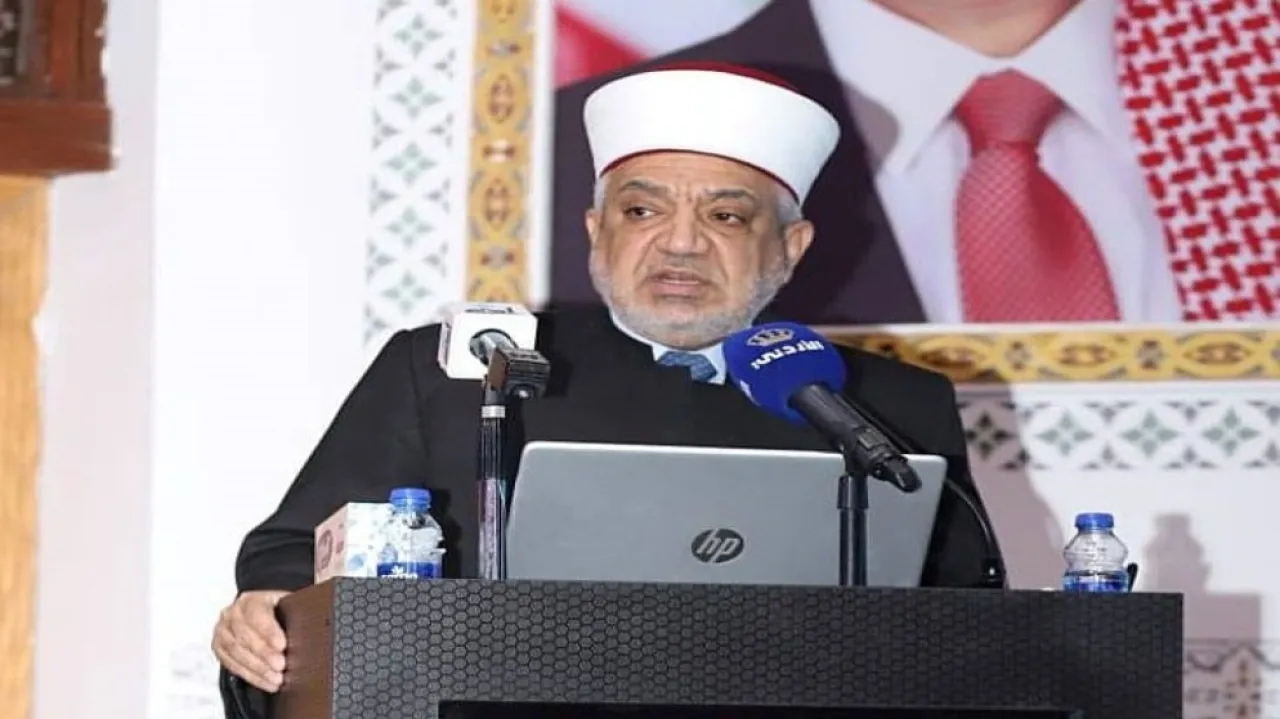
Khaberni - Minister of Religious Endowments and Islamic Affairs, Mohamed Al-Khlaileh, encouraged the employees of the ministry to translate the values of work and perfection into a tangible reality, through plans and executive programs that develop work methods and enhance concepts of productivity and achievement.
During his meeting with the directors of the departments in the ministry on Saturday, attended by the Secretary General of the ministry Ismail Al-Khatib, Al-Khlaileh emphasized the importance of embodying the faith values that are a pivotal foundation in the journey of the nation, and moving from theoretical frameworks to practical application in building humans and society.
He stressed the necessity to develop work in alignment with the public sector modernization map and the royal directives, to enhance the level of services offered to citizens, through enhancing the framework of institutional work, and achieving creativity and innovation in the religious, social, and developmental fields.
The meeting reviewed the achievements of the ministry during the past year in the areas: legislation, management of preaching and guidance, mosque affairs and Quranic centers, Hajj and Umrah, Zakat, digital transformation, care for Islamic Holy places, and development and investment of endowment.
Regarding the care of Al-Aqsa Mosque, last year the ministry completed the installation of modern cabinets for the preservation of Qurans and manuscripts, and developed a comprehensive electronic archiving program to document all endowment properties in Al-Quds Al-Sharif.
The Al-Aqsa Mosque was also equipped with an integrated sound system using the latest technologies, ensuring sound quality and clarity.
The works included implementing projects for the restoration and maintenance of a number of historical buildings within Al-Aqsa Mosque, including Khan Tankaz and the clinic, and gilding the capitals of columns and upper decorations of the supports in the Dome of the Rock, with a royal grant from His Majesty King Abdullah II. The study for the "Chair" endowment of Imam Al-Ghazali's thought in the blessed Al-Aqsa Mosque was completed, aiming to revive its scholarly role and enrich the mosque with scholars and students of knowledge.
The ministry worked on improving water and sewage networks inside the courtyards of the Al-Aqsa Mosque, and began the project of lighting the interior of the Dome of the Rock.
On the legislative and regulatory front, the ministry completed 13 systems and instructions during the past year, in addition to an amended law for the Ministry of Religious Endowments currently presented before the Parliament.
The ministry organized 22 preaching and guidance forums, 4 main Hashemite scholarly councils, and 84 local scholarly councils in the provinces, in addition to 14 scholarly chairs, and sent 200 preachers and preacheresses to participate in specialized courses in Shafi'i jurisprudence, English language, and voice pitches, while the Women's Affairs Directorate held 36 cultural seasons and the first forum for preacheresses, in addition to thousands of specialized training courses in combating extremism and protecting the family and child from violence.
In the affairs of mosques, the ministry equipped 500 mosques with solar power systems during the past year, established a solar farm in the Qatraneh area to supply mosques in the Karak province with electric power, implemented water harvesting projects in 30 mosques, carpeted 160 mosques, installed sound systems in 400 mosques, and connected all mosques in Ma'an and the Northern Jordan Valley to the unified call to prayer.
In the field of Hajj and Umrah, the ministry last year and for the second consecutive time received the Silver "Labbaikum" Award for excellence in Hajj services, in recognition of its distinguished performance in the areas of management, organization, accommodation, sustenance, transportation, and healthcare for Jordanian pilgrims, numbering 12,500. Last year, 541 thousand pilgrims from Jordan performed Umrah.
In the sector of religious education, the ministry opened 270 Quran houses for boys, girls, and people with disabilities during the past year, with more than 200,000 students participating. More than 2,000 competitors participated in the local edition of the Hashemite Competition for Memorizing the Holy Quran, and in the international edition, 96 contestants from 49 countries participated, and 215 Hafiz certificates and 6,751 level certificates were awarded, and 20,000 copies of student curricula and 4,000 copies of Ijaza books were printed.
As for endowment programs, 7474 million dinars were spent benefiting 25850 citizens, in addition to the Holy Quran program.
In relation to the Institution for Development of Endowment Funds, its revenues exceeded 7 million dinars, its assets reached around 38 million dinars, and the profits from the cash endowment exceeded two million dinars.
The profits of the Hajj Fund increased by 13 percent last year, reaching 24.5 million dinars, while its assets reached about 421 million dinars, with 18.6 million dinars being distributed to the savers, and endowment affairs for Hajj and Umrah by 4.8 percent, while the share of stakeholders amounted to 7 million dinars.
In the field of Zakat, 249719 families benefited from the Zakat Fund programs, with a total expenditure of 33.3 million dinars, including monthly cash aid of 2.576 million dinars for 4800 poor and needy families, sponsorship of orphans valued at 770 thousand dinars, emergency aid worth 150 thousand dinars, and parcels and vouchers worth 842 thousand dinars.
In terms of digital transformation, the ministry completed automation of 12 services to facilitate and simplify procedures, launched a dedicated application, established an endowment registry, and made system integrations with the Departments of Lands and Surveys, Civil Status and Passports, and installed a cybersecurity firewall and reconditioned computers.
The strategic plan of the ministry for the years (2026–2030) and the executive plan for the cleanliness strategy and reduction of random waste disposal were discussed during the meeting.
The results of the second edition (2024–2025) of the National Integrity Index showed a notable improvement in the ministry's performance, as the average adherence to national integrity standards rose to 57.68 percent, compared to 36 percent in the first edition, confirming the ministry's progress in the path of administrative modernization and establishing a culture of integrity in institutional work.