Khaberni - Italian writer and philosopher Maurizio Ferraris, in an opinion piece published by the Spanish newspaper "El País," warns that Europe has become forced to choose between building a defense force and an independent unified government, or falling again under the absolute dominion of the power poles in Washington and Moscow, indicating the decay of the political and sovereign entity of the Old Continent in the midst of the fierce conflict between the major powers.
Ferraris begins his article with a grim prophecy, stating that within 3 years "Europe will cease to exist" after exhausting its energies in formulating bureaucratic warnings and laws, pointing out that the rules of human history confirm the inevitability of this scenario.
The writer recalls lessons from history, referring to the year 1812 when Talleyrand questioned Napoleon's motives for invading Russia, a decision that broke a centuries-old balance and ultimately led to Tsar Alexander reaching the heart of Paris in 1814. Since then, Ferraris sees that Russia has been waiting to return to Paris or Berlin, which it indeed achieved in 1945 when it took over half of the continent.
"Deception" of self-determination
The writer notes the United States' entry onto the international stage in 1917, where, with minimal human cost and through the principles of the then-President Woodrow Wilson about "the self-determination of nations," it managed to dismantle the multi-ethnic European entity. Ironically, the same principle (self-determination) was later used by Adolf Hitler to justify the occupation of Sudetenland and the annexation of Austria.
Ferraris describes the United States at that time as a young aspiring power, a reflection of the aged Russian power with entrenched strategic depth; where the American intervention in World War I saved the Western powers from a certain defeat against the Germans, after the collapse of the Austro-Hungarian Empire, Turkey, and Italy.
Division of Europe
The writer moves on to World War II, explaining how British Prime Minister Winston Churchill, with desperate realism during the war, plotted the division of Europe into two spheres of influence, hoping the Americans would reach Berlin before the Soviets. That did not happen due to Washington’s desire to avoid human losses and the absence of effective leadership following President Franklin Roosevelt's death, who had been severely weakened since the Yalta Conference.
Ferraris questions European rulers: "Do you think humanity has become kind?" asserting that reality does not support this hypothesis, as the United Nations has not achieved its "childish" goals, and NATO has remained merely a tool to protect American rather than European interests, just as the Warsaw Pact was a tool for Moscow.
Conflict and anticipation
The writer warns that the current conflict between Washington and Moscow—amid the anticipation of China reclaiming Taiwan—will conclude with Europe ending up like in 1945 under the mercy of two masters.
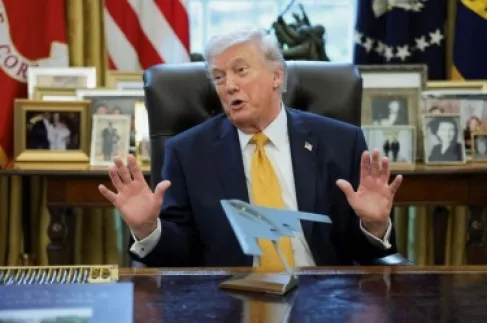
Ferraris goes further in describing the current American regime as "authoritarian" to the extent of its Russian counterpart, citing Donald Trump's threats to punish his opponents.
Faced with this tense reality, Ferraris criticizes what he describes as "feeble calls and weak threats," as well as a sanctions policy he finds ineffective, considering that Europe today is nothing more than a "geographical expression" or a "disparate people without identity."
Radical solution
From this standpoint, the writer proposes a radical solution based on two paths; the first political and military, involving the establishment of a united European army led by a genuine government headed by a leader with exceptional war-time powers. The second is financial, represented in investing "digital capital" and the vast data generated by network users on the continent, considering it a strategic resource currently left as a ripe fruit in the hands of major digital empires.
The writer concludes his article with a warning cry for the continent he describes as a "continent of the elderly and lazy," asserting that possessing deterrent power through technology and digital financing is the only way to reclaim sovereignty, and avoid falling into a "peace of the graveyards" or disguised slavery, emphasizing that the harshness of his words is but a reflection of an even harsher reality.