Khaberni - The President of the Jordan Chamber of Commerce, and Jordanian head in the Saudi-Jordanian Business Council, Khalil Hajj Tawfiq, emphasized the importance of transitioning the Jordanian-Saudi relations from their solid historical and political framework to a practical economic product that reflects on the interests of both countries, creating real opportunities for the private sector and youth on both sides.
Hajj Tawfiq added, “The Jordanian-Saudi relationship, over decades, has been built on trust, integration, and unity of stance, and has always been a model for constructive Arab cooperation. Today, as we meet in Riyadh, we are translating this solid political legacy into structured economic actions led by the private sector and responding to the aspirations of the next phase.”
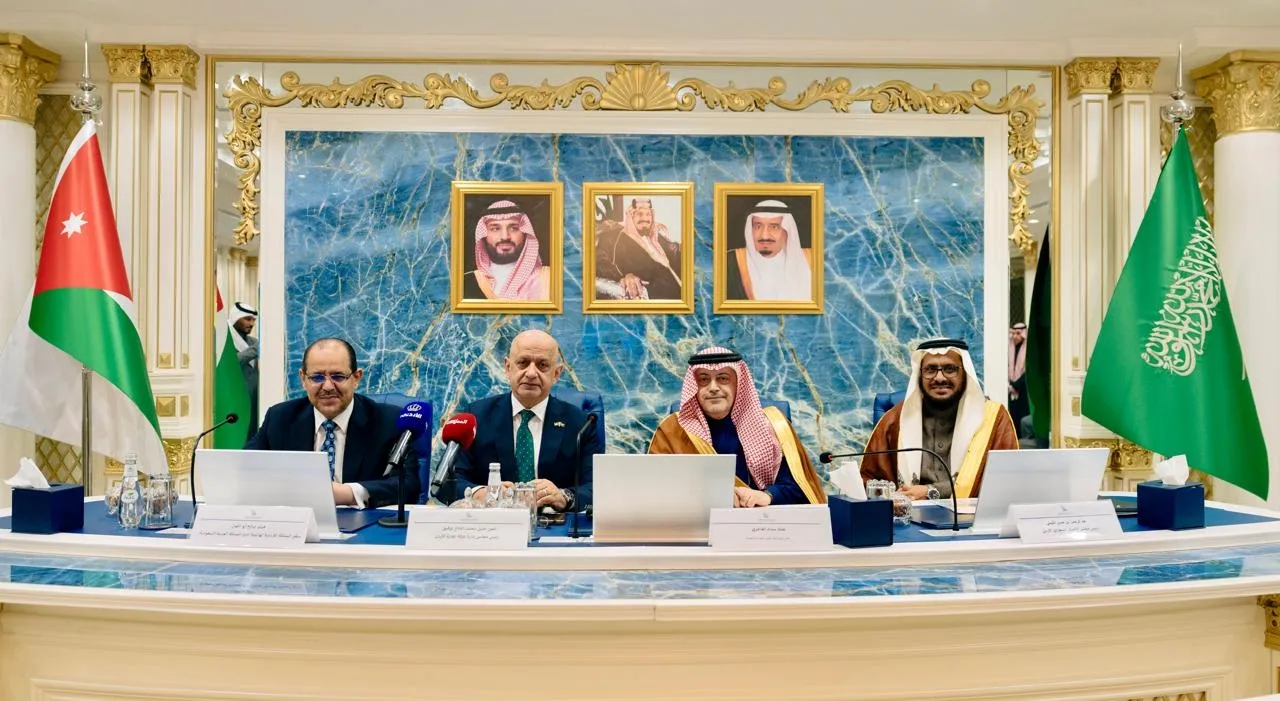
This came during his speech at the joint meeting of the Saudi-Jordanian Business Council held in the capital Riyadh today, Wednesday, attended by the head of the Saudi-Jordanian Business Council, Abdulrahman Al-Thubaiti, the Vice President of the Saudi Chambers Federation, Emad Al-Fakhry, and the ambassador of the Hashemite Kingdom of Jordan to the Kingdom of Saudi Arabia, Haitham Abu Al-Foul, with the participation of representatives of the Saudi Chambers’ Federation and business owners from both countries.
Hajj Tawfiq expressed his thanks and appreciation for the warm reception and generous hospitality, affirming that the Jordanian delegation felt as if they had not left Amman, due to the genuine brotherly feelings experienced from the moment of arrival.
Hajj Tawfiq mentioned that the relations between Jordan and Saudi Arabia are broader and deeper than some might assume, pointing out that the shared history and the close relationship between the leaderships of the two countries form a solid base for shared economic construction.
He noted that the private sectors in both countries are highly relied upon, especially in the face of accelerating global challenges, including technological development and artificial intelligence, confirming that the joint committees are a fundamental tool for turning ideas into executable projects.
Hajj Tawfiq clarified that the participating Jordanian delegation is the largest in the history of the economic relations between the countries, consisting of a selection of major businessmen and heads of economic sectors and trade unions, reflecting the Jordanian private sector's confidence in the Kingdom of Saudi Arabia and in the mutual cooperation opportunities.
He pointed out the importance of reactivating the office of the Saudi-Jordanian Business Council within the Jordan Chamber of Commerce building, to serve as a permanent headquarters for facilitating communication and follow-up, and implementing the outcomes of the meetings, affirming that the upcoming phase should focus on execution rather than diagnosis.
He also emphasized that Jordan and Saudi Arabia, amidst geopolitical changes and global economic groupings, deserve economic integration, illustrated through opportunities to link Saudi Vision 2030 and Jordan’s Economic Modernization Vision and highlighting the potential for launching joint projects in diverse sectors, including energy, tourism, and logistics, similar to the possible integration between major projects like “Neom” and Aqaba.
In turn, Abdulrahman Al-Thubaiti, head of the Saudi side in the Saudi-Jordanian Business Council, confirmed that the relations between the Kingdom of Saudi Arabia and the Hashemite Kingdom of Jordan represent a steadfast model of joint Arab cooperation, based on solid historical foundations of trust, respect, and integrated interests, noting that the leaderships of both countries give special attention to these relations, always careful to develop them, especially in economic, trade, and investment aspects.
He explained that the current stage presents qualitative opportunities to enhance the economic partnership between the countries in the face of ambitious developmental visions, primarily Saudi Vision 2030 and Jordan’s Economic Modernization Vision, both of which grant the private sector a central role in leading growth, stimulating investment, creating job opportunities, and achieving sustainable development.
He detailed that the Saudi-Jordanian Business Council forms an effective institutional framework for organizing cooperation between business communities in both countries, transforming ideas into practical initiatives, and opportunities into real projects, confirming that the council's role is not limited to coordination and dialogue, but also extends to building partnerships, exchanging expertise, transferring knowledge, and opening new horizons for investors and businessmen.
He mentioned that forming sector-specific committees within the council represents a strategic step in developing institutional performance, as these committees contribute to deeply studying the challenges facing various sectors, whether in industry, trade, energy, agriculture, services, technology, transport, logistics, or others, in addition to unifying efforts, defining priorities, and proposing practical, executable solutions.
He added that the council relies on the outputs of these committees to draft clear initiatives, implementation programs, and joint projects to be submitted to relevant authorities in both countries, contributing to addressing obstacles, enhancing enablers, improving the business environment, and supporting the private sector's competitiveness.
He also highlighted that the council's success is linked to its ability to act as a reliable link between businessmen and women on one side, and governmental and regulatory agencies on the other, aiding in facilitating procedures and stimulating joint investments, increasing the volume and quality of trade exchange, and achieving real added value for both the Saudi and Jordanian economies.
The president of the Saudi side in the Saudi-Jordanian Business Council urged council members and businessmen to actively participate, exchange views and expertise, and work as a team, affirming that what binds the two countries is greater than any challenges, and that the council’s success is the fruit of collective effort and sincere cooperation between all parties.
In the same context, the sector-specific committees in the Saudi-Jordanian Business Council, during their meetings held on the sidelines of the Saudi-Jordanian business forum, adopted a broad package of practical recommendations aimed at strengthening the economic and investment partnership between the countries, within specified execution timelines.