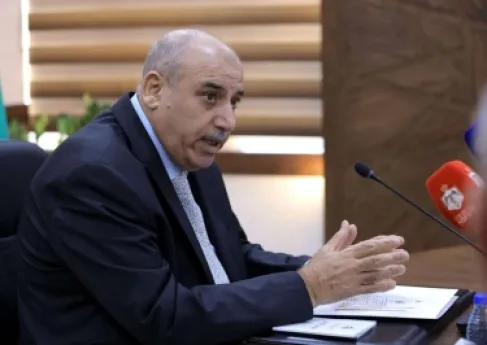
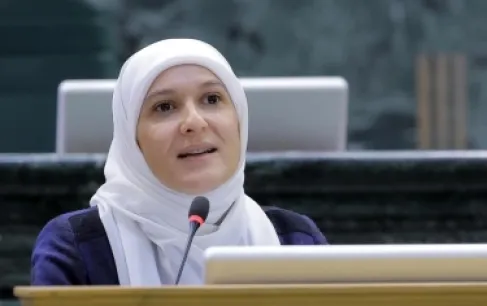
After nearly fifteen months of government formation, the prime minister, Dr. Jaafar Hassan's interview placed the "government's approach" on the table in a different language: the language of timing, commitment, and measurement. Remarkably, he did not limit his discussion to general diagnostics; instead, he presented a series of revisable commitments in front of the people and the Parliament, clearly stating: Do not judge the intentions... Judge the implementation. In a moment that is both economically and regionally delicate, this type of discourse can either be a gateway to regaining trust that has waned over the years, or a tough test if the application stumbles.
At the core of the interview, the prime minister set a pivotal rule: the government has a "clear action plan," and the upcoming executive program is "governed by a clear timeframe and evaluation with clear impacts for measurement". This is not merely a rhetorical statement; it is an announcement of a new standard for accountability: a plan + time + impact. From our parliamentary position, this is exactly what has been demanded for years: for plans to evolve from documents that are read to commitments that are measurable.
He then moved on to the idea he tried to establish as both a political and economic headline: that the "visions of modernization" are not just a government item, but "Jordan's project for the future," and that the most important goal is to "ensure job opportunities and income for our youth". Here lies the crux: the government ties its practical legitimacy to the employment and income file, not to the sheer number of projects or the count of rounds. This automatically raises the stakes: because those who link themselves to work and income must offer real tools for their production, not just slogans.
When he spoke about fieldwork, he did not leave it as a media image. He stated it literally: "Fieldwork is my style and my school of operation". Then, he mentioned a large number: visiting 130 sites within a year, with promises of continued visits and holding Cabinet meetings in the provinces, and he added that "at every site, a positive change was made or solutions to some issues were found". This commitment is verifiable: 130 sites mean 130 files, and 130 results that should be visible to the citizens, and deputies can ask the government about them "site by site" instead of letting generalities dominate the scene.
The real difference in the interview was not in the "narration of the projects," but in how they were presented: as a cohesive package meant to stimulate the economy, not just to embellish the speech. The Prime Minister talked about major projects worth about 11 billion dollars in water, energy, transport, tourism, and construction, stating that they would start "this year" and over the next few years. This figure alone raises two questions before the government: how will these billions transform into actual local job opportunities? And how can we ensure that the impact does not go in directions that do not produce added value within the Jordanian economy? Here comes the role of oversight: not to oppose investment, but to protect it from waste and poor priorities.
Specifically in the water file, he provided a rare timetable in government rhetoric: the final financial closure of the national carrier project within sixty days, and the start of execution by the end of the first quarter, with delivery by the end of 2030. These are not minor details; they are precise measuring points. From our position as deputies, this kind of timeline commitment opens the door to respected accountability: what is achieved after 60 days? What is completed by the end of the first quarter? What are the risks of delay and how are they managed?
In energy, he laid out a clear sovereign goal: to cover over 80% of sector needs with natural gas from Al-Risha field. This goal has a direct economic meaning: reducing the energy bill, lowering external risks, and expanding the margin of national decision-making. But it is also a sensitive goal; because it requires transparency in the figures, capabilities, and expansion plans, so it does not become a grand promise without an executive structure.
As for health services, he chose to describe a particular decision as the "most important" for the government: to insure more than 4 million Jordanians at the King Hussein Cancer Center. This decision carries two implications: the first is social, related to justice in access to treatment, and the second is financial, related to the sustainability of funding and efficiency of management. This file naturally needs parliamentary monitoring to ensure the decision remains a "continuous reality" rather than news that shines and then fades under budget pressures.
In public finance, he mentioned a figure no less critical: repaying more than 600 million dinars of arrears from previous years, and a commitment to not leave subsequent arrears. He clearly stated that the government is committed to reducing the debt to 80% of the gross domestic product within the next two years. Here specifically begins the test: not the test in announcing the goal, but in how it is done—what is its impact on growth? On capital spending? On the quality of services? And on the government's ability to maintain social balance without additional pressure on citizens.
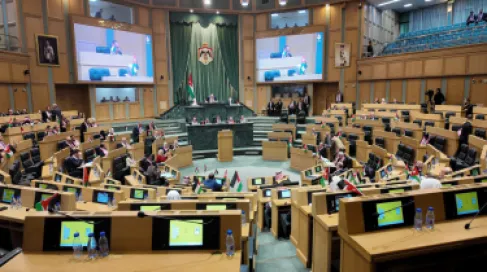
Politically and constitutionally, the Prime Minister tried to outline the relationship with the Parliament in a direct sentence: "The relationship with the Parliament is a cooperative one governed by the constitution." He added that he met with parties and blocs, and that the government benefits from the deputies' observations, especially in the work of provinces, development programs, and field visits. This opens an important window: if the government says it benefits from deputies' observations, it is essential that these benefits translate into announced decisions, not remain a political courtesy in an interview.
Because the interview came in the midst of a tumultuous region, he did not overlook foreign policy: he prioritized "establishing a ceasefire in Gaza and quickly moving to the next phase," and affirmed that Jordan's relations are governed by "its interest, security, and stability first and foremost," and he spoke about Syria as its success being Jordan’s success, with an emphasis on border security and the water issue with the Syrian side and the need to reach a "fair" agreement. These messages are not peripheral; they indicate that the government sees the economy, security, and foreign policy as a single package—which is fundamentally Jordan’s reality.
The conclusion I draw is that the Prime Minister has laid out a "map of commitment" in front of the Jordanians and the Parliament with numbers and timing: 130 sites, 11 billion dollars, 60 days for financial closure, delivery in 2030, 80% of the gas from Al-Risha, 4 million insured at the King Hussein Cancer Center, 600 million arrears paid, and reduction of the debt to 80% within two years. This type of discourse heightens the value of the public debate if translated into action, and it completely falls if it remains within the confines of the interview. From here, our parliamentary standard will not be the beauty of the display or the arrangement of the sentences; our standard will be: What has been achieved within the declared time? What is its impact on job opportunities, income, and the quality of services? Because trust is not created by words... it is regained when the numbers become a reality that walks among the people, and it is necessary that we be united in implementing this plan, as a people, Senate, and deputies for the sake of Jordan because it deserves it.