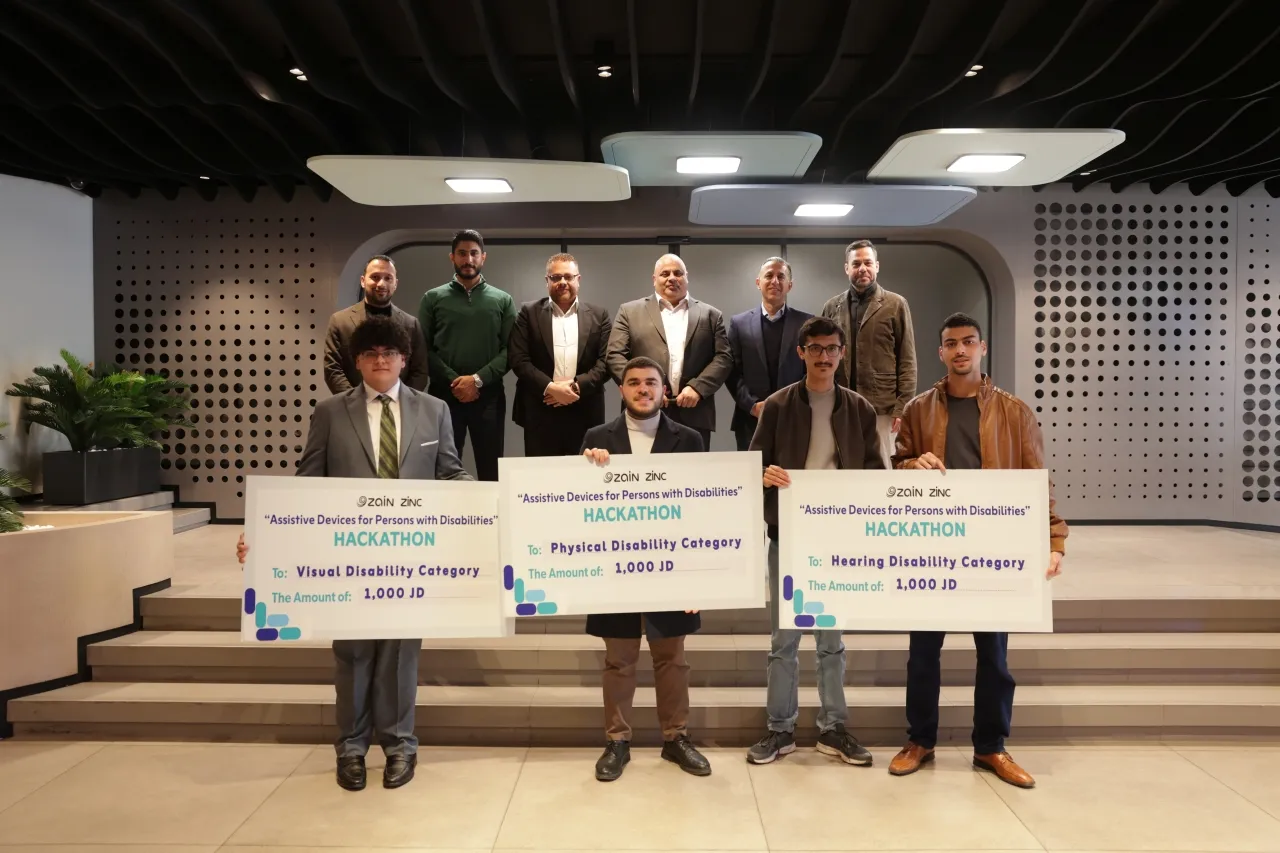
Khaberni - The Zain Creativity Platform (ZINC), in collaboration with “Makerspace”—one of the Crown Prince Foundation’s programs—and the Higher Council for the Rights of Persons with Disabilities, held a hackathon “for people with disabilities” aimed at developing innovative solutions that contribute to improving the everyday quality of life for people with disabilities and enhancing their integration into society, through supporting entrepreneurial ideas and transforming them into practical, actionable models.
The hackathon addressed the development of innovative solutions targeting auditory, visual, and physical disabilities, with the participation of 30 projects selected from 128 submissions. The event continued over three continuous weeks and included a series of developmental phases aimed at transforming entrepreneurial ideas into practical solutions.
The hackathon stages included a number of specialized training sessions with the participation of a selection of trainers and experts, aimed at empowering participants and providing them with the knowledge and tools needed to develop their ideas. This was alongside mentoring and guidance sessions that lasted over three days, covering various topics including the development of technical solutions, designing prototypes, and building business models.
Participants then moved on to the preliminary presentation stage in front of a specialized judging panel, where 9 projects qualified for the next stage. The qualifiers submitted a list of materials required to work on their projects, and each qualifying project received the necessary materials to develop their prototypes, in addition to additional development sessions to support the progress of the projects and enhance their readiness.
In the final stage of the hackathon, three projects were selected, one from each category of the hackathon. The Zain Creativity Platform (ZINC) provided financial support of 1000 Jordanian Dinars to each selected project.
"Taha Al-Rawi" won the first prize in the category of physical disability with the idea of a medical device called “Walker”, which allows people with physical disabilities to ascend or descend stairs by altering its shape to suit the required movement, enhancing their independence and ease of movement. "Issam Malhees" was selected in the category of visual disability for a project involving an integrated system consisting of a smart cane and specialized glasses. It relies on changing light patterns to transform sensory data into visual signals, enabling people with visual impairments to perceive their surroundings based on the remaining visual sense.
Meanwhile, "Omar Ziad Al-Tabbakh" was selected in the category of hearing disability for a project named “Sentry”, a smart watch that turns auditory alerts into sensory alerts to warn the user of surrounding hazards, such as gas leak alarms. It can also be linked to the smartphone via Bluetooth technology and used for communication through text messages.
The organization of this hackathon by the Zain Creativity Platform (ZINC) is part of its commitment to supporting entrepreneurial projects that aim to have a positive impact, within Zain's strategy to promote concepts of inclusion and community integration, and to enable people with disabilities to actively participate in developing technological solutions that meet their needs and contribute to building a more just and sustainable society.