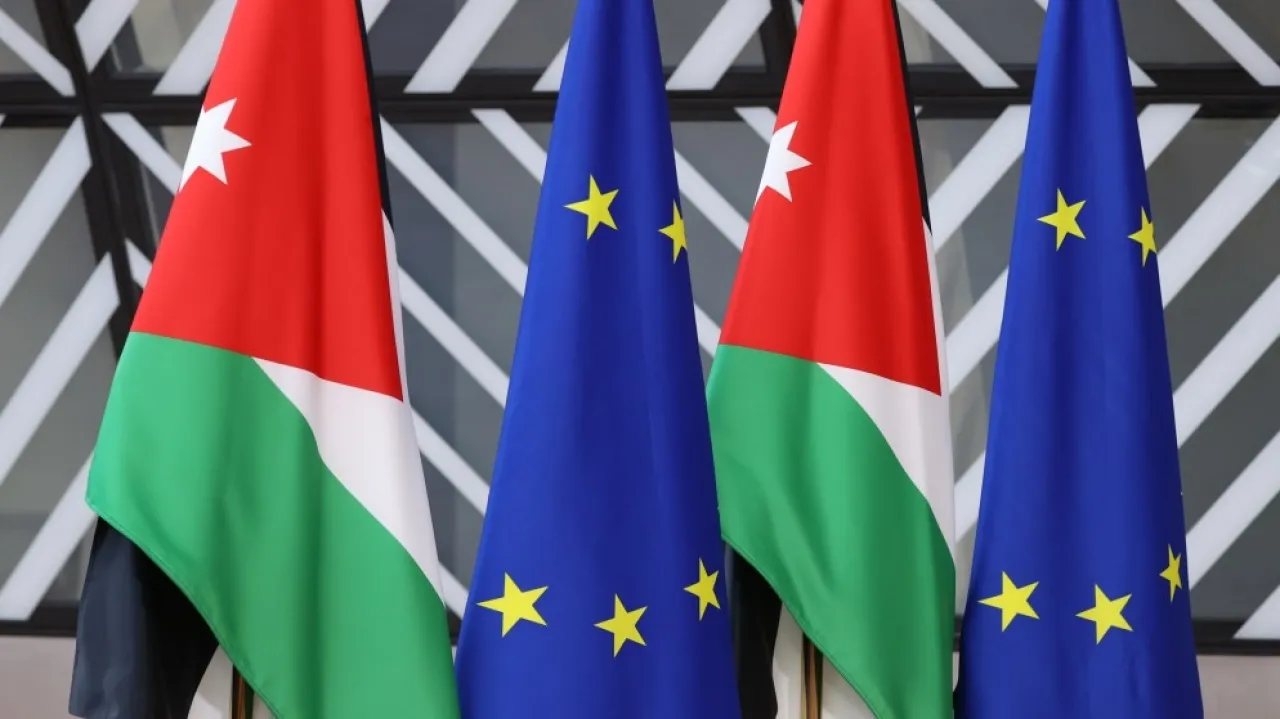
Khaberni - Jordan and the European Union are holding, in Amman on Thursday, their first-ever bilateral summit, featuring His Majesty King Abdullah II, European Council President Antonio Costa, and European Commission President Ursula von der Leyen. This event has been described as "very important" in the course of relations between the two sides.
The summit will take place within the framework of the comprehensive and strategic partnership between the European Union and Jordan, signed in January 2025. Discussions will address mechanisms to strengthen political and economic cooperation, as well as exploring latest developments at regional and international levels.
The strategic partnership covers five main pillars: political relations and regional cooperation, security and defense, economic resilience, trade and investment, human capital, and migration, protection, and support for refugees.
The partnership is based on a financial and investment package for the period 2025–2027 estimated at around 3 billion euros, including 640 million euros in grants, one billion euros in concessional loans (total financial assistance), and approximately 1.4 billion euros in additional investments.
The partnership also focuses on supporting Jordan's stability amid extraordinary geopolitical challenges, pushing for political, economic, and administrative modernization, and enhancing economic resilience.
The comprehensive and strategic partnership is founded on a longstanding relationship based on the partnership agreement since 2002 and the Jordanian-European partnership priorities (2021–2027), with the most recent partnership council meeting between the European Union and Jordan taking place on July 15, 2024. King also met with Costa in Brussels to discuss relations on January 29, 2025, and again on September 21, 2025, on the sidelines of the United Nations General Assembly meetings in New York.
The meeting between His Majesty King Abdullah II and the EU High Representative for Foreign Affairs and Security Policy, Kaya Kalas, on December 7th last year, focused on ways to strengthen cooperation between Jordan and the European Union, based on the comprehensive strategic partnership agreement between them, emphasizing the importance of building on available economic opportunities, especially through the Jordanian-European summit to be hosted by Amman, as well as the planned joint economic forum in 2026 with the participation of investors from both sides.
The meeting also addressed regional developments and the need for a comprehensive calm in the region, maintaining state sovereignty, and emphasized that the two-state solution is the only way to achieve fair and comprehensive peace.
* Deepening the Comprehensive Partnership
Leaders at Thursday's summit will focus on strengthening bilateral relations and deepening political and economic partnership, alongside discussing foreign policy issues and global challenges, particularly developments in the Middle East, as well as security, trade, and migration issues amidst an increasingly complex international and regional environment.
European Council President Antonio Costa stated that Jordan is a strategic partner for the European Union and plays a pivotal role in the stability of the region, saying: "Our first bilateral summit will provide a great opportunity to enhance our partnership and address shared challenges in these turbulent times."
He also emphasized the European Union's appreciation of Jordan's role and leadership, especially in hosting Syrian refugees for more than a decade.
European Commission President Ursula von der Leyen stated during the signing of the comprehensive strategic partnership agreement on January 29, 2025, that the European Union and Jordan are "elevating their unique relationship to a new level," confirming that Jordan is "a major partner and one of the pillars of stability in the region."
Kalas, during her meeting with His Majesty the King last month, emphasized the importance of the European Union's partnership with Jordan and the joint commitment to deepening cooperation in various areas, noting the Kingdom’s central role in the region.
European Commissioner for the Mediterranean Dobravka Suica, during the signing of the comprehensive strategic partnership earlier last year, described the event as a "successful milestone," confirming that the partnership will enhance security, stability, and economic opportunities for both Jordan and the European Union.
Head of the European Union Delegation to Jordan, Ambassador Pierre-Christophe Chatsisavas, stated that Jordan is one of the closest allies of the European Union, with complete consensus on perspectives regarding Lebanon, Syria, the Palestinian issue, and Iraq.
He added during a previous interview with "Al-Mamlaka" that there is a strong agreement between Jordan and the European Union regarding the principles of the United Nations and international law and the charters stipulated in the United Nations Charter, adding, "Our relationship with Jordan is of great importance and thus we are close partners and work closely together not only within the United Nations but also in the Mediterranean region."
* Jordan's Third Largest Trade Partner
Economically, it is highlighted in the trade relationship facts and figures that the European Union is "Jordan's third largest trade partner," representing more than 12% of Jordan’s good trade with the world.
In 2024, trade in goods between the two sides reached about 4.8 billion euros, distributed into 4.13 billion euros of European Union exports to Jordan, 0.66 billion euros of imports from Jordan by the European Union.
As for services trade (last year data available) in 2023, it amounted to 2.5 billion euros; 1.2 billion euros EU imports from Jordan, compared to 1.3 billion euros of EU exports to Jordan.
At the level of foreign trade, Jordanian exports to the European Union countries increased by 45.7% during the first ten months of 2025, reaching about 520 million dinars compared with 357 million dinars for the corresponding period of the previous year.
Conversely, the Kingdom's imports from the European Union countries increased by 12.4% during the same period, reaching 2.647 billion dinars compared with 2.355 billion dinars for the same period in 2024.
National goods exported to the European Union countries focused on clothing, fertilizers, pharmaceuticals, chemical products, and some agricultural products, while major imported goods included vehicles, industrial machinery and equipment, pharmaceutical and medical products, chemical substances, electrical and electronic machinery, and food products.
The "financial support" aspect indicates that Jordan has benefited from funding under the European Global Neighborhood, Development, and International Cooperation Instrument, with approximately 377 million euros in grants allocated for the period 2021–2024 to support reforms, effective management, rule of law and security, the green transition and economic resilience, and human development including education and social protection.
The European Union has spent more than 4 billion euros since 2011 in humanitarian aid and total financial assistance to support Jordan in handling the Syrian refugee crisis, especially the pledges made during the Brussels Conference to Support Syria’s Future.
* Multi-Year Financial Implementation Plan
On the financial execution side, the European Commission has adopted an executive decision to finance a multi-year action plan with Jordan for the period 2025–2027 with a total value of 228 million euros to support the partnership and enhance security and economic development and develop human capital and government reforms.
The financing plan is distributed over three years; 93 million euros for 2025, 74 million euros for 2026, and 61 million euros for 2027. The decision also grants financial flexibility to reassign amounts within certain limits not exceeding 20% of the annual funding value.
The plan covers areas related to the five pillars of the partnership, focusing on improving border management and trade facilitation and regular migration policies, enhancing the efficiency of the border protection system, and supporting the resilience of Jordan's economy by improving the investment environment and encouraging local and foreign investments to promote growth and job opportunities, and developing human capital and empowering women and people from disadvantaged groups including persons with disabilities, in addition to direct financial support for the general budget within a comprehensive national program for economic and general modernization to improve governance and enhance sustainable growth.
The European Commission has approved a program worth 110 million euros lasting until 2027 to support the economic and general modernization path and strengthen the national economy's capacity to create job opportunities and increase growth and investment, through three annual installments. In 2025, the Commission approved an amount of 48 million euros, 24 million euros in 2026, in addition to 38 million euros in 2027.
The program focuses on supporting financial governance reforms and economic management, including expanding the productive economic base, improving the business environment, enhancing financial transparency and efficiency, developing public debt management tools and government spending, in addition to supporting the transition towards a green renewable economy through renewable energy projects and electrical storage and improving the efficiency of energy and water usage.
The program also includes support for industrial initiatives related to the low-carbon economy, enabling Jordan to develop the necessary infrastructure for green hydrogen projects and the circular economy. It also includes support for expanding employment opportunities and entrepreneurship and vocational training, and enhancing the role of women and youth in the labor market.
Additionally, the European Commission has adopted an additional funding package valued at 80 million euros to support Jordan's efforts in hosting Syrian refugees and providing social assistance and basic services to the most vulnerable groups among the refugees and host communities affected by the displacement since the beginning of the Syrian crisis.
In the economic and competitiveness axis, the European Union has allocated 63 million euros for the period 2025–2027 to support competitiveness and investments and trade, over three stages, distributed into: 20 million euros in 2025, 20 million euros in 2026, and 23 million euros in 2027.
The funding targets supporting government projects and programs to improve the business environment and strengthen value-added sectors and enabling small and medium enterprises to access markets and enhance their competitiveness, and enhancing the economic link between Jordan and the European Union and improving systems and policies related to trade and investment and facilitating regulatory procedures.
The program pays special attention to the digital economy and technological transformation by supporting innovation and digital entrepreneurship and enhancing the legislative environment related to the digital economy and cybersecurity and technical standards, alongside supporting green transformation pathways and sustainable energy and water projects.
The executive package also includes new funding valued at 25 million euros to support integrated border management and enhance the efficiency of security devices, distributed as: 15 million euros in 2025, and 10 million euros in 2026, with reference to working on providing an additional investment grant valued at 10 million euros in 2027 by a separate decision to enhance the strategic impact.
The Union also launches a human capital development program valued at 30 million euros in two installments; 10 million euros in 2025, and 20 million euros in 2026, with implementation spanning five years, to support education and social protection, and participation of women, youth, and persons with disabilities in public life.
The program includes support for developing vocational training and improving the quality of basic education by developing teacher training and raising levels of reading, writing, and mathematics in early stages, in addition to expanding the scope of social services for the most vulnerable groups, and supporting initiatives to increase women's participation in the labor market such as promoting flexible work and social protection for working women.
It also includes support for the political modernization process by enhancing the participation of women, youth, and persons with disabilities, developing the capacities of political parties, expanding civil and electoral awareness programs based on recommendations from the European Election Observation Mission for 2024.
* New One Billion Euro Total Financial Assistance
Total Financial Assistance (Macro-Financial Assistance) is one of the basic pillars in the relationship between Jordan and the European Union, based on concessional and long-term loans approved under the ordinary legislative process by the European Parliament and the European Council, aimed at supporting economic stability and enhancing Jordan’s capacity to deal with external shocks and regional challenges.
Since 2013, Jordan has benefited from successive total financial assistance programs, including 180 million euros in the first program, 200 million euros in the second program, and 700 million euros during the period 2020–2023 to address the impacts of the COVID-19 pandemic, reaching a total of approximately 1.08 billion euros by 2023, according to the European Council.
In 2025, the European Parliament approved total financial loans valued at one billion euros for Jordan, with the first installment of 500 million euros approved in April, followed by a second installment of the same value in December, under the European Union's total financial assistance mechanism.
These loans are provided as concessional and long-term financing, disbursed in stages, and linked to the implementation of a reform program in cooperation with the International Monetary Fund, coming within the framework of the comprehensive and strategic partnership between Jordan and the European Union, supporting financial stability and economic stability for the kingdom amid regional tensions and globally unstable economic conditions.
European Parliament President Roberta Metsola confirmed that supporting Jordan contributes to consolidating regional stability and enhancing shared security for Europe, considering this assistance an investment in a strategic partner and supporting the kingdom in continuing reforms and enhancing economic resilience.