Khaberni - Modern science has led to a breakthrough in historical studies, enabling DNA analysis, the discovery of buried cities, and the examination of sealed artifacts without opening them. Yet, some historical mysteries remain unsolved.
This is due to the disappearance of evidence due to natural disasters and human activity, or the obscurity of the events themselves, leaving mysterious explosions, lost tombs, and unknown technologies stuck between what can be proven and what remains unexplained to this day.
Below are 7 documented historical mysteries, based on real events and scientific evidence:
Tunguska Explosion (1908) – Siberia, Russia
On June 30, 1908, a massive explosion occurred over a remote area near the Tunguska River in Siberia, destroying about 80 million trees over an area exceeding 2,000 square kilometers. Its seismic waves were recorded across Eurasia, and atmospheric disturbances were observed as far as Western Europe.
Although scientists agree that the event was caused by a meteor explosion or a comet fragment in the sky, no impact crater or confirmed debris has been found to this day. More than a century later, this remains the largest known impact event in recorded human history, with its precise details still the subject of ongoing scientific research.
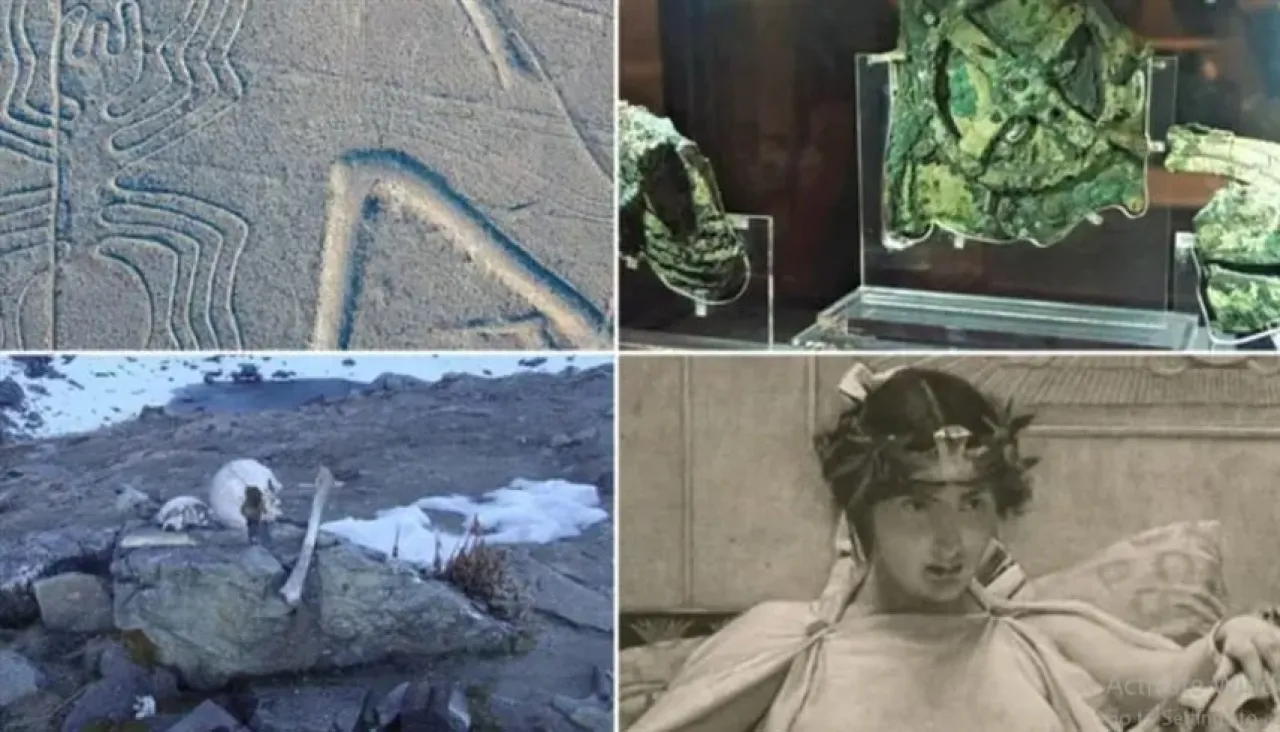
The Tombs of Cleopatra and Alexander the Great.. The Missing Burial Mystery
Despite centuries of search, the burial sites of Cleopatra VII and Alexander the Great remain unknown. Ancient sources indicate that Cleopatra was buried near Alexandria next to Mark Antony, while Alexander's body was transferred to Egypt after his death in 323 BCE, and it was said that Roman emperors visited his tomb.
However, earthquakes, rising sea levels, and urban expansion have obscured the features of ancient Alexandria, and excavations have not produced conclusive evidence, leaving the question open: Are the tombs still buried somewhere, or have they been lost forever?
The Lost Colony of Roanoke – America
Roanoke Colony was established in 1587 as the first English attempt at permanent settlement in North America. When Governor John White returned after 3 years, he found the colony completely deserted, without bodies or signs of violence.
The only clue was the word “Croatoan” carved on a post, referring to a local tribe. Despite theories of assimilation with the indigenous people or disappearance due to hunger and disease, no confirmed remains have been found, making Roanoke one of the most enigmatic mysteries of colonial history.
The Lost Cities of the Amazon and the Collapse of the Indus Valley Civilization
Lidar technology has revealed networks of cities, roads, and plazas buried beneath the Amazon forests, debunking the previous belief that the region did not host large communities. Evidence suggests that millions lived there prior to European arrival, but the reasons for their collapse remain unclear.
Similarly, the Indus Valley Civilization collapsed around 1900 BCE without sudden destruction, as cities were gradually abandoned, likely due to climate changes and river course shifts, while their undeciphered writings obscure our full understanding of their society.
The Nazca Lines – Peru
Between 500 BCE and 500 CE, the Nazca civilization created hundreds of giant ground drawings only clearly visible from the air. These drawings vary between animals, geometric shapes, and lines extending for kilometers.
While some are associated with religious or astronomical rituals or water management, no single theory fully explains their purpose, making the Nazca Lines one of the most intriguing archaeological mysteries in South America.
Skeleton Lake Roopkund – India
In the high Himalayas, hundreds of skeletal remains were found around the frozen Roopkund Lake. Genetic analysis has shown that the remains belong to various groups from distant time periods.
Evidence suggests that one group met their death in a severe hailstorm in the 9th century, while another belonged to pilgrims or travelers. But the question remains: Why was this remote site a stage for death more than once?
The Antikythera Mechanism – A Lost Engineering Marvel
The Antikythera Mechanism, found in the wreckage of a Greek ship dating to the 1st century BCE, is the most complex mechanical device known from the ancient world, used to accurately predict planetary movements and eclipses.
Despite a significant part of its function being reconstructed, fundamental questions remain unanswered: Who designed it? And why did this level of knowledge disappear for more than a millennium? The device stands as a testament to advanced scientific traditions lost over time.