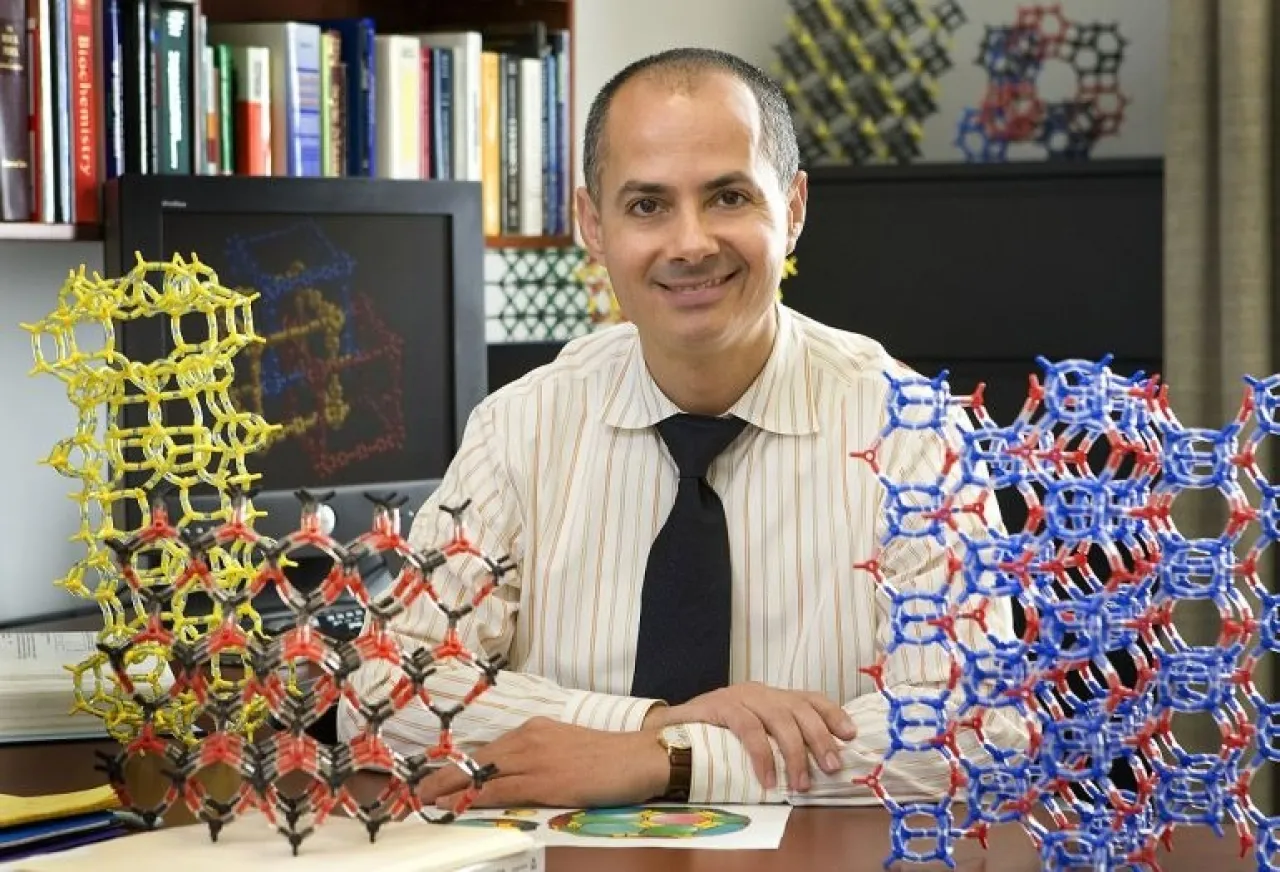
Khaberni - Professor Omar Yaghi, a chemistry professor at the University of California, Berkeley, and the 2025 Nobel Prize winner in Chemistry, is a leading contributor to the development of a new class of materials known as metal-organic frameworks.
The concept of these materials involves the creation of microstructures like tiny rooms, made up of metal atoms such as copper and zinc, serving as connection points or joints similar to columns in buildings, while organic molecules linked to them act as bridges between these points.
By repeating this pattern in multiple directions, a three-dimensional network containing numerous microscopic voids is formed.
Yaghi's win was in recognition of his role in taking these structures from a mere theoretical idea to a complete scientific field, founding its principles under the name "reticular chemistry".
This approach is based on arranging atoms within precisely interconnected networks, allowing control over the shape, size, and function of the pores, which grants metal-organic frameworks properties that traditional materials do not possess.
Among these properties is their ability to capture gases, purify the air, and absorb minimal amounts of humidity from the atmosphere, which has made them fundamental in developing modern technologies used today in the fields of energy, water, and the environment.
Water from the Desert
In a conversation with Dr. Yaghi, when asked about the scientific developments he expects in 2026 in his field of specialization, Yaghi indicated that the coming year might represent a pivotal moment for a technology directly related to his research, the technology of harvesting water from the air, as reported by Al Jazeera.
Yaghi explains that the global need for such solutions is rapidly increasing, estimating that by 2050, nearly half of the world's population will live in areas suffering from severe water stress, whether due to drought or limited access to clean water.
In light of this, Yaghi anticipates that the coming year will witness the first public introduction of devices capable of extracting water from desert air, leveraging the metal-organic frameworks' ability to capture very small amounts of water vapor in the atmosphere, then releasing it as liquid water using minimal amounts of heat or sunlight.
Yaghi sees this step as a significant advancement in addressing the water crisis, especially in dry and climate-affected areas.
These metal-organic frameworks, as explained by Dr. Yaghi, act as materials capable of attracting water vapor from the air thanks to their highly precise structure, which forms a microscopic network resembling a sponge filled with tiny pores.
These structures are characterized by having an immense internal surface area, which can reach thousands of square meters per single gram of material.
Marvelous Structures
Scientists compare this to a very large sheet folded thousands of times until it becomes small in size while retaining its original area if unfolded completely. This enormous internal space is what gives metal-organic frameworks their exceptional ability to capture large amounts of water molecules or gases compared to any traditional material.
In asking Dr. Yaghi about the expected productive capacity of these devices, he explained that they would be capable of producing at least two thousand liters of water per day, and that this quantity could be maintained for a period ranging from 6 to 7 years before needing to replace the material or restart the system.
He adds that these materials operate without the need for complex systems, as they capture the water vapors during the night or in the cooler hours, then release it as liquid water when exposed to sunlight or a simple energy source.
This feature allows the device to operate without electricity or compressors or low cooling degrees, making the technology significantly different from traditional air conditioning or desalination technologies that require large amounts of energy.
Also, its ability to function in desert conditions (where the humidity is less than 20%) makes it a promising option for addressing water challenges in dry regions around the world.
Scientific Revolution
It is worth mentioning that the fundamental idea of metal-organic frameworks first appeared in the late 1980s, but the structural fragility of these materials was the biggest barrier to their use. The initial structures presented on paper were networks with weak connections that easily collapsed when exposed to moisture, heat, or even during purification attempts in the lab, making them more like theoretical models that are difficult to manufacture or operate in reality. The links that connect metal components to organic links were unstable, leading to the rapid disintegration of the structure under any chemical or thermal stress.
In 1995, Yaghi achieved a groundbreaking scientific breakthrough by developing charged and more robust chemical bonds between the metal and organic components, which provided these structures with unprecedented strength and stability, making their formation and maintenance practically possible. Thanks to this development, thousands of different compositions of metal-organic frameworks can now be produced, each with specific properties that can be designed as needed.
It should be noted that the absorption capability of metal-organic frameworks is not limited to water vapor only, but also extends to a wide range of gases, such as carbon dioxide, produced from industrial processes. This could contribute to reducing the amount reaching the atmosphere, thereby helping to decrease emissions that cause global warming.
These materials can also absorb methane, the main component of compressed natural gas used in powering some vehicles. In this context, the German chemical company BASF collaborated with Dr. Yaghi to develop car fuel tanks that rely on metal-organic frameworks for more efficient gas storage, a step that targeted benefiting from the increasing demand for low-emission fuel.
However, these plans were halted in 2015 due to the sharp decline in gasoline prices, as the investment in this technology was no longer economically viable at that time, despite its promising scientific and application potentials.