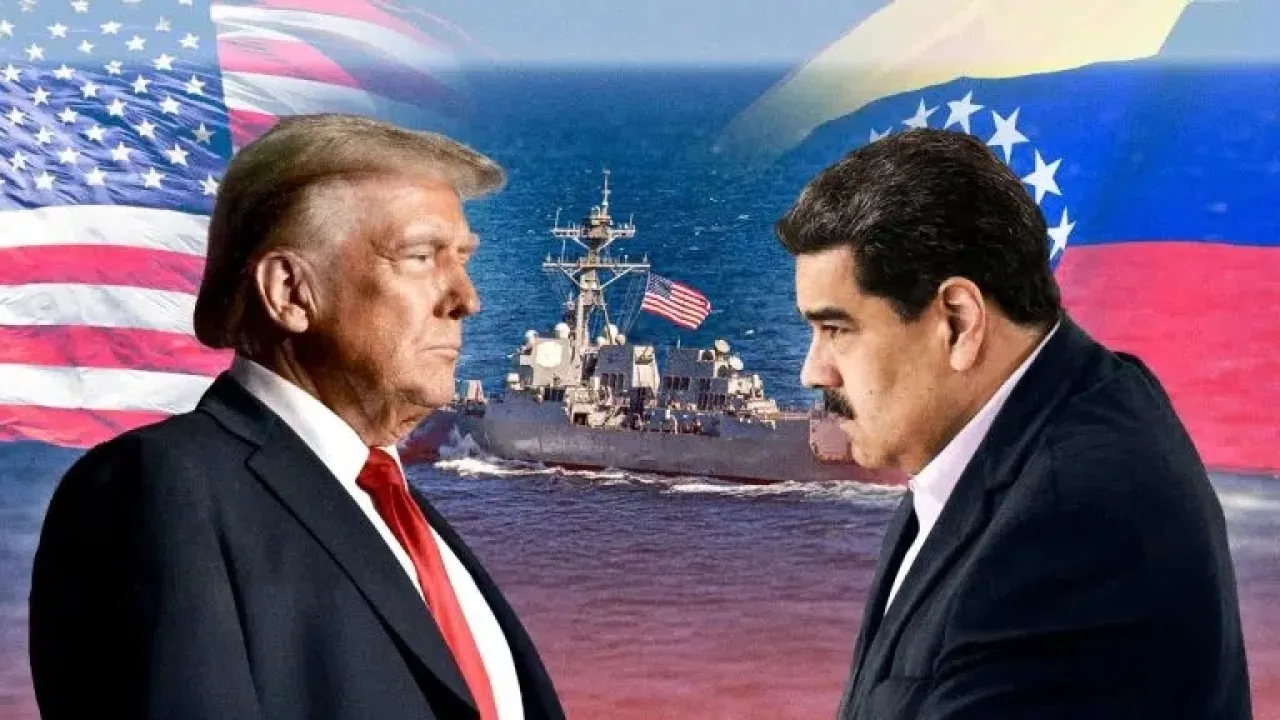
President Donald Trump announced that his country will soon start a ground operation in Venezuela, and that Washington wants to launch broader strikes against drug gangs in Latin America, not limited to Venezuela only.
During remarks to reporters in Florida, Trump claimed that "the proportion of drugs coming from the sea has dropped by more than 96%", and said, "We will do the same on land, and it will be easier and faster."
In a move considered a controversial legal and political precedent, Trump affirmed that the United States will retain for itself the oil confiscated from Venezuelan tankers in international waters, justifying this as part of "efforts to combat smuggling and drug trafficking."
In response, Venezuela firmly responded, with President Nicolás Maduro sending an official message to the heads of states in Latin America and the Caribbean region, as well as to all member states of the United Nations, confirming that "Venezuela is committed to peace, but ready to defend its sovereignty, territory, and resources relentlessly."
Venezuelan Foreign Minister, Iván Gil Pinto, stated on "Venezuela de Television" channel: "Venezuela reaffirms its desire for peace, but at the same time shows its full readiness to defend its sovereignty, territorial integrity, and resources in accordance with international law."
Maduro revealed that the US forces had launched 28 attacks on civilian ships in the Caribbean and the eastern Pacific Ocean, "resulting in 104 extrajudicial executions," pointing out that these violations "have no legal justification," while emphasizing at the same time that Venezuela has not committed any act that calls for this military pressure.
The Venezuelan president explained that the United States had detained two tankers in international waters carrying about 4 million barrels of Venezuelan oil, and imposed a "complete maritime siege" on them, considering these practices "exceed international law and the American Constitution, and constitute "systematic piracy on energy resources."
Maduro warned that these measures would cause significant damage to the global oil markets and exacerbate economic instability in the Latin American and Caribbean countries, calling on the international community to "reject the use of energy resources as a tool for political pressure or military aggression."
On December 10, Trump announced the seizure of a sanctioned oil tanker carrying Venezuelan oil, stating that Washington "will keep the oil."
On December 20, Washington confirmed the interception of the "Santrize" tanker, which was under the Panamanian flag and transporting oil on behalf of a Chinese company although it was not subject to US sanctions.
On December 21, "Bloomberg" reported the seizure of the "Bella 1" tanker, on the pretext of its alleged involvement in transporting previous Iranian oil, according to the "New York Times."
Trump's statements about "ground strikes" and the seizure of Venezuelan oil are seen as a serious escalation that could open the door to a broader military confrontation in Latin America, at a time when the countries of the Global South are seeking to enhance their sovereignty and reject unilateral domination.
Conversely, Venezuela holds to its defensive stance, asserting that "peace does not mean submission," and that it will not allow "the plundering of its resources under any pretext."