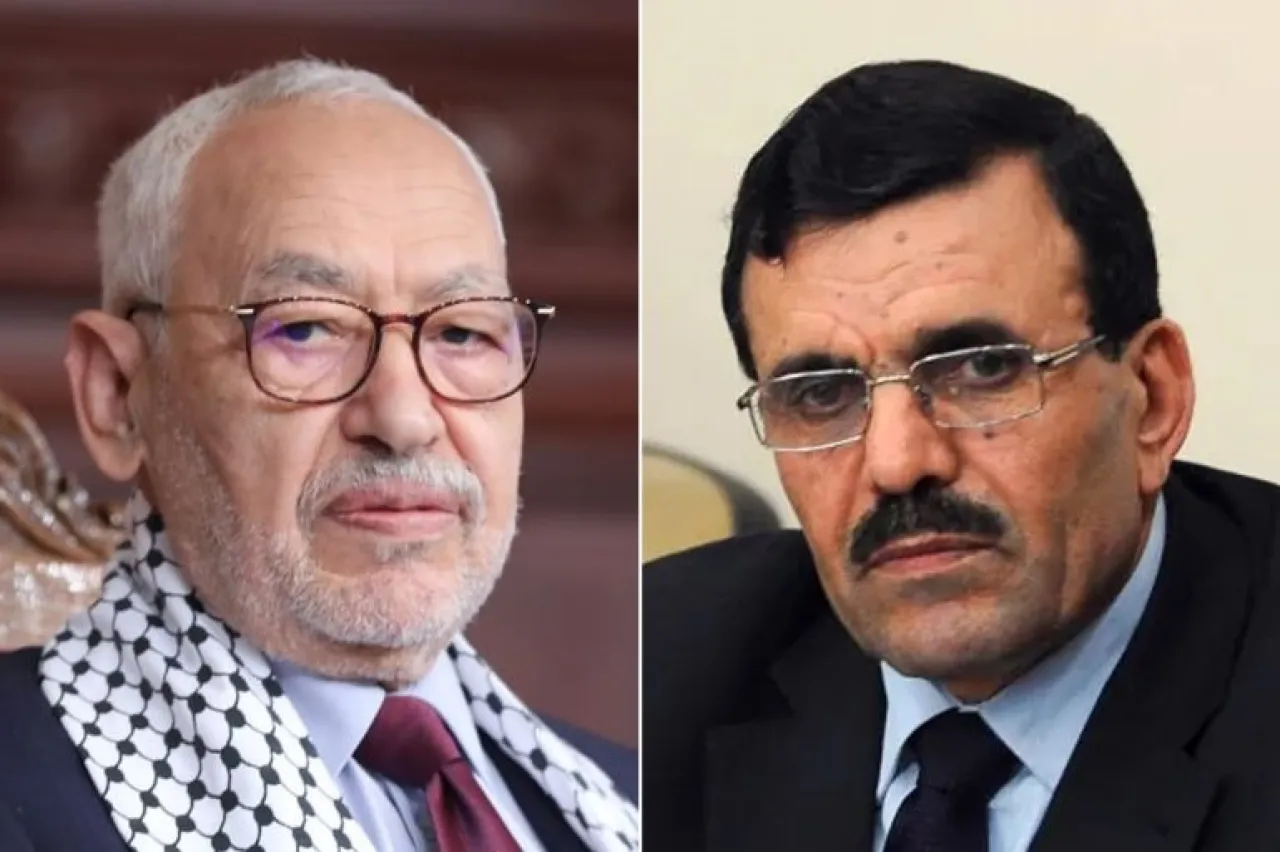
The head of the Tunisian Ennahda movement, Rached Ghannouchi, and former Prime Minister Ali Larayedh, entered a hunger strike from their prison for three days on Monday, in solidarity with the detained lawyer Ayachi Hammami, who called for the strike to demand his right to a fair trial.
Ennahda, in a statement, quoted Ghannouchi's defense team stating that he decided to go on a hunger strike on December 22, 23, and 24, 2025, to express his rejection of unfair trials and unjust sentences, and in support of an independent judiciary and freedom, according to their statement.
Ghannouchi has been detained since his arrest on April 17, 2023, after his house was raided, before a court ordered his imprisonment in a case involving statements attributed to him that incited against state security.
Several prison sentences have been issued against him in various cases, while he insists on not attending the courts, considering them to be politically motivated.
Meanwhile, Ali Larayedh's defense team, in a statement by his lawyer Osama Boutheleja, announced his participation in the hunger strike in response to the call of the political detainee, professor Ayachi Hammami.
Larayedh was sentenced by a Tunisian court last May to 34 years in prison, after being arrested on September 22, 2022, on charges of sending youths to fight in Syria during the revolution.
Hammami's Demands
On December 2, Tunisian authorities arrested Hammami following the verdict against him in a conspiracy case that sentenced him to five years in prison, and since his arrest, he has been on an open-ended hunger strike to demand his right to a fair trial.
According to his lawyer, Hammami called for a collective hunger strike on December 22, 23, and 24.
Hammami previously held the positions of Minister of Human Rights and President of the National Authority for the Defense of Liberties and Democracy (a civil organization).
The conspiracy case dates back to February 2023, when opposition politicians, lawyers, and civil society activists were arrested, and they were charged with attempting to undermine public order and state security, espionage with foreign entities, and inciting chaos or disobedience.
On November 28, the Tunis Appeals Court issued its verdicts in the case, with sentences ranging from 5 to 45 years against the defendants.
Among the convicted are Ahmed Nejib Chebbi, the leader of the National Salvation Front opposition, Noureddine Bhiri from Ennahda, former presidential chief of staff Reda Belhaj, General Secretary of the Republican Party Issam Chebbi, and former minister Ghazi Chaouachi.
The Tunisian authorities affirm that the defendants were tried on criminal charges, and that the judiciary is independent and not interfered with, while opposition forces see the case as "politically motivated" and used to eliminate political opponents.
Tunisia has been experiencing a political crisis since President Kais Saied began imposing exceptional measures on July 25, 2021, which included dissolving the parliament, issuing legislation by presidential decrees, approving a new constitution through a referendum, and holding early legislative elections.
Some Tunisian forces view these measures as a coup against the constitution and an establishment of absolute individual rule, while others see it as a correction of the path of the 2011 revolution, which overthrew then-president Zine El Abidine Ben Ali. Meanwhile, Saied states that his actions are measures within the constitution to protect the state from imminent danger, emphasizing that they do not infringe upon freedoms and rights.