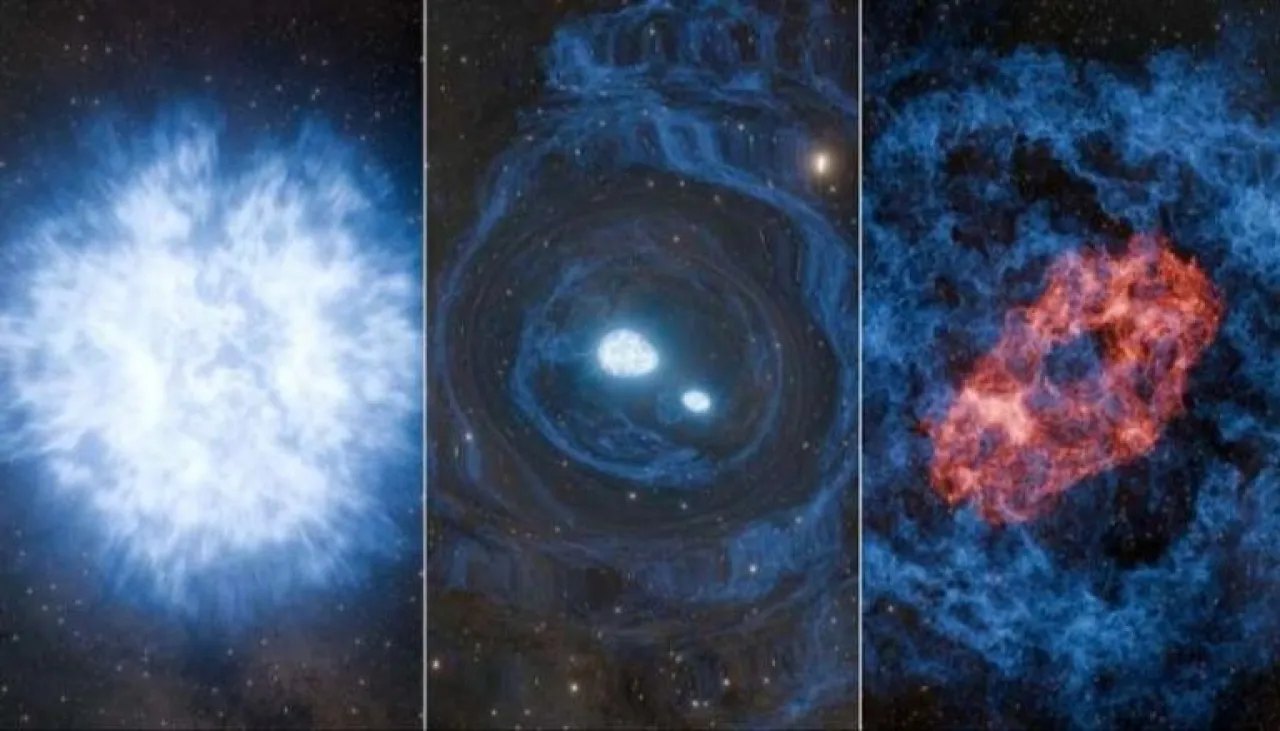
Khaberni - Astronomers announce evidence pointing to the observation of a rare and unprecedented cosmic event that may represent a new type of violent explosions in the universe.
The explosion is known as "Superkilonova", resulting from the collision of neutron stars that is preceded or accompanied by supernovae.
A rare cosmic event represents a new type of violent explosion in the universe.
Typically, giant stars explode at the end of their lives as supernovae (supernova), spreading heavy elements such as carbon and iron. A kilonova occurs when two neutron stars collide, producing heavier elements like gold and uranium, which are fundamental building blocks for the formation of planets and stars.
To date, only one confirmed kilonova has been unequivocally recorded in 2017, known as "GW170817", when scientists detected gravitational and light waves resulting from the merger of two neutron stars.
Today, researchers announce a second potential candidate for this type of explosion, named "AT2025ulz", but its story is more complex. The data suggests that the event started as a kilonova, before later transforming into an explosion resembling a supernova, which confused scientists and sparked a wide debate.
Professor Mansi Kasliwal, an astronomer at the California Institute of Technology and director of the Palomar Observatory, said, "During the first three days, the explosion appeared almost identical to the 2017 kilonova, but later its behavior changed and it became similar to a supernova, which made some doubt its nature. We have not done so."
The new study, published in The Astrophysical Journal Letters, suggests that this event may be the first observational evidence of a Superkilonova, a scenario that was theoretically anticipated but had never been observed before.
The story began on August 18, 2025, when the "LIGO" observatory in the United States and the "Virgo" in Italy detected a new gravitational wave signal, believed to be the result of the merger of two astronomical bodies, one smaller than usual.
Hours later, the Zwicky Transient Facility cameras identified a rapidly fading light source about 1.3 billion light years away, nearly at the same location.
Initially, the light exhibited a red color and rapid fading, characteristics known for kilonovae, where heavy elements block blue light and allow red light to pass. However, days later, the object glowed blue and hydrogen lines appeared in its spectrum, typical signs of a supernova explosion.
This transformation led some scientists to believe that the event was just an ordinary supernova unrelated to the gravitational waves, especially since distant supernovae typically do not produce signals that the "LIGO" observatory can detect. However, the study team believes that the strange timing may indicate a dual explosion: a supernova that preceded or incited a kilonova.
Scientists continue to analyze the data, hoping to resolve the debate about the existence of Superkilonovae, which may represent a new window into understanding how the heaviest elements of the universe and its most violent explosions are formed.