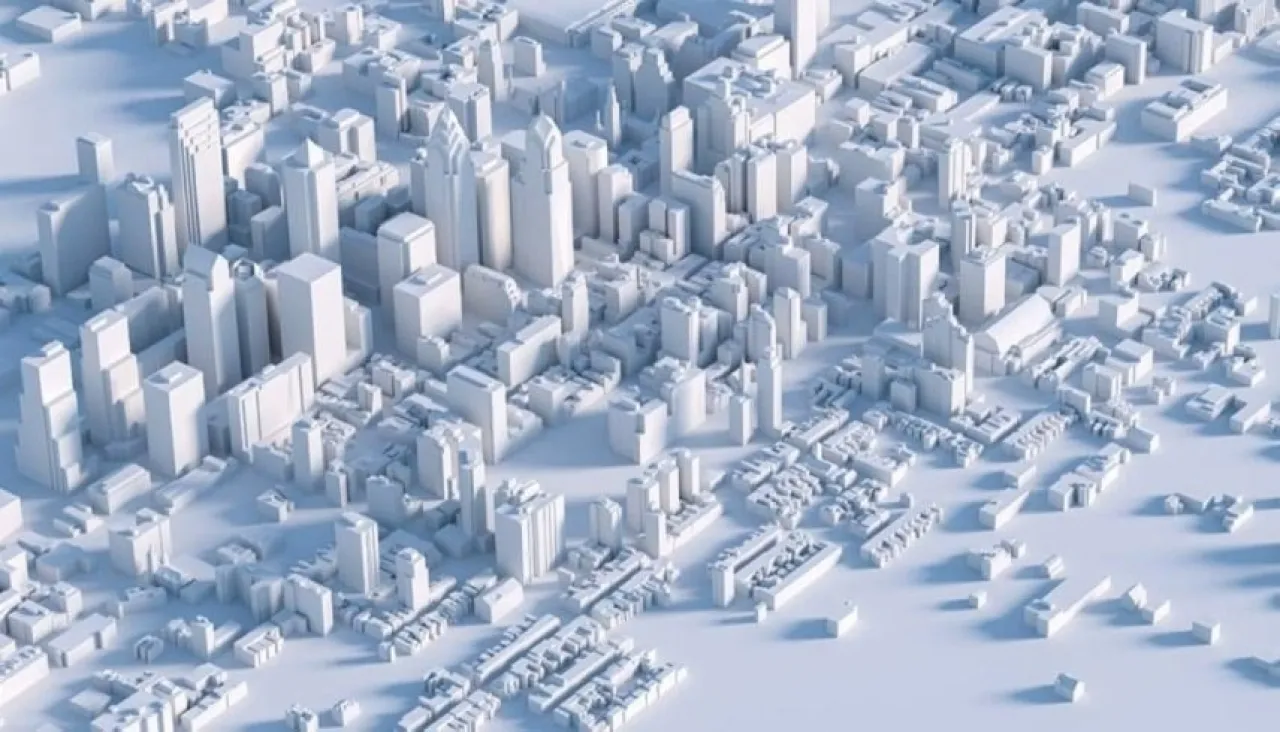
Khaberni - A research team at the Technical University of Munich has achieved an unprecedented scientific feat by developing a digital map that includes 2.75 billion buildings across continents, using machine learning techniques and high-resolution satellite imagery.
The project extends to everything from skyscrapers in China's major cities to small tents in Inner Mongolia, offering 3D models with an accuracy never achieved before.
Analysis of years of space data
The researchers spent years analyzing satellite images using advanced machine learning algorithms, resulting in a comprehensive database named "Global Building Atlas".
The database contains 2D footprints of all buildings that satellites detected during the year 2019, in addition to simplified 3D models for about 97% of them.
The importance of the third dimension in understanding urbanization
Professor Xiaoxiang Zhu, who leads the project and heads the Earth Observation Data Science Department at the university, says the real achievement lies in presenting a three-dimensional picture of the spaces that humans actually inhabit.
The 3D information provides a much more precise picture of urbanization and poverty compared to traditional 2D maps, as it reveals not only the land area but also the size of each building.
An additional billion buildings over previous records
The project surpasses the "Google Open Buildings" database, which includes 1.8 billion building plans, as researchers added another billion buildings using advanced artificial intelligence techniques.
The team began by collecting daily images from the "PlanetScope" satellite constellation, which captures the Earth with a resolution of about three meters per pixel.
Complex scientific methodology
The researchers collected about 800,000 cloud-free scenes from 2019, then integrated them into a global mosaic, and trained an artificial neural network to recognize buildings using well-known schemes from "OpenStreetMap" and other sources.
The team used aerial laser measurements from surveys in advanced countries to train an artificial intelligence capable of estimating building heights from a single satellite image.
Staggering numbers reveal the extent of human urbanization
The 2.75 billion buildings cover a land area of about 507,000 square kilometers, with a total volume reaching approximately 1.85 quintillion cubic feet.
The researchers believe that previous United Nations estimates of there being four billion buildings around the world were inaccurate, based on the precise data they collected.
Clear continental disparities
Asia leads with about 1.22 billion buildings and the largest cumulative size, while Africa has about 540 million buildings but with a much smaller area and volume, indicating that most African buildings are small and single-story.
While Europe and North America have fewer buildings compared to Africa, they have a much higher average size per building.
Practical applications for the benefit of humanity
The project goes beyond merely being a scientific achievement, as it provides a measuring tool for climate scientists, urban planners, economists, and disaster managers.
The German Aerospace Center is exploring the use of the atlas within the "International Charter Space and Major Disasters", which coordinates space support for emergency response after floods, earthquakes, and other disasters.
The 3D data helps to improve models of energy demand and carbon dioxide emissions and guide decisions on adding housing or public facilities like schools and health centers in deprived neighborhoods.