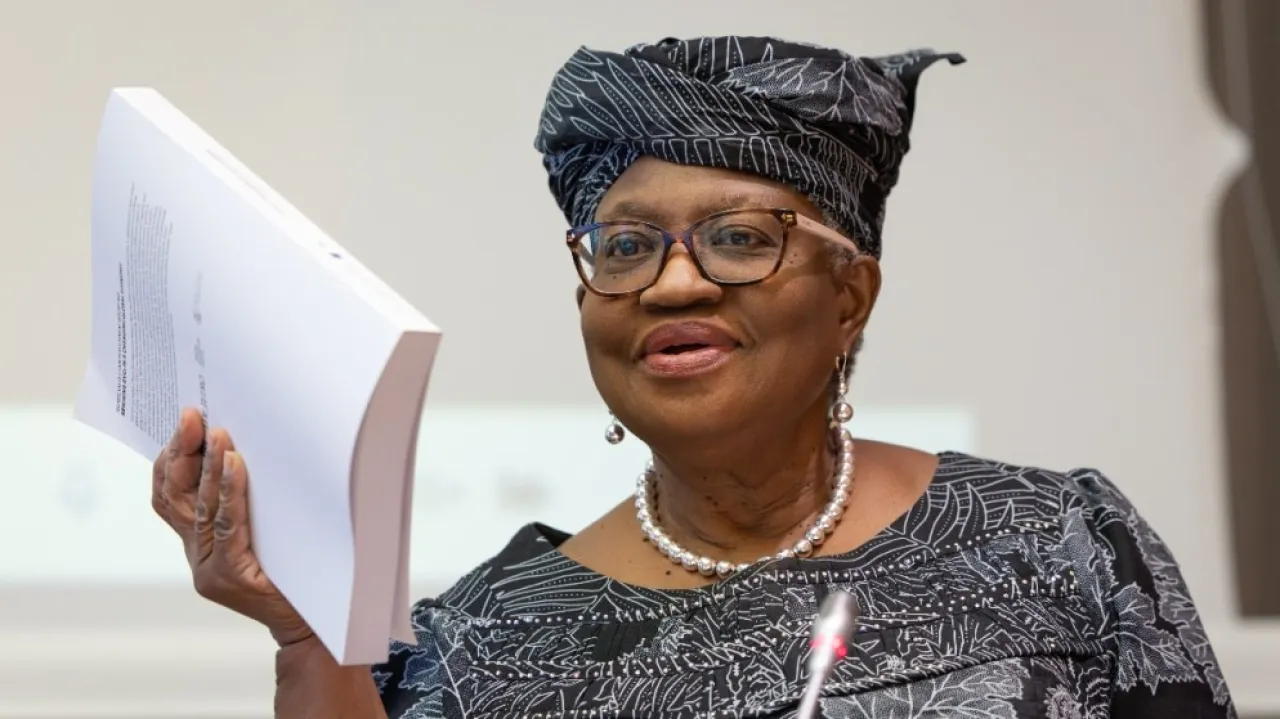
Khaberni - The Director-General of the World Trade Organization, Ngozi Okonjo-Iweala, stated on Monday that globalization has not ended, and that global value chains are still a fundamental element in the global economy, despite the successive shocks that the world has experienced over the past decade.
She explained, during the launch of the Global Value Chain Development Report 2025 in Geneva, that the share of global value chain trade in total global trade has slightly decreased from 48% in 2022 to 46.3% last year, emphasizing that businesses and governments are not withdrawing from global integration, but are reshaping it to align with new economic, political, and social priorities.
Okonjo-Iweala pointed out that the report, which covers data up to 2024, demonstrates the resilience and adaptability of supply chains despite the COVID-19 pandemic, accelerated climate pressures, rising geopolitical tensions, and financial uncertainty, noting that the latest available data confirm the continued growth of trade and resilience of value chains.
She highlighted that the ongoing transformations are opening new opportunities for Latin America and Africa to integrate into global value chains, thanks to technology, green transformation, and diversification of supply chains, while governments are using industrial policies and strategic partnerships to reposition their economies.
She also noted that the increase in trade costs and the lack of its financing, which exceeds one trillion dollars annually, still poses a significant challenge for the less integrated regions, confirming that enhancing cooperation in governance through flexible frameworks and targeted trade agreements, along with developing new frameworks within the World Trade Organization, is a fundamental element for building more diversified and resilient value chains in the next phase.
She said that the world is facing a unique opportunity to reduce excessive concentration in value chains, noting that what is striking in the current phase is the level of resilience shown by the global system despite the intensity of disruptions. She pointed out that businesses, manufacturers, and investors continue to operate under uncertainty, and continue to do what they are skilled at, which explains the ongoing resilience of global value chains.
She added that global production networks have shown a high capacity to adapt in the face of unprecedented shocks during the past decade, starting from the COVID-19 pandemic, through accelerated climate pressures, to the rising geopolitical tensions and financial uncertainty. She confirmed that value chains have not disintegrated as some predicted, but have adapted and become more reliant on digitalization, and more responsive to security and sustainability requirements.
She indicated that the data and evidence that the report is based on cover the period up to 2024, before the increases in customs duties and the uncertainty that saw the year 2025, but the most recent data available up to this month confirm the main findings of the report regarding the resilience of value chains. She clarified that trade growth remains strong, and that supply chains have proven their ability to adapt thanks to the resilience of companies and the adoption of innovative policies to manage disruptions, despite those who doubt these results and consider them non-obvious.
She gave an example of the electric vehicle sector, where China has emerged as a leader encompassing inputs, assembly, and recycling, while African countries seek to retain greater value through mineral processing, as Latin American countries work on signing an increasing number of sectoral arrangements, which are mostly regulatory and non-binding, aiming to establish their position as a key supplier in this sector.
In contrast, she warned that the increase in trade costs driven by policies and the high level of uncertainty pose a particular burden on marginalized regions lacking a previous record in hosting multinational production. She explained that the readiness assessments of value chains in the report show existing structural barriers, including gaps in digital infrastructure, institutional bottlenecks, logistical constraints, along with a chronic shortage in trade financing, estimated at over a trillion dollars annually, which explains why countries that were already established suppliers benefit more from the reshaping of global value chains than others.
She emphasized that making value chains more diverse, less concentrated, and more flexible requires innovative solutions to overcome these obstacles, noting that the report shows continued cooperation in governance, albeit less through traditional bilateral and regional agreements and more through informal and non-binding frameworks focusing on specific issues.
She noted that the report identified more than 180 targeted trade agreements focusing on digital trade and vital minerals up to the year 2024, considering that these arrangements contribute to building trust and enhancing the predictability in the new governance landscape, and that developing new frameworks within the World Trade Organization, such as the Multilateral Agreement on Investment Facilitation for Development, will be of significant value in this context.