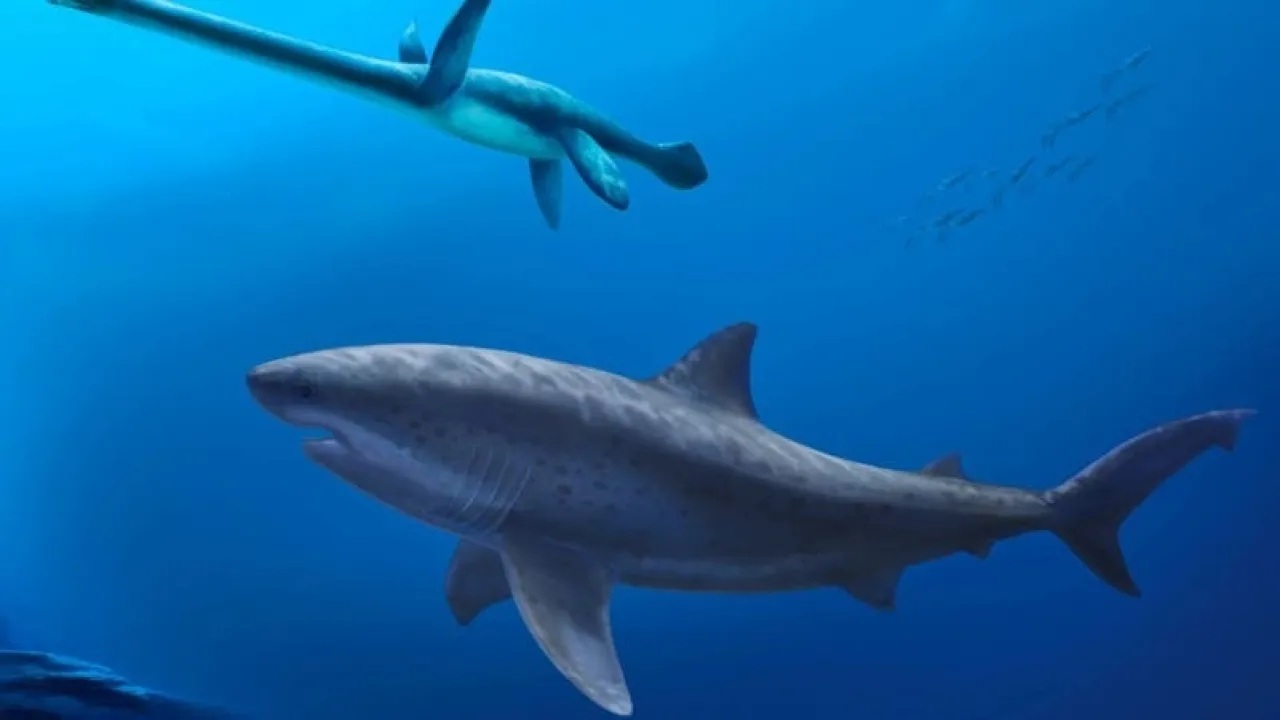
Khaberni - Researchers revealed that the northern seas of Australia were, during the dinosaur era, home to a giant predatory shark that existed before the appearance of whales, white sharks, and the famous "Megalodon" shark, in a scientific discovery that reevaluates the history of modern shark evolution.
Scientists who studied enormous vertebrae found on a beach near the Australian city of Darwin reported that this creature is known as the oldest giant marine predator within the lineage of modern sharks, having lived about 115 million years ago, around 15 million years before the appearance of the giant sharks previously known, according to a report published by the American "Associated Press".
According to a study published in the journal Communications Biology, this shark was estimated to be about eight meters long, making it larger than the ancestors of the contemporary white sharks, which currently have an average length of about six meters.
Benjamin Kerr, the curator of paleobiology at the Swedish Museum of Natural History and one of the study's authors, said that this discovery "expands the time frame for the appearance of giant sharks more than was expected," explaining that the Cardabiodontid lineage was thought to be common only in the later periods of the Cretaceous era, which was about 100 million years ago.
A New Interpretation
However, despite the importance of the discovery, the five vertebrae that formed the basis of this study are not new. They were extracted during the late 1980s and 1990s, and each vertebra measured about 12 centimeters in diameter, but they remained preserved in museums for years without in-depth analysis.
Kerr explained that these fossils were found in an area that was in the past the seabed of an ancient ocean that stretched from the continent of Gondwana, which currently includes Australia, to the continent of Laurasia, which encompasses Europe. This area is one of the richest sites for ancient marine fossils, where remains of large marine reptiles like long-necked plesiosaurs and ichthyosaurs have been discovered.
Why Are the Vertebrae Important?
Studying ancient sharks is a significant challenge for paleontologists because shark structures are made of cartilage, not bone, which makes finding preserved vertebrae rare. Scientists often rely only on teeth, which are not always sufficient for accurately estimating body size. Kerr emphasized that "the vertebrae give us a direct indication of the true size. Relying only on teeth is problematic, as large teeth do not necessarily mean huge bodies."
A Scientific Enigma
The international research team used complex mathematical models, along with data from fisheries and computed tomography imaging techniques, to estimate the potential size of this giant shark. After years of analysis, the researchers reached a conception that shows a massive creature resembling modern sharks in structure.
Kerr affirmed that "it would have looked like a giant modern shark in all dimensions. This is a successful evolutionary physical model that remained effective for more than 115 million years."
Implications Beyond the Past
The researchers believe this discovery indicates that modern sharks reached the top of the oceanic food chain much earlier than previously thought. It also opens the door to finding similar species in other regions of the world that contained ancient marine environments.
Kerr believed that studying these ancient ecosystems could help scientists understand how current marine species respond to environmental and climate changes... and he concluded saying, "By understanding what happened during past climate shifts and biological diversity, we can form a clearer picture of what our marine world might face in the future."
"The Oldest Marine Predator".. A Giant Shark Dominated the Seas of Australia