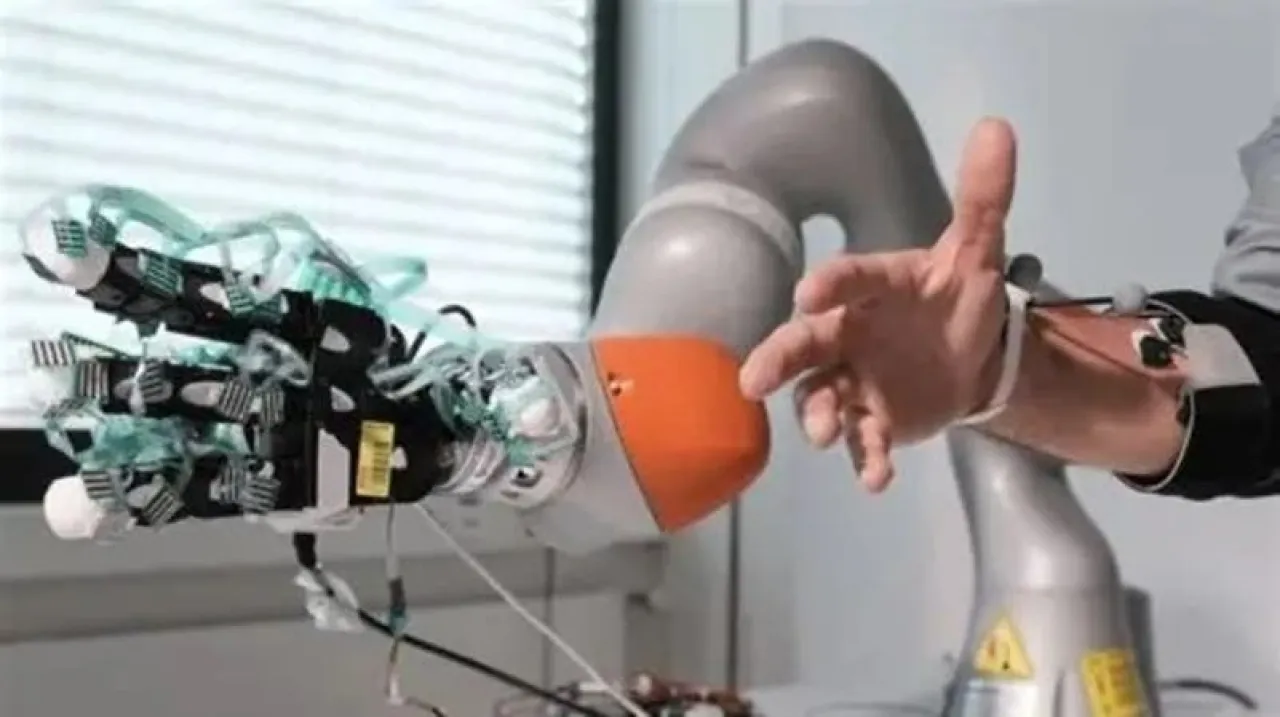
Khaberni - Researchers at the Massachusetts Institute of Technology, in collaboration with Shanghai Jiao Tong University, have developed an innovative inflatable robotic hand that provides immediate control and real-time tactile sensation for upper limb amputees, a step that could radically transform the world of smart prosthetics.
According to the study published in "Nature Biomedical Engineering", volunteers who used the new robotic hand were able to perform daily tasks such as closing a suitcase, pouring juice, writing, and even petting a pet, with efficiency comparable or sometimes better than current advanced prosthetics available on the market.
A lightweight and inexpensive alternative for smart limbs
Despite the significant developments in neural prosthetics, the high costs, which may reach tens of thousands of dollars, along with their weight and stiffness due to their reliance on metallic structures and electrical motors, still pose a barrier to their widespread adoption.
In contrast, the new hand features a soft, lightweight design weighing no more than half a kilogram, with component costs not exceeding $500, making it a promising option, especially for those with limited income.
Professor Xuanhe Zhao, a leader of the research team at MIT, said, "This is not yet a commercial product, but its performance is comparable or superior to current neural limbs. We see tremendous potential to make this low-cost hand available to a broader swath of amputees around the world."
Design inspired by fantasy
The new robotic hand resembles the inflatable robot in the animated film Big Hero 6.
It is made from a flexible rubber material known as EcoFlex, and includes five balloon-like fingers reinforced with internal fibers that mimic human finger bones.
Unlike traditional limbs that rely on heavy electric motors, this innovation uses a simple pneumatic system to precisely control the inflation of the fingers, allowing for various grips such as pinching, full grip, or holding objects.
The pump and valves can be worn on the waist, reducing the burden on the user.
Neural control and touch sensation
The hand uses EMG sensors to capture electrical signals from the remaining muscles in the user's arm.
Using intelligent algorithms, these signals are translated into precise movements of the fingers, such that the hand moves in response to what the user imagines.
To add a rare feature in this type of limb, the researchers equipped the fingertips with pressure sensors that convey tactile signals to specific areas in the remaining limb, allowing the user to distinguish which finger was touched, and even estimate the size of objects being held.
Promising results and real-life trials
During the tests, one of the blindfolded volunteers was able to identify the touched finger and distinguish between bottles of different sizes, indicating the restoration of a primitive form of sensation.
The hand also demonstrated notable durability, quickly regaining its shape and function even after being struck with a hammer or run over by a car.
Towards commercial production
The team has patented the design and is currently working on improving the sensing accuracy and extending the range of motion, with plans to develop a version suitable for large-scale commercial production.
Zhao concludes by saying, "We are still at the beginning, with improvements to neuro-signal decoding techniques and reduction in the size of the pump, this hand can become a practical model that changes the lives of millions."